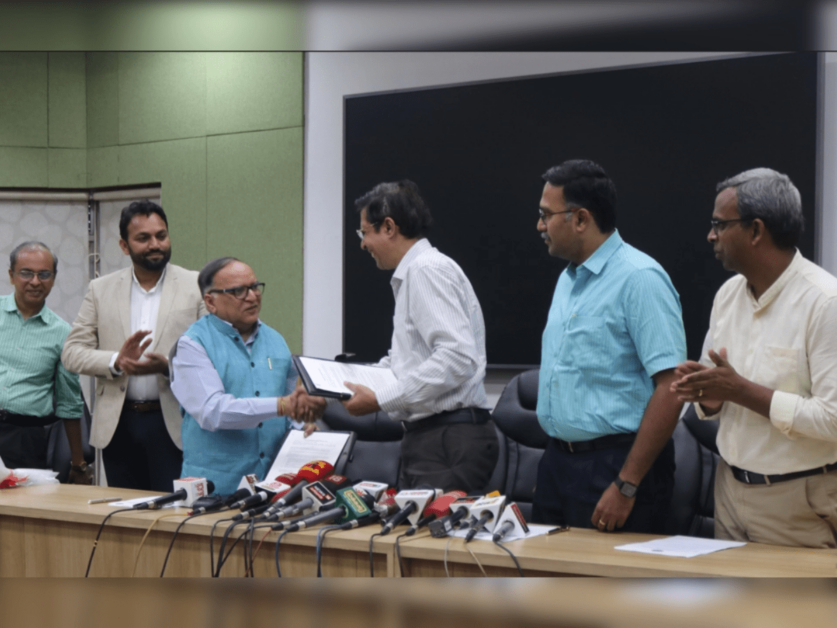
Author – Ritesh Ranjan: India’s Extended Reality ecosystem is entering a decisive phase. A new report by researchers at IIT Madras has outlined how the country can move from being a service-led technology market to becoming a global leader in XR innovation, hardware, research and deep-tech entrepreneurship.
The report, titled “Bolstering India’s XR Startup and Innovation Ecosystem: A Case Study of the TN AVGC-XR Policy 2026,” studies Tamil Nadu’s newly announced AVGC-XR policy and offers recommendations for both state and central governments. Its central message is clear: India has the talent, market potential and startup energy to become a global XR powerhouse, but it must now invest in hardware, compute infrastructure, academic research and forward-looking policy.

XR, or Extended Reality, includes immersive technologies such as Virtual Reality, Augmented Reality and Mixed Reality. These technologies are no longer limited to gaming or entertainment. They are now being used in healthcare, defence, education, manufacturing, professional training, architecture, retail and public services.
According to the IIT Madras report, India already has more than 1,000 XR startups and 1,000 SMEs active in the sector. This gives the country a strong base to build upon. However, the report warns that India must not remain focused only on service delivery. To gain long-term global competitiveness, the country needs to create original intellectual property, build XR hardware, develop immersive platforms and strengthen its research ecosystem.
Why XR Matters for India Now
The timing of the report is important. India is already witnessing rapid growth in artificial intelligence, semiconductor manufacturing, digital public infrastructure and startup-led innovation. XR can become the next major layer of this digital transformation.
XR technologies can create highly realistic virtual environments, overlay digital information on the physical world and improve how people learn, work, train and collaborate. In healthcare, XR can help doctors simulate surgeries, train medical staff and provide remote assistance in rural areas. In education, it can make classroom learning more interactive by allowing students to experience complex concepts through immersive simulations. In manufacturing, XR can support digital twins, worker training, machine maintenance and product design.

The report highlights that the next wave of XR growth will not come only from software applications. It will also depend on hardware, cloud infrastructure, compute power, research labs and skilled human resources. This is where India has an opportunity to build a complete XR value chain.
Hardware Manufacturing as a Strategic Priority
One of the strongest recommendations in the IIT Madras report is to treat XR hardware manufacturing as a strategic sector. At present, many XR devices and components are imported. This increases costs and limits India’s control over the value chain.
The report suggests that Tamil Nadu can use its existing electronics manufacturing corridors to develop indigenous XR hardware capabilities. These may include head-mounted displays, motion trackers, haptic interfaces, sensors and related immersive technology components.

This recommendation is significant because hardware leadership can help India move beyond low-margin services. If India builds its own XR devices and components, it can reduce import dependence, create export opportunities and support domestic startups with more affordable access to equipment.
Tamil Nadu is well positioned for this role because of its electronics manufacturing ecosystem, industrial base and policy focus on AVGC-XR sectors. By combining hardware manufacturing with software talent, the state could become a major XR innovation hub.
Need for Compute Infrastructure: The TN-XR Cloud Idea
The report also points to another major requirement: access to high-end compute infrastructure. XR and AI-based immersive applications require powerful GPUs, cloud systems and real-time rendering capabilities. Many startups, researchers and universities may not be able to afford such infrastructure independently.
To solve this, the IIT Madras report proposes the creation of a state-level compute platform such as a “TN-XR Cloud.” This cloud infrastructure could provide subsidised access to high-performance GPUs for startups, researchers, academic institutions and MSMEs working on XR and AI applications.

Such a platform could help smaller companies compete with larger players. It could also encourage experimentation in fields such as spatial computing, digital twins, generative XR environments and AI-driven immersive applications.
For India, compute access is not just a technical issue. It is a competitiveness issue. Countries that provide affordable compute infrastructure to innovators will have a better chance of leading the next generation of deep-tech industries.
Academia Must Anchor the XR Innovation Ecosystem
The IIT Madras report places strong emphasis on the role of academia. Prof. M. Manivannan of XTIC, IIT Madras, has described XR as the natural next wave after AI, closely linked to Physical AI and Embodied AI. This means XR will increasingly interact with robotics, sensors, artificial intelligence and real-world physical systems.
However, the report also identifies a major education and skills gap in the sector. India needs researchers, designers, engineers, hardware specialists, game engine developers, haptics experts and spatial computing professionals.
To address this gap, the report recommends a state-wide XR curriculum framework. This would help universities and technical institutions prepare students for the future of immersive technologies. It also suggests a TN XR Fellowship for MS and PhD researchers working in areas such as haptics, spatial computing, sensor integration and immersive systems.
Making academia the anchor of the XR ecosystem can also help India generate original research and intellectual property. This is important because long-term leadership in deep-tech sectors depends not only on startups but also on universities, labs and research institutions.
Jobs, Skills and Economic Growth
Tamil Nadu’s AVGC-XR Policy 2026 has an ambitious target: to create 2 lakh high-value jobs and capture 20% of India’s XR market. The IIT Madras report supports this ambition but also adds an important caution.
It argues that a service-heavy approach alone may not be enough to build lasting global competitiveness. India must ensure that a large share of future XR jobs are in high-value areas such as intellectual property creation, game engine development, AI-driven immersive technologies, product design, hardware R&D and advanced research.
The report recommends a “50-50 workforce design principle.” Under this approach, at least half of the projected 2 million XR jobs by 2030 should be concentrated in high-value roles. This would help India avoid becoming only an outsourcing destination and instead become a creator of platforms, products and patents.
This recommendation is especially relevant for young professionals and students. As XR grows, demand will rise for multidisciplinary talent across computer science, electronics, design, animation, AI, psychology, human-computer interaction and industrial engineering.
Policy Gaps That Must Be Addressed
The report also identifies several policy gaps that need urgent attention. XR is advancing quickly, and immersive environments are increasingly being combined with artificial intelligence. This creates new questions around safety, ownership, ethics and governance.
Some of the key blind spots highlighted include the absence of dedicated rules for AI-generated XR assets, generative immersive environments, metaverse governance and child safety standards.
These issues are important because XR environments can be highly engaging and emotionally powerful. Without proper safeguards, users may face risks related to privacy, misinformation, manipulation, digital addiction or unsafe content exposure. Children, in particular, require stronger safety standards.
The report suggests that India’s policy framework must keep pace with technological change. A strong regulatory approach can help build trust among users, investors, educators and global partners.
Benefits for Citizens and MSMEs
While XR is often associated with gaming, entertainment and futuristic experiences, the IIT Madras report highlights its wider social and economic impact.
For citizens, XR can improve access to healthcare, education and training. In rural clinics, immersive tools can help reduce medical errors and support remote medical guidance. In classrooms, XR can make learning more practical and engaging. For workers, it can enable faster and safer professional training.
For MSMEs, XR can improve productivity, design processes, customer demonstrations and workforce upskilling. If small businesses receive access to subsidised compute infrastructure and innovation incentives, they can experiment with XR solutions without facing high entry costs.
This broader impact is important because India’s XR future should not be limited to large companies. A strong ecosystem must include startups, MSMEs, students, researchers, public institutions and citizens.
India’s Opportunity in the Global XR Economy
The IIT Madras report makes it clear that India has a timely opportunity. The country already has software talent, a growing startup ecosystem, a large domestic market and strong digital adoption. With the right investments in hardware, compute, academia and policy, India can become a serious global player in XR.
However, the shift must be strategic. India needs to create original IP, support deep-tech research, encourage domestic manufacturing and prepare a skilled workforce. Tamil Nadu’s AVGC-XR Policy 2026 could become an important model for other states if implemented with a deep-tech focus.
XR is not just the next entertainment technology. It could become a foundation for future education, healthcare, defence training, industrial productivity and digital public services. The IIT Madras report provides a roadmap for turning that possibility into a national advantage.
FAQs
1. What is the IIT Madras XR report about?
The IIT Madras report focuses on strengthening India’s Extended Reality startup and innovation ecosystem. It studies Tamil Nadu’s AVGC-XR Policy 2026 and recommends steps such as hardware manufacturing, compute infrastructure, academic research, skilled workforce development and policy reforms.
2. What does XR mean?
XR stands for Extended Reality. It is an umbrella term that includes Virtual Reality, Augmented Reality and Mixed Reality. XR technologies create immersive digital experiences or combine digital elements with the physical world.
3. Why is XR important for India?
XR can support growth in healthcare, education, defence, manufacturing, training, public services and entertainment. It can help India create high-value jobs, build deep-tech startups, reduce import dependence and develop original intellectual property.
4. What is the TN-XR Cloud proposed in the report?
The TN-XR Cloud is a proposed state-level compute infrastructure that would provide subsidised access to high-end GPUs and cloud resources for startups, researchers, universities and MSMEs working on XR and AI-based immersive applications.
5. What are the major policy gaps identified in the report?
The report highlights gaps in areas such as AI-generated XR assets, generative immersive environments, metaverse governance and child safety standards. It suggests that India needs updated policy frameworks to build a safe and trusted XR ecosystem.