

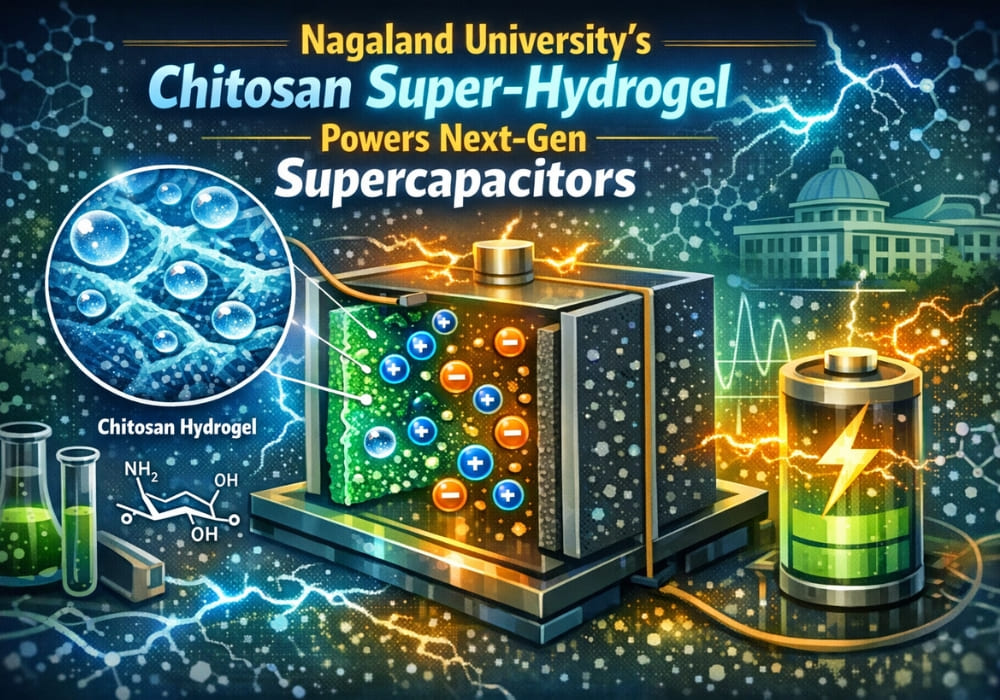
Author – Ritesh Ranjan: Chitosan Supercapacitor Hydrogel – In a major breakthrough in sustainable energy storage, researchers at Nagaland University have developed an innovative oxalate-crosslinked chitosan hydrogel electrolyte that could transform the future of supercapacitors. This eco-friendly, biodegradable hydrogel electrolyte has demonstrated 46,000 charge-discharge cycles without performance degradation, making it a promising solution for electric vehicles, renewable energy storage, drones, and wearable electronics.
The research, published in the International Journal of Biological Macromolecules, represents a significant step toward safer, greener, and more efficient energy storage technologies.
The Innovation: From Crab Shells to Energy Storage
The core material behind this innovation is chitosan, a natural biopolymer derived from chitin, which is commonly found in crab and shrimp shells. By using potassium oxalate as a crosslinking agent, the research team created a 3D hydrogel electrolyte network that combines the conductivity of liquid electrolytes with the stability of solid electrolytes.
This quasi-solid hydrogel electrolyte solves one of the biggest problems in traditional supercapacitors — electrolyte leakage and volatility.
Why This Hydrogel is Special:
- Acts like a liquid electrolyte but behaves like a solid
- Leak-proof and non-flammable
- Biodegradable and non-toxic
- High ionic conductivity (7–10 mS/cm)
- Extremely long lifecycle (46,000 cycles)
This makes the technology ideal for next-generation energy storage devices.
Key Performance Achievements
The Nagaland University team successfully tested the hydrogel electrolyte in an Electric Double Layer Capacitor (EDLC) prototype. The prototype was able to power a red LED continuously, demonstrating real-world applicability.
Major Achievements:
| Feature | Performance |
| Charge cycles | 46,000 cycles |
| Conductivity | 7–10 mS/cm |
| Electrolyte type | Quasi-solid hydrogel |
| Safety | Non-flammable |
| Environmental impact | Biodegradable |
| Prototype | LED powered |
The research is currently at Technology Readiness Level (TRL)-3, meaning laboratory proof-of-concept has been validated.
Why This Matters: The Supercapacitor Market Boom
Supercapacitors are becoming critical for modern energy systems because they charge faster and last longer than batteries. According to industry estimates, the global supercapacitor market is expected to reach $20 billion by 2030, driven by electric vehicles, renewable energy storage, and portable electronics.
India is also investing heavily in advanced energy storage through government initiatives and EV adoption targets. Supercapacitors are especially important for:
- Electric vehicles (fast charging)
- Solar and wind energy storage
- Wearable electronics
- Drones and robotics
- Grid stabilization
The Nagaland University innovation could provide low-cost, sustainable, India-made supercapacitor technology using bio-waste resources from Northeast India.
How the Technology Works
The science behind the hydrogel electrolyte is based on polymer chemistry and ion transport.
Working Principle:
- Chitosan contains amino groups that get protonated.
- Oxalate ions act as crosslinkers and connect polymer chains.
- This forms a 3D hydrogel membrane.
- The membrane allows fast ion movement while remaining solid.
- This enables stable energy storage and long lifecycle.
The result is a high-conductivity, flexible, and stable electrolyte suitable for flexible and wearable energy storage devices.
Environmental Impact: A Green Energy Solution
One of the biggest advantages of this technology is sustainability.
Traditional electrolytes:
- Use toxic chemicals
- Are flammable
- Create plastic waste
- Can leak and damage devices
Nagaland University’s hydrogel electrolyte:
- Made from biomass (crab shell waste)
- Compostable
- Non-toxic
- Non-flammable
- Zero plastic waste
This innovation aligns with:
- UN Sustainable Development Goal 7 (Affordable and Clean Energy)
- India’s Net Zero Target 2070
From Lab to Market: Startup and Commercialization Plans
The research is now moving toward commercialization through a startup launched by the research team. The current TRL-3 prototype will move toward pilot-scale production over the next few years.
Commercialization Roadmap:
| Year | Development Stage |
| 2026 | Pilot production (kg-scale hydrogel) |
| 2027 | Flexible and wearable supercapacitors |
| 2028 | Real-world testing (solar farms, e-rickshaws) |
The team is seeking funding from:
- MNRE (Ministry of New and Renewable Energy)
- BIRAC Grants
- International clean energy investors
If successful, this technology could create green-tech jobs and startups in Northeast India.
Future Applications of Chitosan Supercapacitors
This hydrogel electrolyte technology has the potential to be used in multiple industries.
Potential Applications:
- Electric Vehicles
- Solar Energy Storage
- Wearable Devices
- Smartwatches
- Drones
- Portable Electronics
- Grid Energy Storage
- Medical Devices
Researchers are targeting energy density of 20–30 Wh/kg and stable voltage of 2.3V in future versions.
Nagaland University’s Role in India’s Energy Innovation
India already has supercapacitor research programs at IITs and ARCI, but Nagaland University’s work stands out because of its biodegradable and low-cost hydrogel electrolyte approach.
The university is emerging as a green energy research hub, especially in bio-based materials and sustainable chemistry.
This innovation shows how bio-resources from Northeast India can power future clean energy technologies.
Conclusion
Nagaland University’s chitosan supercapacitor hydrogel represents a major step toward sustainable, safe, and long-lasting energy storage. With 46,000 cycles, high conductivity, and biodegradable materials, this innovation could play a crucial role in electric vehicles, renewable energy systems, and wearable electronics.
As the technology moves from TRL-3 to commercialization, it has the potential to position India as a global leader in green supercapacitor technology.
This innovation proves that the future of energy may not come from rare metals — but from biomaterials like crab shells.
FAQs
1. What is a chitosan supercapacitor hydrogel?
A chitosan supercapacitor hydrogel is a biodegradable electrolyte made from chitosan biopolymer that is used in supercapacitors to store energy safely and efficiently.
2. How many charge cycles can the Nagaland University supercapacitor last?
The hydrogel-based supercapacitor has demonstrated 46,000 charge-discharge cycles without performance loss.
3. Why is hydrogel electrolyte better than liquid electrolyte?
Hydrogel electrolytes are leak-proof, non-flammable, biodegradable, and more stable while still maintaining high ionic conductivity.
4. What are the applications of this technology?
This technology can be used in electric vehicles, solar energy storage, wearable electronics, drones, and portable devices.
5. Is this technology available in the market?
Currently, the technology is at TRL-3 (prototype stage) and is expected to move toward commercialization between 2026 and 2028.