

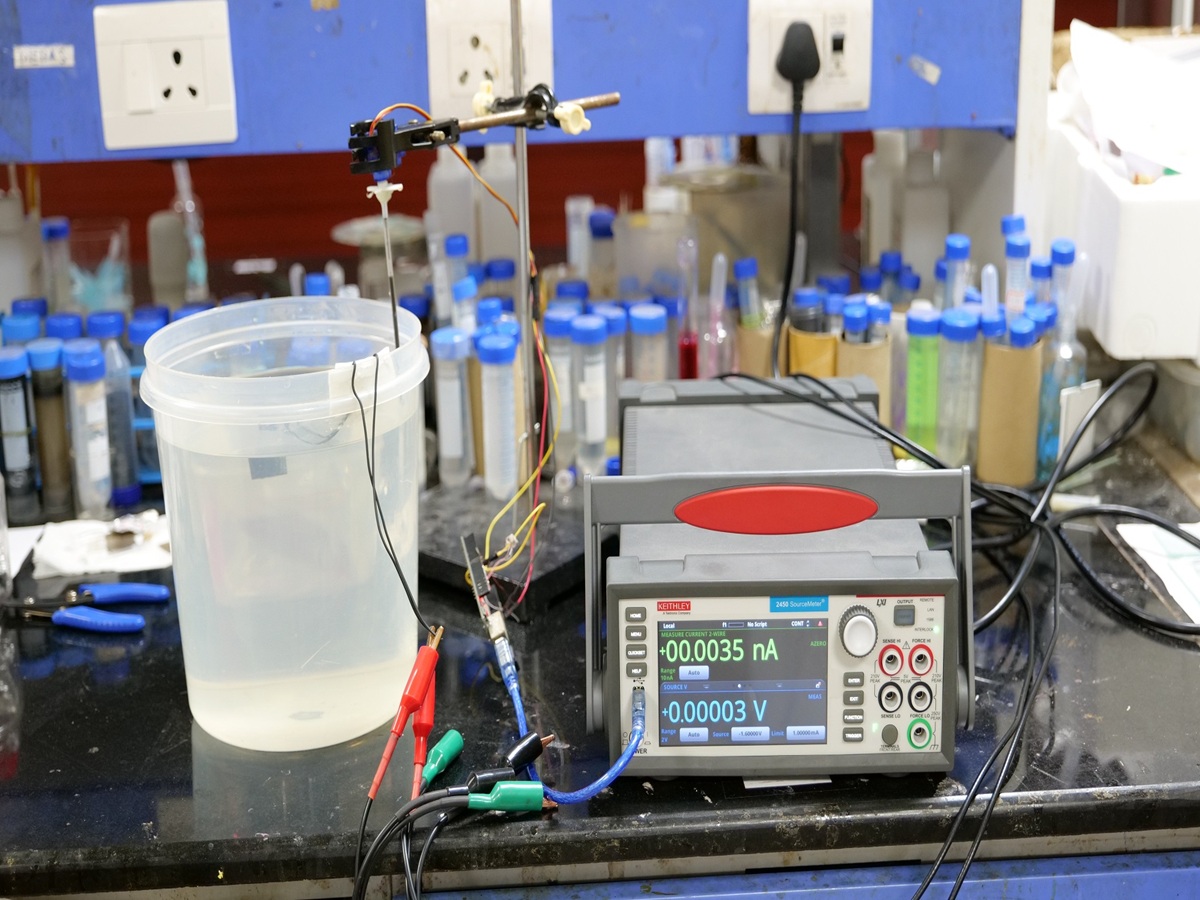
IIT Guwahati researchers developed an underwater vibration sensor that enables automated and contactless voice recognition.
Conducted in collaboration with researchers from Ohio State University, USA, the developed sensor offers a promising alternative communication method for individuals with voice disabilities who are unable to use conventional voice-based systems.
 Findings
The findings of this research have been published in the prestigious journal Advanced Functional Materials, in a paper co-authored by Prof. Uttam Manna, Department of Chemistry, along with his research scholars Ms. Debasmita Sarkar, Mr. Rajan Singh, Mr. Anirban Phukan, Mr. Priyam Mondal, and Prof. Roy P. Paily, Department of Electronics and Electrical Engineering from IIT Guwahati, and Prof. Xiaoguang Wang along with Mr. Ufuoma I. Kara from The Ohio State University, USA.
Voice recognition
In recent years, voice recognition has become an integral part of modern life, say sources from IIT Guwahati.
It helps users in operating smart devices including mobile phones, home appliances and other devices through voice commands.
However, for the people with voice disorders, this technological development remains inaccessible, say sources from IIT Guwahati.
Studies
Recent studies show that a noticeable percentage of children and young adults aged between 3 and 21 experience some form of voice disability, underscoring the significant need for more inclusive communication technologies.
 Solution
To address this limitation, the research team has found a solution by focusing on the exhale air through the mouth while we speak, a basic physiological function, say IIT Guwahati researchers.
In cases where individuals cannot produce sound, attempting to speak generates airflow from their lungs.
When this air flows over a water surface, it produces subtle waves. The research team have developed an underwater vibration sensor which can detect these water waves and interpret speech signals without depending on audible voice, thus creating a new pathway for voice recognition.
Sensor
The developed sensor is made from a conductive, chemically reactive porous sponge.
When placed just below the air-water interface, it captures the tiny disturbances created by exhaled air and converts them into measurable electrical signals.
The research team used Convolutional Neural Networks (CNN), a type of deep learning model, to accurately recognise these subtle signal patterns, say sources from IIT Guwahati.
This setup allows users to communicate with devices from a distance, without the need to generate sound.
 IIT Guwahati Department of Chemistry
Prof. Uttam Manna, Department of Chemistry, IIT Guwahati, said, “It is one of the rare designs of material allowing to recognize voice based on monitoring the water wave formed at air/water interface because of exhaling air from mouth.
This approach is likely to provide a viable solution for communication with those individuals with partially or entirely damaged vocal cords, said Prof Uttam of IIT Guwahati.
Working prototype
On a lab-scale the working prototype costs Rs. 3000. With research exploring potential industry collaboration for bringing the technology from lab to real world use, the cost of the final product is expected to reduce.
Key features
Key features of the developed sensors include:
⮚ Contactless communication for individuals with voice disabilities
⮚ AI-powered interpretation using CNNs
⮚ Hands-free control of smart devices
The next step
In the next step, the research team plans to get clinical validation for the developed device, say sources from IIT Guwahati.
Further, the team plans to collect more datasets from individuals with voice disabilities who can articulate different words necessary for operating home appliances and other voice-commanded smart devices.
Using these datasets, the research team will be able to refine the developed model for recognising specific words or phrases when exhaled air is directed over a water surface.
Potential
This development holds potential beyond voice recognition.
Other than hands-free operation of various devices, the developed sensor can also be used in exercise tracking and movement detection.
Additionally, its proven durability, remaining stable after extended underwater use, suggests potential applications in underwater sensing and communication, say sources from IIT Guwahati.
Also Read – Top 5 Colleges for BDes in India, For Great Aspiring Designers