

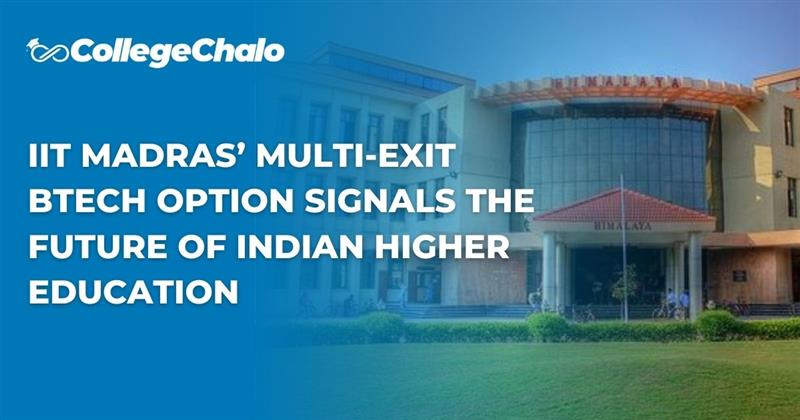
In a significant step toward reshaping higher education in India, IIT Madras has announced that BTech students will now be allowed to exit their programme after three years with a Bachelor of Science (BSc) degree. This move aligns seamlessly with the National Education Policy (NEP) 2020, which emphasises flexibility, student choice, and multiple pathways to success. More importantly, it reflects a long-overdue shift away from rigid, one-size-fits-all degree structures toward a system that recognises diverse aspirations and life realities.
BTech Students can exit after 3 years with a B.Sc. degree; IIT Madras
Traditionally, engineering education in India has followed a strict four-year model. Students who, for any reason, chose or were forced to leave midway often walked away empty-handed despite having completed years of rigorous coursework. IIT Madras’ decision challenges this outdated mindset. By formally recognising three years of academic effort with a BSc degree, the institute ensures that students do not “lose” valuable years of learning simply because their goals evolve.
This multi-exit option opens up powerful new possibilities. A student who realises midway that their interests lie in management can now exit after three years and pursue an MBA, either in India or abroad, without the stigma of an incomplete degree. Those inclined toward civil services, public policy, entrepreneurship, or even creative and interdisciplinary careers can pivot with confidence, backed by a recognised qualification from one of India’s most prestigious institutions.
Crucially, this change does not dilute academic rigour. Students who wish to continue can still complete the full four-year BTech programme, while those opting out receive a degree that reflects the depth and breadth of education they have already acquired. Flexibility here is not about lowering standards; it is about respecting individual choice and acknowledging that learning trajectories are rarely linear.
The move also reflects a deeper understanding of today’s students. Career paths in the 21st century are no longer predictable or singular. Many students discover new interests through exposure, internships, research, or real-world experiences during college. Locking them into a rigid degree structure often results in disengagement, burnout, or wasted potential. By contrast, adaptable exit points empower students to make informed decisions at different stages of their academic journey.
From a policy perspective, IIT Madras is effectively demonstrating how NEP 2020 can work in practice. The NEP advocates multiple entry and exit points, interdisciplinary learning, and a shift from credentialism to competence. While these ideas have been widely discussed, implementation has been uneven. When a premier institution like IIT Madras leads by example, it sets a benchmark for universities across the country to follow.
There is also a broader economic and social benefit. Students who exit early to start businesses or prepare for competitive exams can enter the workforce or entrepreneurial ecosystem sooner, armed with strong analytical and technical foundations. Others may pursue research, international education, or emerging fields that do not require a traditional engineering degree. The result is a more dynamic, responsive talent pool aligned with India’s evolving needs.
Critics may argue that such flexibility could encourage dropouts or reduce commitment. However, this concern underestimates students. Choice does not weaken commitment; it strengthens it. When students know they are not trapped, they are more likely to engage meaningfully with their education. Those who stay for the full BTech will do so because they genuinely see value in it—not because they have no alternative.
Ultimately, IIT Madras’ decision sends a clear message: rigid, one-shot degrees are no longer suited to a fast-changing world. Education systems must adapt to students, not the other way around. By embracing flexibility without compromising excellence, IIT Madras has shown what future-ready education looks like.
As India aims to become a global knowledge leader, such student-centric reforms are not just welcome, they are essential. The NEP gets this right, and IIT Madras has taken a bold, commendable step in turning vision into reality.