

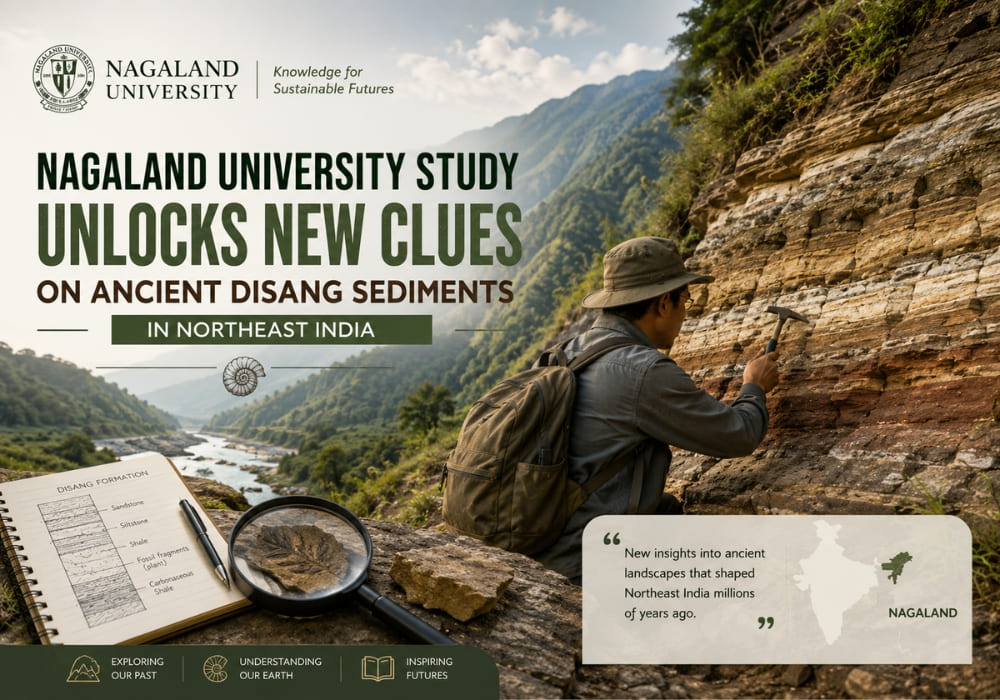
Author – Ritesh Ranjan: A new geological study by researchers at Nagaland University has brought fresh attention to the ancient sedimentary history of Northeast India. The research focuses on the Upper Disang Formation in Nagaland, a geologically important rock unit that forms part of the wider Indo-Myanmar sedimentary domain. Through this study, scientists have gained deeper insights into how ancient sediments were formed, transported, deposited and altered over millions of years.
The study is significant because Nagaland lies along the eastern margin of the Indian tectonic plate, close to the Indo-Myanmar ranges. This region has a complex geological history shaped by plate convergence, sediment movement and active tectonic processes. Despite its importance, parts of Nagaland have remained less studied compared with neighbouring areas such as Upper Assam. The new research helps fill this gap and adds valuable data to the understanding of Northeast India’s geological evolution.
Understanding the Upper Disang Formation
The Upper Disang Formation is a part of the Palaeogene sedimentary sequences found in Northeast India. These rocks preserve important evidence of ancient environments, sediment sources and tectonic activity. By studying such formations, geologists can reconstruct how landscapes, basins and mountain systems evolved in the past.
In the case of Nagaland, the Upper Disang Formation offers clues about sediment pathways along the Indo-Myanmar margin. This margin is known for intense geological activity because of the interaction between the Indian plate and the Burma plate. Over geological time, this interaction influenced the development of sedimentary basins, drainage systems and depositional environments.
Earlier research on the Upper Disang Formation was mostly concentrated in Upper Assam and nearby regions. Nagaland, despite being a key part of the geological system, had limited detailed data. The latest investigation by Nagaland University therefore provides an important regional contribution.
What the Study Investigated
The research team adopted an integrated geological approach to study the Upper Disang sandstones. Instead of relying on a single method, the researchers combined petrography, heavy mineral analysis and diagenetic studies.
Petrography helps scientists examine the composition and texture of rocks under a microscope. It reveals the types of minerals present in the sandstone and provides information about the original source rocks. Heavy mineral analysis is useful for identifying minerals that can survive long transport and weathering processes. These minerals help trace sediment provenance, or the origin of sediments. Diagenetic studies, meanwhile, examine the physical and chemical changes that occur after sediments are deposited and buried.
Together, these methods helped the researchers build a clearer picture of the Upper Disang sediments. The findings show that the sandstones were not derived from a single source. Instead, they came from multiple source terrains, including igneous, metamorphic and sedimentary rocks.
Multiple Sources of Ancient Sediments
One of the major findings of the study is that Upper Disang sediments were supplied from different types of rocks. Igneous rocks, formed from cooled magma or lava, contributed some of the mineral material. Metamorphic rocks, altered by heat and pressure, were also identified as source contributors. Sedimentary rocks, formed from earlier deposits, were another important source.
This mixed provenance suggests that the sediment supply system was dynamic and complex. Sediments may have travelled from both nearby and distant sources before being deposited in the basin. Such a pattern indicates active erosion, changing drainage networks and continuous tectonic influence.
Lead researcher Prof. S. K. Srivastava highlighted that the Upper Disang sediments reflect contributions from both local and far-off source areas. This points to rapid basin evolution and active sediment transport during the Middle to Late Eocene period.
Evidence of Tectonic Activity
The study also found evidence that the depositional setting of the Upper Disang Formation was tectonically active. This means that sediment accumulation was strongly influenced by movements of the Earth’s crust.
During the Middle to Late Eocene, the eastern edge of the Indian plate was affected by plate convergence. The interaction between the Indian and Burma plates likely played a major role in shaping the basin. Tectonic activity may have affected erosion rates, sediment supply, basin subsidence and drainage reorganisation.
This finding is important because it helps scientists understand how sedimentary basins develop in regions affected by active plate movements. The Indo-Myanmar margin is still considered geologically complex, and studies like this help explain its long-term evolution.
Diagenetic Features and Burial History
Another important aspect of the study is the identification of diagenetic features in the Upper Disang sandstones. Diagenesis refers to the changes sediments undergo after deposition, especially during burial.
The researchers found signs that the sediments experienced shallow burial changes. These features provide information about compaction, mineral alteration, fluid movement and thermal history. In simple terms, the rocks carry preserved evidence of what happened to them after they were deposited.
Such information is valuable because it helps geologists understand not only where sediments came from, but also how they changed over time. Diagenetic signatures can also support future work in sediment quality assessment and basin modelling.
Why This Research Matters
The study is important for several reasons. First, it fills a long-standing knowledge gap in Nagaland’s geological record. While related formations in Upper Assam and neighbouring regions had received more attention, Nagaland’s Upper Disang Formation needed detailed investigation.
Second, the research improves understanding of sediment provenance in Northeast India. Knowing where sediments came from helps scientists reconstruct ancient landscapes, erosion patterns and transport systems.
Third, the findings contribute to broader tectonic reconstruction models. The Indo-Myanmar region has a complicated geological history involving plate movement, basin formation and possible closure of ancient oceanic domains. The new data from Nagaland can help refine these models.
Fourth, the study has regional relevance beyond Nagaland. Similar Palaeogene siliciclastic sedimentary sequences are found in nearby areas. The results can therefore serve as a useful comparison for researchers studying related geological systems across Northeast India and adjoining regions.
Contribution of Nagaland University
The study reflects Nagaland University’s growing role in geoscientific research. Supported by the university’s Start-up Research Grant, the project shows how regional universities can contribute meaningful scientific data to national and international research discussions.
Prof. Jagadish Kumar Patnaik, Vice-Chancellor of Nagaland University, noted that the work demonstrates the university’s commitment to high-quality earth science research. He also emphasized that such studies can encourage young scholars to pursue interdisciplinary research in geology and related fields.
The paper was published in Evolving Earth, a peer-reviewed open-access journal focused on Earth system science and global environmental change. The study was co-authored by researchers from Nagaland University and VBS Purvanchal University, Uttar Pradesh.
A Step Forward for Northeast India’s Geological Research
Northeast India is one of the most geologically interesting regions of the country. Its mountains, basins and sedimentary formations preserve evidence of ancient tectonic movements and changing environments. However, several areas still require detailed scientific documentation.
The Nagaland University study on the Upper Disang Formation is a major step in this direction. By combining petrography, heavy mineral analysis and diagenetic studies, the researchers have provided a more complete understanding of the region’s sedimentary history.
For geologists, students and researchers, the findings open new possibilities for studying basin evolution, sediment dispersal and tectonic processes along the Indo-Myanmar margin. The Upper Disang Formation now offers a richer story of ancient sediment movement, active-margin tectonics and geological transformation.
As more research emerges from Northeast India, the region is likely to play an increasingly important role in understanding the geological evolution of the Indian plate and its eastern boundaries.
FAQs
1. What is the Upper Disang Formation?
The Upper Disang Formation is a sedimentary rock unit found in parts of Northeast India, including Nagaland. It preserves evidence of ancient sediment deposition, sediment sources and tectonic activity along the Indo-Myanmar margin.
2. Why is the Nagaland University study important?
The study is important because it fills a major data gap in Nagaland’s geological record. It provides new insights into sediment origin, transport, basin evolution and tectonic activity in a region that had been less studied compared with neighbouring areas.
3. What methods were used in the study?
Researchers used petrography, heavy mineral analysis and diagenetic studies. These methods helped identify sediment sources, mineral composition, transport history and post-depositional changes in the sandstone.
4. What did the study reveal about the source of sediments?
The study found that the Upper Disang sandstones were derived from multiple source terrains, including igneous, metamorphic and sedimentary rocks. This suggests a complex and dynamic sediment supply system.
5. How does this study help future geological research?
The findings can support future work on tectonic reconstruction, basin modelling, sediment provenance analysis and sediment quality assessment. They also provide useful comparison data for similar geological sequences in Northeast India and adjoining regions.