Introduction
What happens when a 5,000-year-old language meets the technology of the future?
India just found out — and the answer is historic.

For the first time ever, Central Sanskrit University has launched an AICTE-approved B.Tech in Artificial Intelligence and Data Science, making it one of the most unique engineering programmes in the country. The course blends cutting-edge AI education with Sanskrit studies and India’s traditional knowledge systems — a combination no university has attempted before at this scale.
If you are a Class 12 PCM student searching for a programme that is both technically rigorous and deeply rooted in Indian heritage, this could be the opportunity you have been waiting for. The application window is open right now, but it closes on June 30, 2026 — so there is no time to waste.
This guide covers everything: eligibility, important dates, how to apply, what you will study, and why this programme matters for your future.
Table of Contents
- What Is This Programme?
- Key Highlights at a Glance
- Eligibility Criteria
- Important Dates
- How to Apply — Step by Step
- What Will You Study?
- Career Opportunities
- Why This Programme Is Different
- Tips to Strengthen Your Application
- Common Mistakes to Avoid
- Key Takeaways
- Conclusion
- FAQs
What Is This Programme?
Central Sanskrit University — a central university under India’s Ministry of Education — has introduced a four-year undergraduate B.Tech programme in Artificial Intelligence and Data Science at its Nashik campus for the academic session 2026–27.

The programme has received formal approval from the All India Council for Technical Education (AICTE), the apex body that regulates technical education in India. This approval is significant: it confirms the programme meets national quality benchmarks for engineering education.
What makes it truly different is the interdisciplinary design. Students will not just learn Python, machine learning, and data analytics. They will also study Sanskrit language and explore traditional Indian knowledge frameworks alongside those modern technical skills. Think of it as a bridge between Bharatiya Gyan Parampara (Indian knowledge tradition) and the algorithms that power today’s digital world.
Key Highlights at a Glance
| Detail |
Information |
| University |
Central Sanskrit University |
| Campus |
Nashik, Maharashtra |
| Course |
B.Tech in Artificial Intelligence & Data Science |
| Approval |
AICTE Approved |
| Duration |
4 Years (8 Semesters) |
| Total Seats |
66 |
| Eligibility |
Class 12 with Physics, Chemistry, Mathematics (PCM) |
| Additional Requirement |
Basic understanding of Sanskrit |
| Application Mode |
Online |
| Last Date to Apply |
June 30, 2026 |
| Academic Session |
2026–27 |
| Selection Process |
JEE score / University Entrance Examination |
Eligibility Criteria
Before you apply, confirm that you meet all the requirements.

Academic Qualification
You must have passed Class 12 (or an equivalent examination) from a recognized board with the following subjects:
- Physics
- Chemistry
- Mathematics
This standard PCM combination is required because the BTech curriculum builds heavily on concepts from all three disciplines — calculus for AI models, physics for computational thinking, and chemistry for an understanding of data patterns in the sciences.
Sanskrit Requirement
This is the unique element most applicants miss. Since the programme integrates Sanskrit language studies, candidates are expected to have a basic understanding of Sanskrit. This does not mean you need to be fluent or have a formal Sanskrit certificate. However, a foundational familiarity — perhaps from school-level study — will help you keep up with that component of the curriculum.
Age Limit
The university has not specified a separate age restriction. Standard central university norms typically apply, so check the official portal for any updates.

Important Dates
These are the critical deadlines for the 2026–27 academic session:
| Event |
Date |
| Application Portal Open |
June 2026 (Already Open) |
| Last Date to Apply |
June 30, 2026 |
| Entrance Examination |
To be announced after June 30 |
| Result / Merit List Declaration |
To be announced |
| Counselling Rounds |
To be announced |
| Fee Payment Deadline |
To be announced after seat allotment |
| Session Commencement |
2026–27 Academic Year |
Important: After the application window closes on June 30, the university will announce entrance exam schedules, merit lists, counselling dates, and seat allotment details separately. Regularly monitor the official Central Sanskrit University website for updates.
How to Apply — Step by Step
The application process is entirely online. Here is exactly what you need to do:
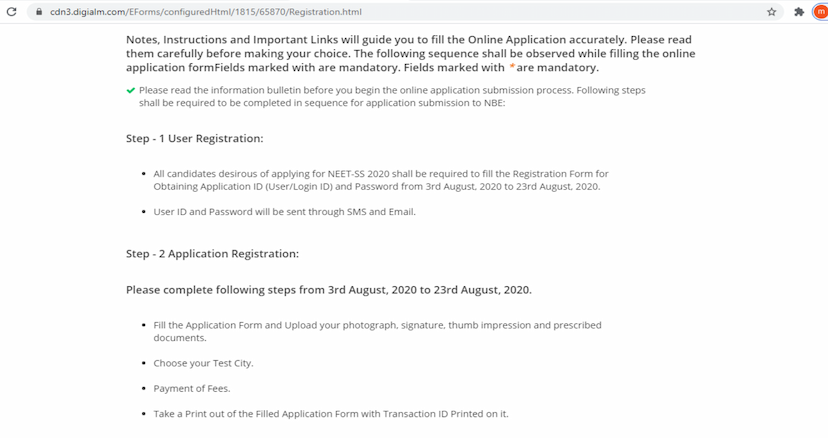
Step 1: Visit the official admission portal of Central Sanskrit University.
Step 2: Complete the online registration — enter your name, email ID, and mobile number to create an account.
Step 3: Fill in your personal details, academic qualifications, and contact information accurately.
Step 4: Select B.Tech in Artificial Intelligence and Data Science as your preferred programme.
Step 5: Upload the required documents. These typically include your Class 12 mark sheet, school leaving certificate, passport-size photograph, and ID proof. Check the portal for the exact list.
Step 6: Review every detail carefully before submitting — errors in name, date of birth, or subject combination can lead to rejection.
Step 7: Submit the application form online and pay any applicable application fees through the portal.
Step 8: Download and save your confirmation receipt or acknowledgement page. Keep it for future reference during counselling.
Step 9: After submission, wait for communication regarding the entrance examination date or JEE-based shortlisting.
Pro Tip: Do not wait until June 29 to apply. Technical issues and server loads frequently spike on the last day. Apply at least 5–7 days before the deadline.
What Will You Study?
The curriculum weaves together two worlds. Here is a broad overview of what the four-year programme covers:
Technical Subjects (AI & Data Science Core)
- Programming fundamentals and data structures
- Machine learning algorithms and applications
- Deep learning and neural networks
- Data analytics and big data tools
- Natural language processing (NLP)
- Computer vision
- Database management and SQL
- Cloud computing concepts
- Software engineering principles
Sanskrit and Traditional Knowledge
- Sanskrit language foundation
- Indian knowledge systems and epistemology
- Computational linguistics as applied to classical texts
- Integration of traditional frameworks with modern analytical methods
Mathematics and Science Foundation
- Calculus and linear algebra (essential for AI models)
- Statistics and probability
- Physics and chemistry fundamentals
This interdisciplinary blend is genuinely novel. Researchers around the world are increasingly exploring how classical Indian texts — written in Sanskrit — can be processed computationally, opening up entire new fields of digital humanities and AI-powered archiving. Students of this programme could be at the forefront of that work.
Career Opportunities
Graduates of this BTech programme will be equipped for roles in both the technology and the knowledge-preservation sectors. Potential career paths include:
- AI Engineer — building and deploying machine learning models
- Data Scientist — analyzing large datasets to generate business or research insights
- Data Analyst — translating data into actionable reports
- NLP Researcher — particularly in Sanskrit computational linguistics
- Digital Humanities Specialist — digitizing, processing, and analyzing classical texts
- Research Scholar — pursuing MTech, MSc, or PhD in AI or Sanskrit studies
India’s AI job market is growing rapidly. According to industry estimates, the demand for data science and AI professionals in India is expected to grow significantly through 2030, with salaries for entry-level AI engineers starting above ₹6–8 LPA at major companies.
The Sanskrit dimension adds a niche but valuable skill: very few AI professionals in India have formal training in classical Sanskrit, making these graduates uniquely positioned for government cultural projects, archiving initiatives, and research roles at institutions like the IITs, IISc, and national language bodies.
Why This Programme Is Different
Most BTech AI and Data Science programmes available in India are technically solid but essentially identical in structure. They follow the AICTE-recommended curriculum, hire industry trainers, and produce graduates with largely the same skill sets.
Central Sanskrit University’s programme breaks that pattern in three ways:
1. Genuine interdisciplinarity. The integration of Sanskrit is not cosmetic. The programme is designed to explore computational approaches to classical knowledge — an area with real research potential.
2. A central university degree. Central Sanskrit University is a centrally funded institution under the Ministry of Education. A BTech from a central university carries significant credibility compared to many private colleges.
3. Limited seats, serious selection. With only 66 seats, this is a selective programme. The small cohort size often translates to better faculty attention and a tighter academic community.
4. PM Modi’s endorsement. Prime Minister Narendra Modi publicly praised this initiative, calling it a meaningful step toward integrating modern technology with India’s traditional knowledge heritage. That level of national recognition signals long-term institutional support.
Tips to Strengthen Your Application
- Score matters. If you qualified for JEE (Main or Advanced), your score will likely play a role. A stronger JEE score improves your chances given the limited 66 seats.
- Brush up on Sanskrit basics. Even a short revision of Class 8–10 Sanskrit will prepare you for the screening or interview process.
- Apply early. The deadline is June 30 — this is very close. If you are reading this, open the portal today.
- Keep documents ready. Scan your mark sheets, photograph, and ID proof in advance so uploading does not slow you down.
- Monitor the official website. Counselling and exam dates will not be widely advertised — check the official Central Sanskrit University site directly.
Common Mistakes to Avoid
- Assuming Sanskrit is optional. The programme officially requires a basic understanding of Sanskrit. Do not overlook this when assessing your fit.
- Submitting wrong subject combinations. Only PCM (Physics, Chemistry, Mathematics) is accepted. Commerce or Biology students are not eligible.
- Missing the June 30 deadline. The university is unlikely to extend it. Treat this as a hard cutoff.
- Not saving the confirmation receipt. You will need it during counselling. Losing it creates unnecessary complications.
- Relying on unofficial sources. Check only the official Central Sanskrit University portal for dates, fees, and seat allotment updates. Third-party aggregators sometimes carry outdated or inaccurate information.
Key Takeaways
- Central Sanskrit University has launched India’s first AICTE-approved BTech in AI and Data Science that integrates Sanskrit studies.
- The programme is at the Nashik campus, runs for 4 years, and has 66 approved seats.
- Eligibility requires Class 12 PCM plus a basic understanding of Sanskrit.
- The application deadline is June 30, 2026 — there is very little time remaining.
- Selection is based on JEE scores or a university entrance examination.
- Career paths span AI engineering, data science, NLP research, and digital humanities.
- The programme has received national recognition, including acknowledgment by Prime Minister Modi.
Conclusion
India’s engineering landscape just got significantly more interesting. Central Sanskrit University’s AICTE-approved BTech in AI and Data Science is not just another technical programme — it is a genuine attempt to create something new: graduates who understand both the algorithms driving modern AI and the ancient language that houses some of humanity’s oldest recorded knowledge.
For a student who has studied PCM, has some exposure to Sanskrit, and wants a degree from a central university in one of the highest-demand career fields of the decade — this programme ticks every box.
The window is narrow. Apply before June 30, 2026. Visit the official Central Sanskrit University website today.
FAQs
1. What is the last date to apply for Central Sanskrit University BTech AI 2026? The last date to submit the online application form is June 30, 2026. Applications submitted after this date will not be considered.
2. Is Sanskrit mandatory for the Central Sanskrit University BTech AI programme? Yes. Since the programme integrates Sanskrit language studies with AI and Data Science, candidates are required to have a basic understanding of Sanskrit. This is part of the admission criteria.
3. How many seats are available in this BTech programme? The AICTE-approved intake is 66 seats for the 2026–27 academic session at the Nashik campus.
4. What is the eligibility for Central Sanskrit University BTech AI admission? Candidates must have passed Class 12 or equivalent with Physics, Chemistry, and Mathematics (PCM) from a recognized board, along with a basic understanding of Sanskrit.
5. Will JEE score be considered for admission? Yes. JEE-qualified candidates will be considered in the admission process. Candidates who have not taken JEE may need to appear for the university’s own entrance examination. Check the official portal for the exact process.
6. What career can I pursue after this BTech in AI and Data Science? Graduates can work as AI engineers, data scientists, NLP researchers, data analysts, or pursue higher education in AI or Sanskrit computational linguistics. The programme also opens doors in government cultural and archiving projects.
7. Is this the first time a Sanskrit university is offering an engineering programme? Yes, this is a first-of-its-kind initiative. Central Sanskrit University’s launch of an AICTE-approved BTech in AI and Data Science represents the first time a Sanskrit-focused university in India has introduced a modern engineering degree.