

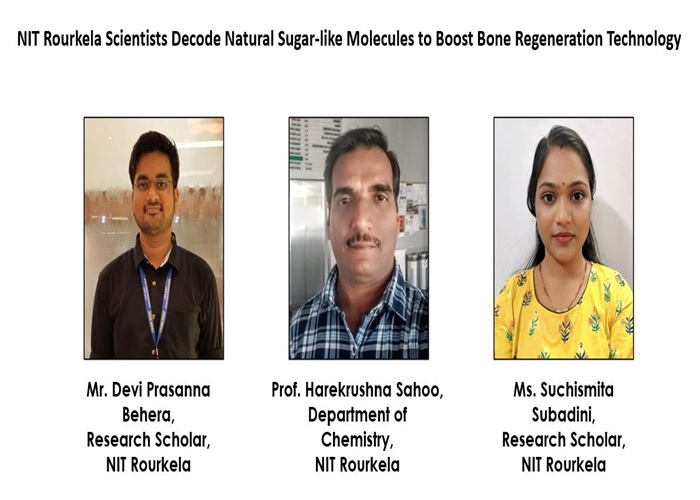
NIT Rourkela researchers have uncovered how natural sugar-like molecules in the human body can alter the behavior of Bone Morphogenetic Protrin-2 (BMP-2), a protein responsible for bone formation and repair.
Published in the prestigious journal Biochemistry, the findings of this research can be used for advanced treatments in bone and cartilage regeneration, improved implants, and more effective protein-based medicines.
 Folding or Unfolding
From building tissues, and supporting chemical reactions, to acting as signals between cells, proteins carry out various functions in the human body, say sources from NIT Rourkela.
However, for best productivity, they need to be folded or unfolded into precise three-dimensional shapes.
Understanding why and how proteins unfold is a major goal in biology, with implications for medicine, biotechnology, and drug delivery, say NIT Rourkela researchers.
BMP 2
In this context, BMP-2 plays a crucial role in forming bones and cartilage, healing injuries, and guiding stem cells to become bone-forming cells, say researchers from NIT Rourkela.
However, in the human body, this protein interacts with different Glycosaminoglycans (GAGs), special sugar-like molecules found in connective tissues and joint fluids.
NIT Rourkela research team
The NIT Rourkela research team led by Prof. Harekrushna Sahoo. Department of Chemistry, National Institute of Technology, Rourkela, along with research scholars Mr. Devi Prasanna Behera and Ms. Suchismita Subadini, investigated how these different GAGs affect BMP-2 when it is exposed to “stress” in the form of urea-induced chemical denaturation.
 NIT Rourkela researchers observation
The team at NIT Rourkela observed that BMP-2 unfolded faster in the presence of Sulfated Hyaluronic Acid (SHA), a type of GAG, compared to regular Hyaluronic Acid or without additives.
The researchers found that SHA binds directly to BMP-2 protein, gently altering its structure and making it unfold in a more controlled manner.
Research impact
Prof. Harekrushna Sahoo, said BMP-2 is a critical protein in humans that plays a fundamental role in osteogenesis and bone regeneration, residing within the glycosaminoglycan-rich extracellular matrix environment of bone tissue.
Our study reveals how specific GAG–BMP-2 interactions influence unfolding dynamics and structural stability, said Prof Harekrushna of NIT Rourkela.
These insights allow scaffold designs to actively preserve BMP-2’s functional conformation, prolong bioactivity, lower dosage needs, and reduce side effects, he said.
Furthermore, the work offers a mechanistic basis for tailoring GAG functional group modifications to modulate protein structure and activity, guiding next-generation pharmaceutical formulation, he said.
Natural existence
BMP-2 naturally exists in vivo and predominantly as part of a proteoglycan complex; consequently, its interactions with GAG chains are integral to its conformational dynamics.
These interactions critically influence the protein’s osteoinductive potential, say sources from NIT Rourkela.
Functional group modifications of GAGs. such as targeted sulfation. can profoundly modulate these interactions, imparting enhanced structural stability under physicochemical stress while preserving bioactivity.
 Potential
This high-resolution molecular understanding underscores the potential to engineer GAG modifications that not only maintain BMP-2 functionality under adverse conditions but also optimise its therapeutic delivery, augment bioactivity through strategic sulfation or other functional group alterations, and extend protein shelf life via improved stabilisation strategies.
About NIT Rourkela
NIT Rourkela is one of the premier national level institutions for technical education in the country and is funded by the Government of India.
NIT Rourkela has earned 19th position in NIRF Ranking 2024 (Engineering Category), Overall 34th position, 30th position under Research and 9th position in Architecture and Planning category.
The campus of the Institute consisting of the Institute buildings, halls of residence and staff colony in over an area of 262 hectares of land.
It is a residential campus offering accommodation to faculty, staff and students. The campus has all the amenities for developing personal, social and academic skills of the student community.
Also Read – Top 20 BDS Colleges in India 2024: Great NIRF Rating 2024