

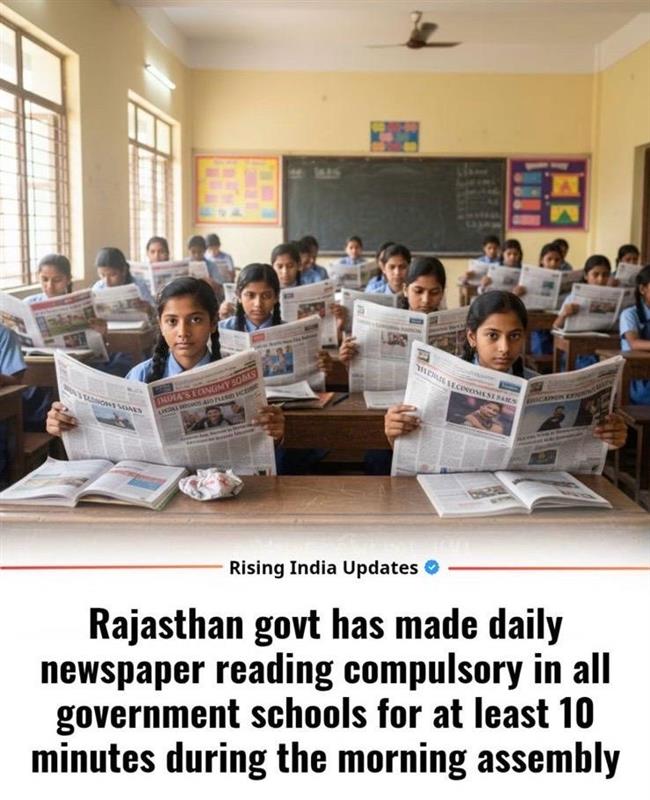
In a significant step toward strengthening foundational learning, the Rajasthan government has officially mandated a daily 10-minute newspaper reading session for students in all government schools. This initiative, announced by the State School Education Department, will come into effect from January 2026 and will be conducted during the morning assembly. The move reflects a growing emphasis on reading as a core educational habit and aims to prepare students to be more informed, articulate, and aware citizens from an early age.
Purpose Behind the New Directive
The primary objective of this directive is to cultivate consistent reading habits among students. In an era dominated by short-form digital content, regular exposure to newspapers can help students develop focus, patience, and critical thinking skills. Newspapers present information in a structured and factual manner, allowing students to understand current events, social issues, and diverse perspectives in a reliable format. By making newspaper reading a daily routine, the government hopes to embed reading as a natural and enjoyable part of students’ lives.
Focus on Vocabulary and Language Development
One of the key educational benefits of newspaper reading is vocabulary enhancement. Newspapers introduce students to new words, phrases, and expressions used in real-world contexts. This exposure is especially valuable for language development, as it improves comprehension, sentence structure, and communication skills. Regular reading can also help students become more confident in both written and spoken language, which is essential for academic success across subjects.
Bilingual Learning Through Hindi and English Newspapers
To ensure inclusive and comprehensive learning, the guidelines specify different newspaper requirements based on school type. Government senior secondary schools and English-medium schools are required to subscribe to at least two newspapers, one in Hindi and one in English. This bilingual approach supports students in strengthening their proficiency in both languages, which is particularly important in a multilingual country like India. Upper primary schools, on the other hand, must provide at least two Hindi newspapers to ensure age-appropriate comprehension while still encouraging reading fluency.
Financial Responsibility Taken by the State
A notable aspect of this initiative is that all newspaper subscription costs will be covered by the Rajasthan School Education Council. By removing the financial burden from schools, the government has ensured uniform implementation across urban and rural institutions. This decision reflects a commitment to educational equity, ensuring that students from all backgrounds have equal access to quality reading materials regardless of their school’s location or resources.
Integration into the Morning Assembly
The decision to conduct the newspaper reading session during the morning assembly is strategic. Morning assemblies already serve as a time for discipline, reflection, and collective learning. Adding a structured reading session ensures that all students participate consistently without disrupting the academic timetable. It also creates a shared learning experience, where students begin their day informed about current events and ideas, setting a thoughtful tone for the rest of their classes.
Encouraging General Awareness from a Young Age
Beyond language skills, the initiative places strong emphasis on improving general awareness. Newspapers cover a wide range of topics, including science, environment, sports, governance, and culture. Early exposure to such content helps students develop a broader worldview and stay connected with societal developments. Over time, this awareness can foster curiosity, informed opinions, and responsible citizenship.
Long-Term Impact on Education and Society
Education experts believe that consistent reading habits formed during school years often continue into adulthood. By institutionalising newspaper reading, the Rajasthan government is investing in long-term intellectual growth. Students who read regularly are more likely to perform better academically, think analytically, and engage constructively with the world around them. This initiative also reinforces the importance of traditional reading mediums at a time when misinformation can easily spread online.
Also Read: Young Innovators Expo – 2026: Empowering Tomorrow’s Visionaries
A Step Toward Holistic Student Development
Overall, the daily 10-minute newspaper reading mandate represents a thoughtful and forward-looking educational reform. It goes beyond textbooks to nurture well-rounded individuals who are informed, articulate, and curious. As the policy rolls out in January 2026, it is expected to set an example for other states to integrate reading-based learning into their education systems, ultimately contributing to a more knowledgeable and engaged generation of students.