

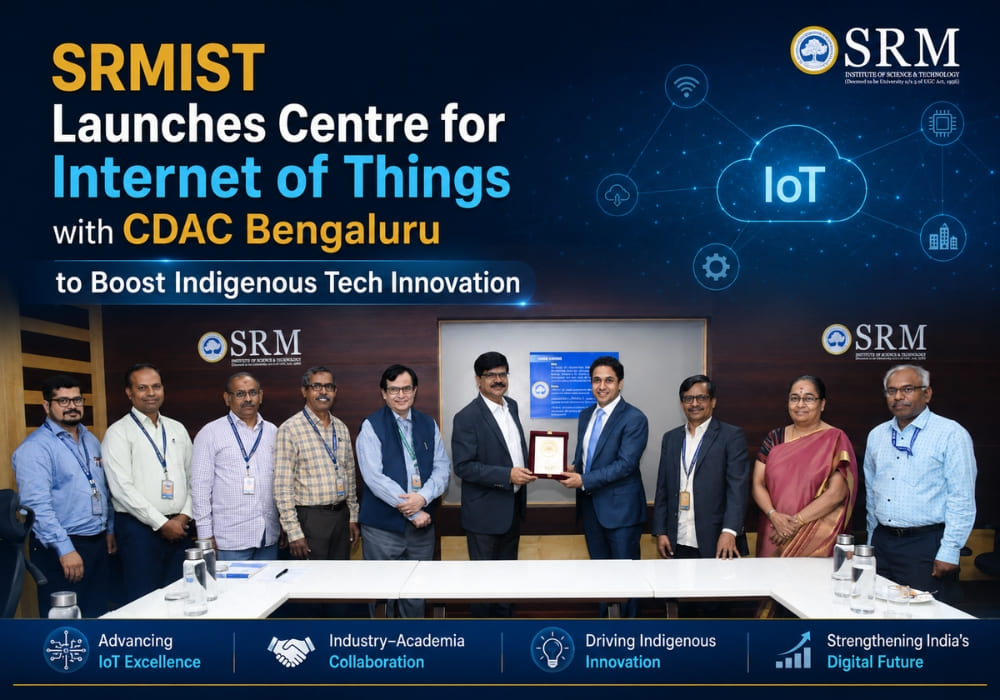
Author – Ritesh Ranjan: SRM Institute of Science and Technology, commonly known as SRMIST, has taken a major step toward strengthening research and innovation in next-generation connected technologies with the launch of a new Centre for Internet of Things at its Kattankulathur campus. The centre has been established by the Department of Networking and Communications, School of Computing, in collaboration with the Centre for Development of Advanced Computing, CDAC Bengaluru.
The new facility is expected to become an important platform for research, product engineering, hands-on learning and industry-oriented skill development in the Internet of Things ecosystem. With a strong focus on embedded systems, IoT security, edge AI and indigenous hardware design, the centre aims to prepare students and faculty for the rapidly evolving world of smart and connected technologies.
The inauguration was held at Techpark-1 on the SRMIST Kattankulathur campus in the presence of senior officials, faculty members, researchers and students. Key dignitaries at the event included Shri Shrikrishna S Chippalkatti, Scientist-E, CDAC Bengaluru; Dr. M. Leenus Jesu Martin, Dean, Faculty of Engineering and Technology; Dr. Revathi Venkataraman, Chairperson, School of Computing; and Dr. M. Lakshmi, Head of the Department of Networking and Communications.
A New Step Toward Future-Ready Technology Education
The launch of the Centre for Internet of Things reflects SRMIST’s growing commitment to future-ready engineering education. As industries across the world move toward automation, smart infrastructure and data-driven systems, IoT has become one of the most important technology domains for students and researchers.
The Internet of Things connects physical devices, sensors, machines and systems through digital networks. These connected systems are now being used in smart cities, healthcare, agriculture, manufacturing, defence, logistics, consumer electronics and several other sectors. With the rise of intelligent sensors, secure communication systems and edge computing, IoT is becoming central to modern digital transformation.
Through this new centre, SRMIST aims to provide students with access to practical learning, advanced research opportunities and industry-relevant projects. The initiative is designed not just as an academic laboratory, but as a hub where students and faculty can work on real-world technology problems and develop usable solutions.
Collaboration with CDAC Bengaluru
One of the most important aspects of the new IoT centre is SRMIST’s collaboration with CDAC Bengaluru. CDAC is known for its work in advanced computing, embedded systems, ubiquitous computing and indigenous technology development. Its association with SRMIST is expected to bring strong technical expertise, mentoring support and access to indigenously developed systems and kits.
During the inauguration, Shri Shrikrishna S Chippalkatti highlighted CDAC’s experience in IoT-related technologies and ubiquitous computing. He explained that the systems and kits introduced through this collaboration are designed indigenously from hardware to software. This approach will allow students and researchers to understand the complete technology stack rather than working only with ready-made commercial platforms.
The collaboration is also expected to encourage product engineering and innovation. Students and faculty will be guided to explore industry-relevant applications in areas such as IoT security, embedded AI, sensor networks, edge computing and indigenous processor technologies. This can help develop deeper technical capability and reduce dependence on imported technology solutions.
Focus Areas of the Centre
The Centre for Internet of Things at SRMIST will focus on some of the most important areas in modern connected technology. One major focus area is embedded systems, which form the foundation of many IoT devices. Embedded systems are used in smart appliances, automotive systems, medical devices, industrial machines and consumer electronics.
Another key focus area is IoT security. As more devices become connected to the internet, the risk of cyberattacks, data breaches and system manipulation increases. Secure IoT design is therefore essential for industries such as healthcare, defence, smart infrastructure and finance. By working on IoT security, the centre can help students understand how to build safer and more reliable connected systems.
Edge AI is another important area of work. Instead of sending all data to cloud servers for processing, edge AI allows devices to process data closer to where it is generated. This improves speed, reduces latency and supports applications such as autonomous systems, smart surveillance, industrial monitoring and healthcare devices.
The centre will also focus on indigenous hardware design. This is especially important as India works toward technological self-reliance. By encouraging local design and development of hardware and software systems, the centre can contribute to India’s broader goal of building strong domestic technology capability.
Building a Centre of Excellence
Speaking at the inauguration, Dr. M. Leenus Jesu Martin said the new centre has the potential to evolve into a Centre of Excellence if it produces strong application-oriented outcomes. He emphasized that the success of the initiative will depend on visible projects, student and faculty participation, and meaningful engagement with industry.
This vision highlights the need for the centre to go beyond classroom learning and theoretical research. The focus will be on building practical solutions, prototypes and technology products that can address real-world challenges. Such an approach can help students gain confidence in product development and applied research.
Dr. Revathi Venkataraman also stressed the importance of tangible outcomes. She said the centre must move beyond ideas and produce products and prototypes. According to her, stronger industry partnerships and technology transfer can transform the centre into a sustainable innovation ecosystem that creates both research impact and student opportunities.
Dr. M. Lakshmi described the centre as a strategic step toward research growth, skill development and future-ready education. She noted that the facility will help students and faculty explore emerging technologies and contribute meaningfully to the growing IoT landscape.
Training, Boot Camps and Hands-On Learning
The new Centre for IoT will not function only as a traditional academic lab. It will also support structured training programmes, Management Development Programmes and boot camps designed with input from industry experts. These initiatives are expected to help students develop practical skills aligned with workplace requirements.
Hands-on training will be one of the key strengths of the centre. Students will be encouraged to experiment with hardware, sensors, communication systems, software platforms and AI-enabled devices. They will also be guided to build minimum viable products and scalable solutions.
This kind of learning can help bridge the gap between classroom education and industry expectations. Many engineering students learn concepts in theory but need more exposure to deployment-ready technology. By working on real devices, real problems and real prototypes, students can develop stronger problem-solving skills and become more employable.
The centre is also expected to encourage interdisciplinary research. IoT is not limited to computer science alone. It brings together electronics, communication engineering, artificial intelligence, cybersecurity, mechanical systems, healthcare, agriculture, manufacturing and data science. By supporting collaboration across departments, the centre can help create innovative solutions for multiple sectors.
Why This Initiative Matters
The launch of the SRMIST Centre for Internet of Things comes at a time when India is focusing strongly on digital transformation, smart infrastructure and indigenous technology development. IoT is expected to play a major role in the future of smart cities, connected healthcare, industrial automation, agriculture technology, defence systems and consumer electronics.
By combining IoT research with embedded systems, cybersecurity, edge intelligence and indigenous hardware, the new centre can help prepare students for high-growth technology careers. It can also support faculty research, industry partnerships and innovation-driven projects.
For students, the centre offers an opportunity to work with advanced technologies and gain practical experience. For faculty, it creates a platform for research collaboration and funded projects. For industry, it can become a source of skilled talent and technology solutions.
The SRMIST-CDAC collaboration also strengthens the university’s innovation ecosystem. With access to CDAC’s technical expertise and SRMIST’s academic infrastructure, the centre can become a strong contributor to India’s connected technology future.
Conclusion
The inauguration of the Centre for Internet of Things at SRMIST Kattankulathur is an important development in the field of technology education and innovation. Established in collaboration with CDAC Bengaluru, the centre aims to promote research, skill development, product engineering and indigenous technology design.
With focus areas such as embedded systems, IoT security, edge AI and indigenous hardware, the centre is well-positioned to support India’s growing need for skilled engineers and locally developed technology solutions. If the centre continues to produce practical projects, prototypes and industry partnerships, it has the potential to grow into a major Centre of Excellence in IoT and connected technologies.
FAQs
1. What is the new Centre for Internet of Things at SRMIST?
The Centre for Internet of Things is a new facility launched at SRMIST’s Kattankulathur campus to support research, training, innovation and product development in IoT, embedded systems, edge AI, security and indigenous hardware design.
2. Who has SRMIST collaborated with for the IoT centre?
SRMIST has collaborated with the Centre for Development of Advanced Computing, CDAC Bengaluru, for the establishment of the Centre for Internet of Things.
3. What are the main focus areas of the SRMIST IoT Centre?
The major focus areas include embedded systems, IoT security, edge AI, indigenous hardware design, sensor-based technologies, product engineering and industry-relevant IoT applications.
4. How will students benefit from the Centre for IoT?
Students will benefit through hands-on training, boot camps, research projects, product development opportunities, exposure to indigenous technology platforms and mentoring from experts.
5. Why is the SRMIST-CDAC IoT centre important?
The centre is important because it supports India’s goal of building indigenous technology capabilities while preparing students for careers in smart devices, connected infrastructure, cybersecurity, automation and edge intelligence.