
Student Support Services: Know how it supports Student Academic Excellence and Emotional Well-beings

Conquering College with Confidence: How Student Support Services Can Help You Thrive
Student support services (SSS) have grown significantly since their inception in the 1960s. These services are designed to help students with finances and basic school needs. These services include a wide range of support systems to ensure student success and development. This comprehensive guide covers various aspects of student support services, their basics, benefits and areas for improvement. Read more, Big Shift in Indian Education: Universities Can Now Admit Students Twice a Year
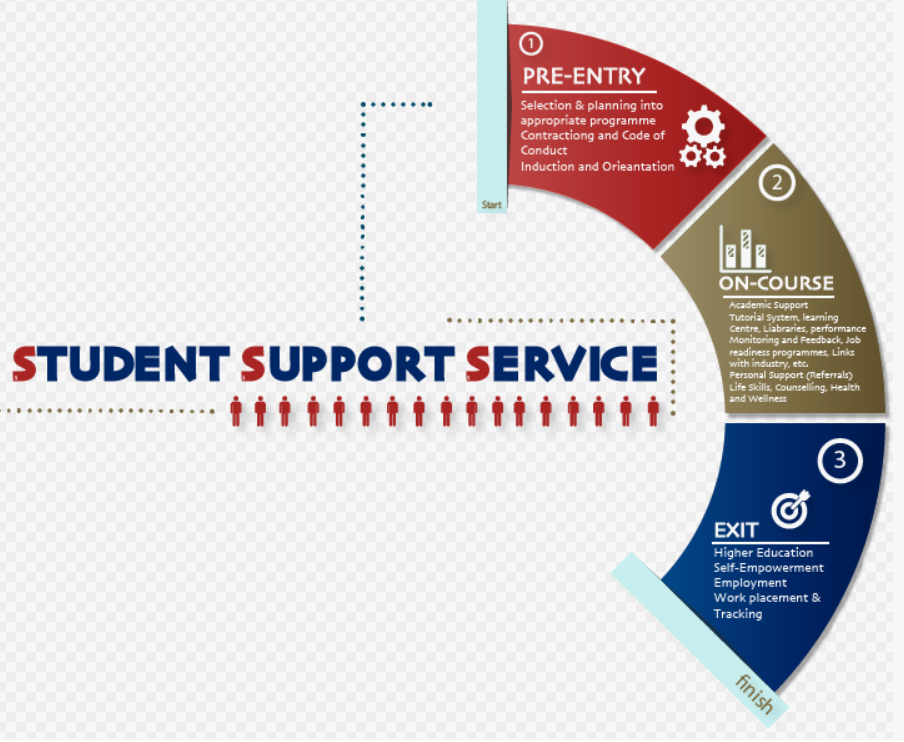

What are Student Support Services?
Student Support Services are comprehensive programs designed to assist students in various facets of their academic, personal, and professional lives. These services include:
- Counselling: Self-help for mental health and emotional well-being.
- Education: Learning assistance through workshops, study groups and individual training.
- Advisors: Expert advice on education and career planning.
- Help with career planning: Help with career choices, career opportunities and relationships.
- Financial Aid Programs and Scholarships: Help with financial aid, student loans and finding scholarships.
- Housing Services: Help in finding good housing and understanding tenants’ rights.
Role of Student Support Services
Student support services play an important role in ensuring student success and well-being. Here are the main goals:


Benefits of Student Support Services
Student support services offer numerous benefits that contribute to student success and well-being
- Academic Assistance: Providing tutoring, study skills workshops and guidance on course selection to improve academic performance.
- Financial Aid: Provides information on scholarships, grants and financial aid to help students manage their finances.
- Personal Counseling: Providing mental health support and personal development counselling to ensure emotional well-being.
- Career Development: Conduct workshops and provide resources for career planning and career placement. Access to
- Resources: Provides access to study sites, textbooks and other educational resources to support learning.
- Improving retention and graduation rates: Improving retention and graduation rates through comprehensive support services.
- Sense of Belonging: Enhancing a sense of belonging and community through support and participation in campus activities.
Deficiencies in support services
Cons of Student Support Services
Despite the numerous benefits, there are challenges associated with student support services:


1. Social Networks
The use of social media can help universities connect with students, develop a sense of community, and provide new knowledge and information. Connecting with students on social media can encourage communication and support.
2. Quick responses
Establishing official communication channels such as Discord or Telegram groups can provide quick answers to students’ questions and create a supportive community. Students can ask questions and get instant help through the forum.

3. Conversations
App Chat can provide 24/7 support, answer frequently asked questions, and direct students to the right resources. Chatbots can handle multiple questions at once and respond faster than employees, allowing students to receive timely assistance.
Conclusions
Student support services are critical to creating an effective learning environment and ensuring student success. These services help students continue their studies with confidence and support. Continuous improvement and adaptation to new technologies and student expectations will ensure that services remain effective and efficient. The quality of higher education depends on student performance. It is therefore important that universities invest in these services and continuously improve them.
Also, read
Related News

UPSC Prelims Result 2026 date, live updates, expected cut-off, and a step-by-step guide to download your scorecard,

IIT Madras Unveils ANCHOR: World’s Most Detailed 3D Human Brainstem Atlas

IMU CET Counselling 2026 registration guide for BTech, BSc & Diploma courses. Get dates

Fulbright-Nehru Academic and Professional Excellence Fellowships 2027–2028: A Prestigious Opportunity for Indian Scholars

ICMR Fellowship Abroad 2026–27: Apply for Short-Term and Long-Term Research Training
UPSC Prelims Result 2026 date, live updates, expected cut-off, and a step-by-step guide to download your scorecard,

If you sat for the Civil Services (Preliminary) Examination on 24 May 2026, you’ve probably checked upsc.gov.in more times this week than your email. That’s normal. Every June, lakhs of aspirants refresh the same page, hoping the “What’s New” section updates with one line: Civil Services (Preliminary) Examination 2026 Result.
This guide walks you through everything you actually need right now — the UPSC Prelims Result 2026 date, how the result PDF works, the exact steps to download your scorecard, what the expected cut-off looks like based on recent trends, and what to do in the days immediately after the result, whether you qualify or not.

No guesswork, no hype — just a clear, practical roadmap.
UPSC Prelims Result 2026: Current Status
As of mid-June 2026, the UPSC Civil Services (Preliminary) Examination 2026 result has not been officially declared. The exam, along with the Indian Forest Service (Preliminary) Examination 2026, was conducted on 24 May 2026 across more than 2,000 centres in 83 cities. Roughly 5.49 lakh candidates appeared out of 8.19 lakh registered — an attendance rate of about 67%, which is fairly consistent with previous years.
Based on the Commission’s typical pattern — results have historically arrived 14 to 20 days after the Prelims exam — the result window for 2026 falls somewhere between early and mid-June 2026. For context, the UPSC Prelims 2025 result was declared on 11 June 2025, almost exactly 18 days after that year’s exam.
There’s no official confirmation of an exact date, and that’s by design — UPSC never pre-announces result dates. The most reliable approach is to bookmark the official site and check the “Latest News” or “What’s New” section once or twice a day, rather than refreshing constantly.

Why UPSC Doesn’t Announce a Fixed Date
This trips up a lot of first-time aspirants, so it’s worth explaining clearly.
UPSC’s internal process for Prelims results is relatively fast because the exam is fully objective — OMR sheets are evaluated by machine, with no subjective answers to assess. That’s the good news. The less convenient part is that the Commission doesn’t publish a calendar entry for “result date” the way it does for exam dates.
Instead, the result simply appears on the website — usually in the afternoon or evening — as a roll-number-only PDF. Coaching platforms and news portals track this pattern and publish “expected date” windows, which is useful, but none of them have insider access to UPSC’s internal timeline. Treat every “expected date” article (including this one) as an educated estimate based on historical trends, not a guarantee.

Step-by-Step: How to Download the Result PDF
When the result is out, here’s exactly what to do. Keep this checklist handy so you’re not fumbling on the day.
- Go to the official website — upsc.gov.in or upsconline.nic.in. Avoid third-party links shared on WhatsApp or Telegram; stick to the official domain.
- Look for the “What’s New” or “Examinations” section on the homepage. The result link is usually titled something like “Civil Services (Prel.) Examination, 2026 — Result”.
- Click the result PDF link. It will open a PDF document — there’s no login screen, no username, no password required at this stage.
- Use Ctrl+F (or Cmd+F on Mac) to search for your roll number directly in the PDF instead of scrolling through thousands of entries.
- Download and save the PDF to your device immediately. Servers get overloaded within minutes of the announcement, so don’t rely on being able to re-access it instantly later.
- Take a screenshot of your roll number highlighted in the result as a backup record.
That’s it — there’s no “scorecard” with marks at this stage (more on that below).
Understanding the Result PDF
One of the most common points of confusion: candidates search for a “UPSC Prelims scorecard” expecting to see their marks immediately. That’s not how this stage works.
- The Prelims result PDF lists only roll numbers of candidates who have qualified for Mains — no names, no marks, no login required.
- Individual marks and cut-off details are released separately, typically a few weeks to a couple of months later, once the entire CSE cycle (including Mains and Interview) for that year progresses or concludes.
- Merit for Prelims is based only on GS Paper I. The CSAT paper (GS Paper II) is qualifying in nature — you need a minimum of 33% marks in CSAT, but those marks don’t count toward your ranking.
So if someone tells you “check your UPSC Prelims score online today,” be skeptical — actual marks come much later through a separate marks notification on the official site.

UPSC Prelims 2026 Expected Cut-Off
While nobody can predict the exact cut-off before the official notification, looking at recent trends gives you a realistic benchmark.
- UPSC Prelims 2025 cut-off (General category): 92.66 marks out of 200 (GS Paper I), up from 87.98 in 2024 — an increase of nearly 4.68 marks.
- Category-wise 2025 figures were approximately: EWS — 89.34, OBC — 92.00, SC — 84.00, ST — 82.66.
- The General–OBC gap has narrowed significantly in recent years, which several mentors interpret as a sign that competition is intensifying across categories.
What this means for 2026 aspirants: most experienced mentors suggest treating 100–110 marks as a “safe zone” for the General category, given the upward trend over the last two years. If your self-assessed score (using unofficial answer keys from coaching institutes) falls in the 85–95 range, don’t assume you’re out — borderline cases have gone either way depending on paper difficulty and normalisation.
A practical tip: cross-check your responses against at least two or three independent answer keys before drawing conclusions. A single coaching institute’s key can occasionally have errors on 1–2 questions, which can shift your estimated score by 4 marks (2 marks for correct, minus the 0.66 penalty difference for wrong answers).
Eligibility for Mains: What Happens Next
If your roll number appears in the result PDF, here’s what follows:
- You become eligible to fill the Detailed Application Form (DAF) for the Mains examination. This is a separate, more detailed form than the one you filled for Prelims — it asks for educational qualifications, work experience, optional subject choice, and more.
- The CSE Mains 2026 is scheduled to begin on 21 August 2026, spanning multiple days with nine papers covering Essay, General Studies (I–IV), and two Optional subject papers, plus qualifying language papers.
- UPSC will release a detailed Mains timetable with paper-wise dates and timings closer to the exam.
- You’ll need to upload supporting documents (caste certificate, EWS certificate, PwBD certificate, etc., as applicable) during DAF submission — so keep these scanned and ready in advance rather than scrambling later.
If you don’t qualify this time, see the section below — there’s a constructive path forward too.
Important Dates and Requirements: Quick Reference
| Event | Date / Status |
|---|---|
| CSE & IFoS Prelims Exam 2026 | 24 May 2026 |
| Candidates appeared | ~5.49 lakh (out of 8.19 lakh registered) |
| Prelims Result 2026 | Expected mid-June 2026 (not yet announced) |
| DAF for Mains | To be opened post-result |
| CSE Mains 2026 | Begins 21 August 2026 |
| Approx. vacancies (CSE 2026 cycle) | ~933 |
| Estimated candidates shortlisted for Mains | ~11,000–12,000 |
Keep your registration ID and password ready — while the result PDF itself doesn’t need login, the DAF portal will require your UPSC account credentials, and password resets can take time if you’ve forgotten them.
Common Mistakes Candidates Make Post-Result
A few patterns show up every year, and most are avoidable:
- Waiting for an SMS or email notification. UPSC does not send Prelims results via SMS or email. The only authentic source is the official website.
- Trusting unofficial “leaked result” links. Fake PDFs and phishing pages circulate heavily around result time. Stick to upsc.gov.in.
- Treating cut-off as an average. The cut-off is the score of the last qualifying candidate, not a typical or average score — don’t misjudge your standing based on misunderstanding this.
- Delaying DAF preparation. Once the DAF window opens, it’s time-bound. Candidates who scramble to gather documents at the last minute often make errors that are hard to correct later.
- Stopping preparation entirely while “waiting” for results. Whether or not you qualify, momentum matters. More on this below.
Tips for the 10 Weeks Before Mains
With Mains scheduled for 21 August 2026, qualifying candidates effectively have about ten weeks to prepare — which is tight but workable if structured well.
- Start Essay and GS answer writing immediately, even before the result, if you’ve self-assessed a safe score. Waiting for the official result before starting Mains prep is one of the biggest time-wasters.
- Revise your Optional subject syllabus in parallel with GS — don’t leave it for the final month.
- Join a structured answer-writing routine (self-discipline or a test series) — Mains is fundamentally about how well you can write under time pressure, not just what you know.
- Prioritize current affairs from the last 12 months, especially government schemes, reports, and international relations developments, which feature heavily across GS papers.
- Don’t neglect the qualifying language papers — they’re “qualifying” only, but failing them disqualifies your entire Mains attempt regardless of your GS and Optional scores.
If you don’t qualify this attempt, take a short break, then do an honest review of where marks were lost — Prelims or CSAT-side time management is a frequent culprit — and plan your next attempt’s strategy accordingly.
Key Takeaways
- The UPSC Prelims 2026 result hasn’t been officially announced as of mid-June 2026; based on historical patterns, mid-June is the realistic window.
- The result is a roll-number-only PDF — no login, no marks shown at this stage.
- Recent General category cut-offs have trended upward (87.98 in 2024 to 92.66 in 2025) — aim for 100+ to feel safe.
- Qualifying candidates move to DAF submission and Mains, which begins 21 August 2026.
- Avoid unofficial links, SMS/email scams, and last-minute document scrambles.
Conclusion
The wait between the Prelims exam and the result is genuinely one of the most stressful stretches of the entire UPSC journey — but it’s also a window you can use productively. Whether you’re confident about your score or unsure, use this time to start (or restart) Mains-oriented preparation, organize your documents, and stay anchored to the official UPSC website for any updates. The result will appear when it appears — your preparation shouldn’t pause while you wait for it.
FAQs
1. When will the UPSC Prelims Result 2026 be declared? UPSC hasn’t announced an official date. Based on past trends (results typically come 14–20 days after the exam), the result is expected around mid-June 2026.
2. How can I check the UPSC Prelims Result 2026? Visit upsc.gov.in, go to the “What’s New” section, click the Prelims result link, and search your roll number in the PDF using Ctrl+F.
3. Do I need to log in to check the UPSC Prelims result? No. The Prelims result is a public PDF listing qualified roll numbers — no username or password is needed.
4. What is the expected cut-off for UPSC Prelims 2026? Based on the 2025 General category cut-off of 92.66, many mentors suggest 100–110 marks as a reasonably safe target for 2026, though the actual cut-off depends on paper difficulty and normalisation.
5. Will UPSC send the Prelims result via SMS or email? No. UPSC does not notify candidates individually through SMS, email, or any messaging app. The website is the only official source.
6. What should I do immediately after qualifying in Prelims? Start preparing for the Detailed Application Form (DAF), gather required documents (category certificates, etc.), and begin or intensify Mains-focused preparation, especially answer writing.
7. When is the UPSC Mains Exam 2026? The CSE Mains 2026 is scheduled to begin on 21 August 2026, with the detailed timetable to be released by UPSC closer to the date.
Related News

UPSC Prelims Result 2026 date, live updates, expected cut-off, and a step-by-step guide to download your scorecard,

IIT Madras Unveils ANCHOR: World’s Most Detailed 3D Human Brainstem Atlas

IMU CET Counselling 2026 registration guide for BTech, BSc & Diploma courses. Get dates

Fulbright-Nehru Academic and Professional Excellence Fellowships 2027–2028: A Prestigious Opportunity for Indian Scholars

ICMR Fellowship Abroad 2026–27: Apply for Short-Term and Long-Term Research Training
Exam News
NEET UG 2026 Re-Examination Admit Card Released: Download Fresh Hall Ticket at neet.nta.nic.in
15 Jun, 2026
Kerala SSLC Revaluation and Scrutiny Results 2026 Released: Complete Guide for Students
12 Jun, 2026
TS Inter Supplementary Results 2026 Out Today: Check TGBIE 1st, 2nd Year IPASE Marks Memo at tgbie.cgg.gov.in
11 Jun, 2026
JoSAA Mock Seat Allotment Round 1 Result 2026 Released: Check Tentative College and Branch Allocation
8 Jun, 2026
Featured News
Pandit Deendayal Upadhyaya Telecom Excellence Awards 2024: Apply by September 30 at awards.gov.in
12 Aug, 2024
Top 20 Management Colleges in Telangana
12 Aug, 2024
Top 20 Colleges for Psychology in India
11 Aug, 2024
Top IITs Launch Future-Proof Courses : New Tech-Savvy Courses in 2024
11 Aug, 2024
Hindenburg Research: A Crucial Study for Commerce Students
10 Aug, 2024
College News
IIT Madras to Showcase Deep-Tech Innovation at Bharat Innovates 2026 in France
10 Jun, 2026
IIT Madras Hosts BRICS Neuroscience Symposium 2026 to Strengthen Global Brain Research
10 Jun, 2026
University of Hyderabad PG Admission 2026 last date extended to June 12. Check eligibility, key dates, application process
9 Jun, 2026
Central Sanskrit University to Launch First B.Tech in AI and Data Science in Sanskrit
6 Jun, 2026