

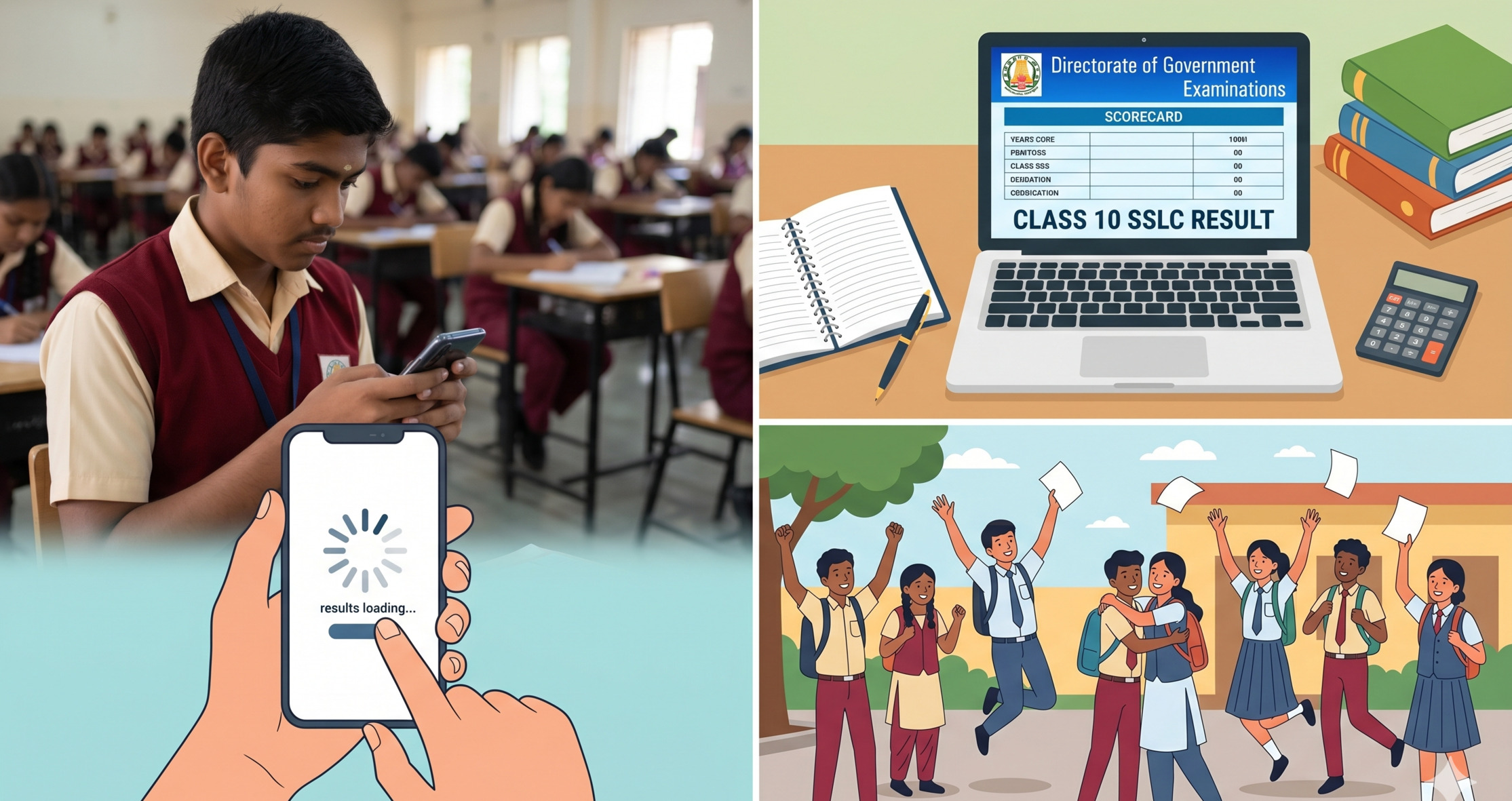
Millions of students across Tamil Nadu and India are waiting for their 2026 board results. Whether you’re a Class 10 student under Tamil Nadu’s State Board or a student appearing under CISCE (ICSE), this guide covers every critical date, step, and detail you need — all in one place.
Results season is always nerve-wracking. You’ve put in months of work, and now it all comes down to a single day when your scorecard goes live. But what happens after that? How do you download your marksheet correctly? What if the site crashes? What does the CISCE result timeline actually look like?
This comprehensive guide answers all of these questions. You’ll find official result dates, step-by-step scorecard download instructions, CISCE Class 10 eligibility requirements, and the most common mistakes students make — along with how to avoid them.
Overview
Tamil Nadu’s school board examinations are conducted by the Directorate of Government Examinations (DGE), Tamil Nadu. Two major certifications are issued every year:
- SSLC (Secondary School Leaving Certificate) — Awarded after Class 10 examinations
- HSE (Higher Secondary Examination) — Awarded after Class 12 examinations (Plus Two / +2)
The CISCE (Council for the Indian School Certificate Examinations) conducts the ICSE (Class 10) and ISC (Class 12) examinations nationally. Both the Tamil Nadu board and CISCE results typically release between April and May each year.
TN SSLC Expected Result
May 2026
TN HSE Expected Result
May 2026
CISCE Class 10 (ICSE) Result
May 2026
Official DGE Portal
dge.tn.gov.in
Important Dates & Timeline
TN SSLC 2026 Key Dates
| Event | Expected Date / Period | Status |
|---|---|---|
| SSLC Examinations Begin | March 28, 2026 | Completed |
| SSLC Examinations End | April 15, 2026 | Completed |
| Answer Sheet Evaluation | April 16 – May 5, 2026 | In Progress |
| TN SSLC Result 2026 | May 8–12, 2026 (Expected) | Awaited |
| Original Marksheets Issued | After result declaration | Awaited |
| Supplementary Exam (if any) | June 2026 | Awaited |
TN HSE (Class 12) 2026 Key Dates
| Event | Expected Date / Period | Status |
|---|---|---|
| HSE (+2) Examinations Begin | March 3, 2026 | Completed |
| HSE Examinations End | March 27, 2026 | Completed |
| TN HSE Result 2026 | May 2–6, 2026 (Expected) | Awaited |
| Re-checking / Re-totalling | Within 30 days of result | Awaited |
ℹ
Note: All dates above are based on historical patterns and official DGE announcements available as of April 2026. Always cross-check with dge.tn.gov.in for the final confirmed date before result day.
How to Download TN SSLC Result 2026 (Step-by-Step)
The DGE Tamil Nadu releases results on its official portal. On result day, the server traffic can be very high, so knowing exactly what to do saves time and reduces stress.
- Visit the official DGE website: Open your browser and go to dge.tn.gov.in or the result portal tnresults.nic.in. Both are official and work simultaneously.
- Find the SSLC Result link: On the homepage, look for the notification or banner labelled “SSLC Result 2026” or “10th Result 2026” and click on it.
- Enter your credentials: You’ll need your Register Number (printed on your Hall Ticket) and your Date of Birth in DD/MM/YYYY format.
- Submit and view result: Click the “Get Result” or “Submit” button. Your subject-wise marks and overall result will appear on screen.
- Download or take a screenshot: Use Ctrl+P (on PC) or your phone’s screenshot feature to save your result. The official digital marksheet is downloadable as a PDF from the portal.
- Check all details carefully: Verify your name, register number, date of birth, and all subject marks. Report any discrepancy to your school immediately.
Alternative Ways to Check TN SSLC Result
- SMS: Type TN10<space>RegisterNumber and send to 58888
- DigiLocker App: Link your Aadhaar and access the official marksheet digitally
- School Notice Board: Schools receive consolidated results from DGE within 24–48 hours
- Third-party result sites: Sites like results.gov.in, Jagran Josh, and India Results aggregate DGE results (use only as a reference)
How to Download TN HSE (Plus Two) Result 2026
The Tamil Nadu Higher Secondary result follows the same portal and process as the SSLC result. Here’s a quick breakdown specific to Class 12 students:
- Go to dge.tn.gov.in or tnresults.nic.in on result day.
- Click on “HSE Result 2026” or “Plus Two Result 2026.”
- Enter your Register Number and Date of Birth.
- Your result appears with marks in all six subjects, including practicals and theory scores separately.
- Save or print the scorecard. Carry your Hall Ticket for future reference when collecting the original marksheet from school.
Pro Tip: If the DGE site is slow or down due to traffic, try checking result via DigiLocker. The Government of India’s DigiLocker platform often loads faster and provides an officially verifiable digital marksheet.
CISCE Class 10 (ICSE) Result 2026: Full Timeline & Details
The Council for the Indian School Certificate Examinations (CISCE) governs two major exams — ICSE (Class 10) and ISC (Class 12). Students appearing for ICSE 2026 results should track the CISCE result portal: cisce.org.
CISCE ICSE 2026 Timeline
| Event | Expected Date | Status |
|---|---|---|
| ICSE Examinations Begin | February 18, 2026 | Completed |
| ICSE Examinations End | March 28, 2026 | Completed |
| Practical / Internal Assessment Submission | Ongoing (school-level) | Completed |
| CISCE ICSE Result 2026 | May 2026 (Expected) | Awaited |
| Re-checking Window Opens | After result declaration | Awaited |
How to Check CISCE ICSE Result 2026
- Visit cisce.org and look for the “Results” section in the top navigation.
- Click on “ICSE Results 2026.”
- Enter your UID (Unique ID) printed on your admit card and your Index Number.
- Your result will display subject-wise marks for all core and elective subjects.
- Download the result as a PDF or take a screenshot. The official marksheet is distributed via your school.
Important: CISCE does not share individual student results on WhatsApp, Telegram, or any unofficial channels. Be cautious of any message claiming to share your result before the official portal update — these are often fraudulent.
Eligibility & Important Requirements
TN SSLC 2026 Eligibility
- Must be a bonafide student of a Tamil Nadu government or affiliated private school
- Must have appeared in all compulsory subjects (Tamil/English, Second Language, Maths, Science, Social Science)
- Minimum 75% attendance required (relaxations apply for medical/sports reasons with documentation)
- Practical examinations and internal assessments must be completed and submitted to DGE
- Hall Ticket (Admit Card) must have been issued by DGE
Key Takeaways
- TN SSLC Result 2026 is expected in the second week of May 2026 on dge.tn.gov.in
- TN HSE (Plus Two) Result 2026 is expected in the first week of May 2026
- CISCE ICSE Class 10 Result 2026 is expected in May 2026 on cisce.org
- Keep your Hall Ticket ready — Register Number and UID are mandatory for checking results
- Download and save your scorecard immediately — DigiLocker is the safest long-term storage
- Always use official portals only; ignore WhatsApp-forwarded results
- Apply for re-totalling within the deadline if marks seem incorrect — don’t miss this window
- Collect the original marksheet from school within 2–4 weeks after result declaration
Conclusion
The TN SSLC, HSE, and CISCE Class 10 results 2026 are among the most important milestones for lakhs of students and their families. Whether you’re nervously waiting for the DGE portal to go live or tracking the CISCE timeline, preparation is everything.
Know your register number and UID in advance. Bookmark the official portals now. And remember — a result is just the beginning of your next chapter, not the final verdict on your potential.
For the latest result updates, bookmark this page. We’ll update dates as soon as official announcements are made by DGE Tamil Nadu and CISCE.
Click here:https://www.collegechalo.com/news-panel/cisce-class-10-result-2026/
Next article
NSUT Admission 2026 guide eligibility, JEE Main entrance details, JAC Delhi counselling dates, selection process, cutoffs & documents