

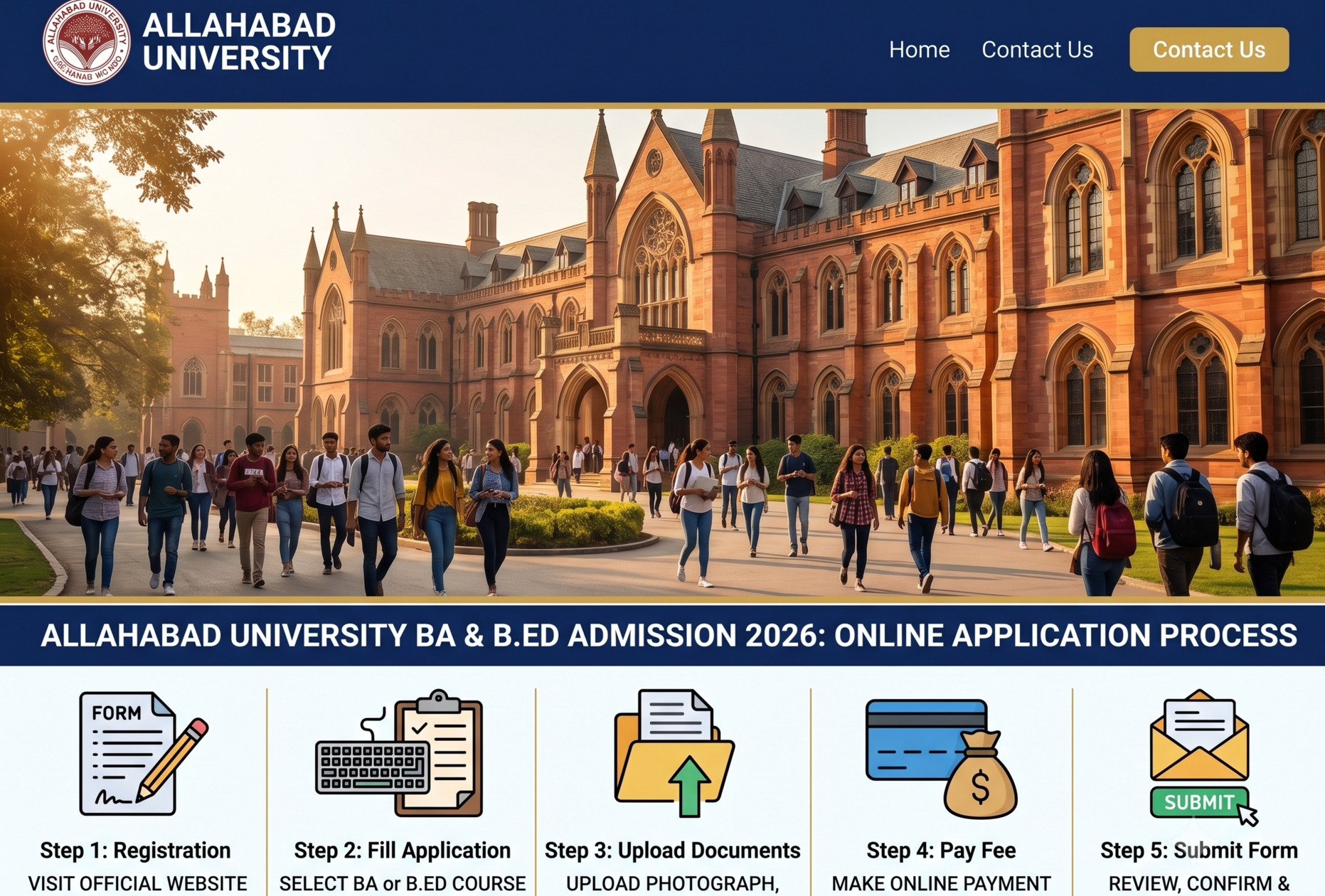
If you’re planning to study at one of India’s oldest and most respected central universities, this is your moment. The University of Allahabad has opened registrations for its BA and B.Ed programmes for the 2026-27 academic session, and the application window is closing soon.
Founded in 1887 and often called the “Oxford of the East,” Allahabad University has built a reputation for academic rigour, a strong alumni network, and government-recognised degrees. Whether you’re a Class 12 pass-out aiming for a BA seat or a graduate looking to become a teacher through B.Ed, this guide walks you through everything: eligibility, important dates, fees, the application process, common mistakes, and preparation tips to boost your admission chances.
By the end of this article, you’ll know exactly what to do, by when, and how to avoid the errors that get thousands of applications rejected every year.
Table of Contents
- Why Allahabad University Admission Matters
- BA Admission 2026: Eligibility & Process
- B.Ed Admission 2026: Eligibility & Process
- B.A. B.Ed Integrated Programme (4-Year Option)
- Important Dates 2026
- Step-by-Step Application Guide
- Documents Required
- Application Fee Structure
- Preparation Tips for CUET & PGAT
- Common Mistakes to Avoid
- Latest Updates & Trends
- Key Takeaways
- Conclusion
- FAQs
Why Allahabad University Admission Matters
Allahabad University (AU) is a Category-1 Central University recognised by UGC and holds a NAAC “A” grade. It’s also ranked among the top universities in India by NIRF and has featured in global rankings such as the Times Higher Education Interdisciplinary Science Rankings.
Here’s why this admission cycle is worth your attention:
- Government-recognised degree valued for higher studies, teaching jobs, and government exams
- Affordable fees compared to private universities, with BA fees typically between INR 5,000–10,000 per year
- Strong legacy with 15 faculties, 86+ departments, and a long list of notable alumni in academics, civil services, and politics
- CUET-based admission, meaning a single national-level exam score can open doors to multiple central universities, not just AU
For B.Ed aspirants specifically, an AU degree carries extra weight in Uttar Pradesh’s teacher recruitment exams (like UPTET and Super TET), since employers recognise the university’s academic standards.
BA Admission 2026: Eligibility & Process
Allahabad University’s BA (Hons) programmes—covering subjects like English, History, Political Science, Sociology, and Economics—are offered through the university’s Faculty of Arts.
Eligibility Criteria for BA
- Passed Class 12 (10+2) from a recognised board (CBSE, ICSE, or State Board)
- Minimum 45% to 50% marks in aggregate, depending on the specific programme and category
- A valid CUET UG 2026 score is mandatory; candidates must have selected Allahabad University as a preferred institute during CUET registration
- Reserved category candidates get standard relaxation as per government norms (SC: 15%, ST: 7.5%, OBC: 27% reservation)
How BA Selection Works
Unlike some universities that combine three subject scores, Allahabad University uses a distinct formula for merit calculation: your CUET score is based on one Language paper + your Domain Subject(s) + the General Test. If you skip any of these three sections, your merit score for most UG programmes becomes zero — so subject selection during CUET registration matters enormously.
B.Ed Admission 2026: Eligibility & Process
The Bachelor of Education (B.Ed) programme at Allahabad University trains graduates to become school teachers and is one of the most sought-after professional courses in Uttar Pradesh.
Eligibility Criteria for B.Ed
- A bachelor’s degree (BA/BSc/BCom or equivalent) from a recognised university
- Minimum 50% marks in the qualifying degree (relaxation applies for reserved categories)
- Selection is through an entrance test/merit process; many affiliated and central universities in UP now align their B.Ed intake with CUET-NCTE for standardisation
Duration and Fees
- Duration: 2 years
- Approximate annual fee: INR 30,000–50,000, depending on category and seat type
B.A. B.Ed Integrated Programme (4-Year Option)
If you’ve just finished Class 12 and know you want to become a teacher, you don’t have to wait to finish a separate bachelor’s degree first. Allahabad University also offers the B.A. B.Ed Integrated Programme, a four-year course admitted through CUET-NCTE.
Why Consider the Integrated Route?
- Saves one year compared to doing BA (3 years) + B.Ed (2 years) separately
- Combines subject knowledge with pedagogy training from day one
- Ideal for students certain about a teaching career early on
Eligibility
- Passed Class 12 with the minimum marks prescribed by NCTE and the university (usually 50%, with relaxation for reserved categories)
- Valid CUET-NCTE score with the correct subject combination
Important Dates 2026
| Event | Tentative Date |
|---|---|
| CUET UG 2026 Registration | January 3 – January 30, 2026 |
| CUET Application Correction Window | February 2 – February 4, 2026 |
| CUET UG Exam Dates | May 11 – May 31, 2026 |
| AU UG/B.Ed Application on Samarth Portal | Ongoing |
| Last date to apply (BA & B.Ed 2026) | July 15, 2026 |
| AU Counselling Registration | Expected third week of July 2026 |
| Choice Filling Closure | Expected last week of July 2026 |
Note: Dates marked as tentative may shift based on official notifications. Always cross-check the live schedule on the official website (allduniv.ac.in) or the Samarth portal before finalising your plans.
Step-by-Step Application Guide
Applying online might feel intimidating the first time, but breaking it into stages makes it manageable.
Step 1: Appear for CUET UG 2026 (or CUET-NCTE for B.Ed/Integrated route)
Register for CUET during the NTA registration window and select Allahabad University as one of your preferred institutes. Choose your language, domain subject(s), and General Test carefully — this decision can’t be easily corrected later.
Step 2: Register on the AU Samarth Portal
Visit alldunivcuet.samarth.edu.in, the university’s dedicated admission portal, and create an account using a valid email ID. You’ll verify this via OTP.
Step 3: Complete Phase 1 — Personal & Academic Details
Fill in your personal information, academic history, and category details. Upload scanned documents (more on this below).
Step 4: Wait for CUET Results, Then Complete Phase 2
Once CUET UG or CUET-NCTE results are declared, log back in to select your preferred course(s) and pay the application fee online.
Step 5: Track the Merit List
Allahabad University publishes course-wise and category-wise cut-offs based on CUET scores. If your score meets or exceeds the cut-off, you’ll be shortlisted for counselling.
Step 6: Attend Counselling and Document Verification
Log in during your assigned counselling slot, upload/verify your original documents digitally, and accept your seat.
Step 7: Pay Fees to Confirm Admission
Your seat is confirmed only after you pay the first-semester tuition fee through the portal. Missing this step, even after being shortlisted, can cost you the seat.
Documents Required
Keep scanned, clear copies (usually PDF/JPEG) of the following ready before you start your application:
- Class 10 and Class 12 mark sheets and certificates
- Bachelor’s degree mark sheet and certificate (for B.Ed applicants)
- CUET UG/CUET-NCTE admit card and scorecard
- Passport-size photograph and signature (as per portal specifications)
- Category certificate (SC/ST/OBC/EWS) in the Central Government format, with certificate number and issue date
- Aadhaar card or other government ID
- ABC ID (Academic Bank of Credits ID)
- Domicile certificate (if applicable)
- Gap year affidavit (if there’s a break in your education)
Tip: Scan all documents in advance in the correct file size and format specified in the Information Bulletin. A large number of applications get delayed simply because of oversized or wrongly formatted files.
Application Fee Structure
Fees vary slightly depending on the source and category, but as a general guide:
- UG programmes (BA): Approximately INR 150–1,000 (varies by category and the specific bulletin year)
- B.Ed programme: Fee is usually higher than UG, in line with professional course norms
- PG Admission Test (PGAT), for reference: INR 1,000 for UR/OBC/EWS and INR 500 for SC/ST/PwD
Always verify the exact fee on the official Information Bulletin before payment, since fee structures are revised periodically.
Preparation Tips for CUET & PGAT
Getting a seat isn’t just about applying on time — your CUET score decides everything. Here’s how to prepare smartly:
- Study the syllabus, not just the subject. CUET domain papers follow NCERT Class 12 syllabus closely; don’t over-prepare beyond it.
- Practice with previous years’ CUET papers to understand question patterns and time pressure (CUET is a timed, computer-based test).
- Master the General Test section. Many students focus only on domain subjects and lose easy marks in General Awareness, Reasoning, and Numerical Ability.
- Time management during the exam matters more than raw knowledge — sectional time limits mean you can’t “borrow” time from one section for another.
- For B.Ed aspirants, brush up on teaching aptitude, general knowledge, and reasoning, which typically form a chunk of entrance-style B.Ed tests.
- Mock tests every week in the final two months before the exam help build exam-day stamina and reduce anxiety.
Common Mistakes to Avoid
Even well-prepared students lose seats because of avoidable errors:
- Wrong subject combination in CUET: Selecting a domain subject not required by AU’s programme means a zero merit score for that programme.
- Missing the correction window: Once the CUET correction window closes, errors in your form can’t be fixed — recheck every field before submission.
- Ignoring the two-phase AU registration: Some students complete Phase 1 but forget to log back in for Phase 2 after CUET results, missing course selection entirely.
- Uploading unclear or oversized documents: This is one of the most common reasons for application rejection at the verification stage.
- Waiting until the last day (July 15) to apply: Server load spikes near the deadline, leading to failed payments and last-minute panic.
- Not tracking the official portal regularly: Counselling dates and merit lists are updated with short notice; checking only once a week can mean missing your slot.
Latest Updates & Trends
- Allahabad University has recently joined the CUET framework for undergraduate admissions, making its process uniform with other central universities — a single CUET score can now unlock seats here alongside institutions like Delhi University and BHU.
- The university has released its UG Information Bulletin 2026, available for download on the official website, detailing programme-wise seat matrices and eligibility.
- B.Ed and the B.A. B.Ed Integrated Programme are increasingly aligned with CUET-NCTE, reflecting a national push to standardise teacher education admissions.
- Counselling and choice-filling for 2026 admissions are expected to run through the Samarth portal into the last week of July, so candidates should not assume the process ends with the July 15 application deadline — it’s just the first milestone.
Key Takeaways
- Allahabad University’s BA and B.Ed admissions for 2026-27 are open, with the application deadline set at July 15, 2026 (tentative — verify on the official site).
- BA admission requires a valid CUET UG score; B.Ed and the integrated B.A. B.Ed programme rely on CUET-NCTE.
- Applications are submitted through the Samarth portal (alldunivcuet.samarth.edu.in) in two phases.
- Keep all documents — mark sheets, category certificates, CUET scorecard, ABC ID — scanned and ready before you begin.
- Counselling and fee payment continue into late July, so the July 15 deadline is only the starting gate, not the finish line.
Conclusion
Getting into Allahabad University for BA or B.Ed isn’t just about filling a form — it’s about understanding the CUET-driven merit system, keeping your documents ready, and tracking every stage of a process that spans several weeks. With the application deadline of July 15, 2026 approaching, the smartest move right now is to register early, double-check your subject combinations, and keep a close eye on the official portal for counselling updates.
Whether you’re chasing a BA seat in one of AU’s respected arts programmes or working toward a B.Ed to build a teaching career, this admission cycle offers a genuine, affordable pathway into a university with over a century of academic legacy behind it.
FAQs
1. What is the last date to apply for Allahabad University BA and B.Ed admission 2026? The tentative last date to submit applications is July 15, 2026. Candidates should confirm this on the official website, as dates can be extended.
2. Is CUET compulsory for Allahabad University BA admission 2026? Yes. BA admission is based on CUET UG 2026 scores, and candidates must select Allahabad University as a preferred institute during CUET registration.
3. What is the eligibility for B.Ed admission at Allahabad University? Candidates need a bachelor’s degree with a minimum of 50% marks from a recognised university, along with a valid entrance/CUET-NCTE score where applicable.
4. Can a Class 12 student directly apply for B.Ed at Allahabad University? Not for the standalone 2-year B.Ed programme, which requires a bachelor’s degree. However, Class 12 pass-outs can apply for the 4-year B.A. B.Ed Integrated Programme through CUET-NCTE.
5. What is the application fee for Allahabad University admission 2026? Fees vary by programme and category, generally ranging from INR 150 to around INR 1,000 for UG courses. Always check the current Information Bulletin for exact figures.
6. How can I apply for Allahabad University admission 2026 online? Applications are submitted through the Samarth portal (alldunivcuet.samarth.edu.in) in two phases — initial registration and document upload, followed by course selection and fee payment after CUET results.
7. Does Allahabad University offer any reservation in admissions? Yes. The university follows India’s standard reservation policy: 15% for SC, 7.5% for ST, and 27% for OBC candidates.
Next article
NSUT Admission 2026 guide eligibility, JEE Main entrance details, JAC Delhi counselling dates, selection process, cutoffs & documents