
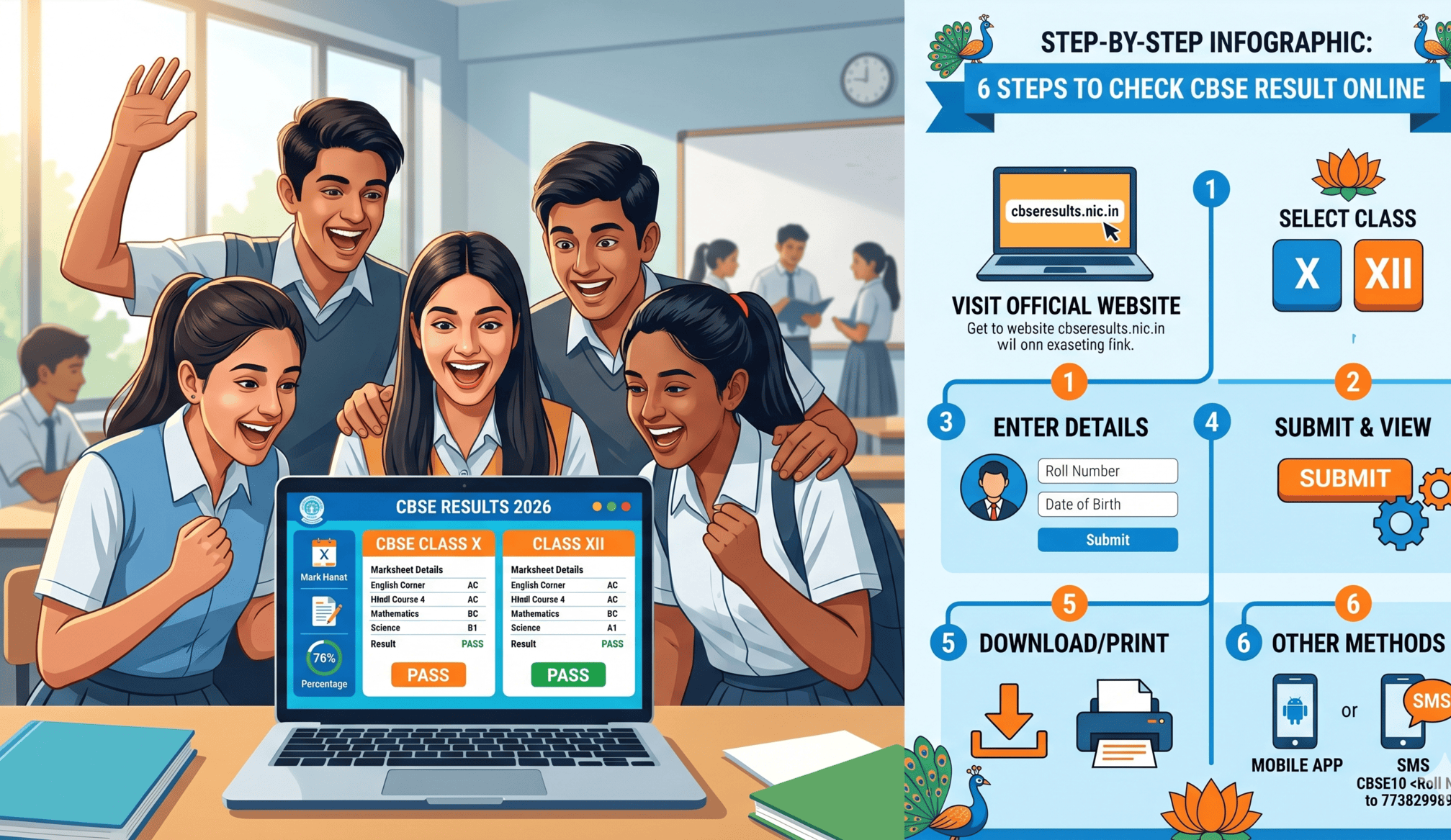
The wait is finally over. The Central Board of Secondary Education (CBSE) has declared the CBSE Class 12 Result 2026 today, May 13, 2026 — and millions of students across India are rushing to check their scorecards right now.
Whether you scored brilliantly, are anxious about a borderline result, or are trying to understand what those cryptic symbols on your marksheet mean — this guide covers everything you need to know in one place. From step-by-step instructions for checking your result to understanding pass criteria, symbols, grace marks, compartment dates, and what to do next, we’ve got you covered.
CBSE 12th Result 2026 — Quick Overview
Detail
Information
Board
Central Board of Secondary Education (CBSE)
Exam
Senior School Certificate Examination (Class XII)
Result Date
May 13, 2026
Result Time
~4:00 PM onwards
Total Students Appeared
~18.59 lakh
Overall Pass Percentage
85.20%
Official Website
results.cbse.nic.in / cbse.gov.in
Alternate Platforms
DigiLocker, UMANG App, IVRS
Highest Pass Region
Trivandrum (95.62%)
Official Websites to Check Your Result
CBSE provides multiple platforms to check results, especially given the massive server traffic during result declaration. Here are all the official links:
cbseresults.nic.in — Primary results portal
results.cbse.nic.in — Alternate results portal
cbse.gov.in — CBSE official website
digilocker.gov.in — For official digital marksheet
UMANG App — Mobile-based access
IVRS — Telephone-based result (for network issues)
Pro Tip: If the main website is down due to heavy traffic, go directly to DigiLocker or the UMANG app — they handle traffic better and give you an officially valid digital marksheet.
Step-by-Step Guide: How to Check CBSE 12th Result 2026 {#how-to-check}
Checking your result is straightforward. Keep your admit card handy before you begin — you’ll need it for your credentials.
Steps to check on cbseresults.nic.in:
Visit cbseresults.nic.in or results.cbse.nic.in
Click on “Senior School Certificate Examination (Class XII) Results 2026”
Enter your Roll Number
Enter your School Number
Enter your Admit Card ID
Enter the Security Pin (shown on screen)
Click “Submit”
Your result will appear — download and save a PDF copy
Credentials You Need:
Roll Number (on your admit card)
School Number (on your admit card)
Admit Card ID (on your admit card)
Date of Birth (may be required on some platforms)
How to Download Your Marksheet on DigiLocker
DigiLocker provides an official, government-valid digital marksheet — you can use it directly for college admissions without waiting for the physical copy.
Steps:
Go to digilocker.gov.in or open the DigiLocker app
Log in or create a free account using your Aadhaar-linked mobile number
Search for “CBSE” under Issued Documents
Click on “CBSE Class 12 Marksheet 2026”
Enter your roll number and the year (2026)
Click “Get Document”
Your marksheet will appear — download or share it directly
The digital marksheet from DigiLocker is legally equivalent to the original and is accepted by most universities and colleges for the admission process.
How to Check via UMANG App
The UMANG (Unified Mobile Application for New-age Governance) app is another reliable option when official websites are slow.
Steps:
Download the UMANG app from the Play Store or App Store
Search for “CBSE” in the services section
Select “Class 12 Result”
Enter your roll number and other required details
Submit to view your result
Understanding Symbols on Your CBSE Marksheet
This is one of the most confusing parts for students. Here’s a clear breakdown of every symbol and abbreviation you’ll see on your CBSE Class 12 marksheet:
Symbol / Abbreviation
Full Form
Meaning
P
Pass
Passed in the subject
F
Fail
Failed in the subject
A
Absent
Did not appear for the exam
UFM
Unfair Means
Used unfair means during the exam
C
Compartment
Failed in 1–2 subjects; eligible for compartment exam
E
Essential Repeat
Failed in 3+ subjects; must repeat the year
XX
Withheld
Result withheld due to pending dues or investigation
R
Result Later
Result will be announced later
SP
School Pass
Passed based on school-based assessment only
Q
Qualified
Qualified for next class
N
Not Graded
Marks not available for administrative reason
Grade Breakdown (CBSE Grading System)
Marks Range
Grade
Grade Point
91–100
A1
10.0
81–90
A2
9.0
71–80
B1
8.0
61–70
B2
7.0
51–60
C1
6.0
41–50
C2
5.0
33–40
D
4.0
21–32
E1
— (Fail)
0–20
E2
— (Fail)
Note: CBSE uses a 10-point grading scale for the final marksheet, but universities often ask for percentage equivalents during admissions. The standard CBSE formula is: Percentage = (CGPA × 9.5).
Pass Eligibility & Minimum Marks Required
To pass the CBSE Class 12 board exam 2026, students must meet the following criteria:
Minimum marks in each subject: 33% (in both theory and practical separately)
For subjects with practicals: 33% in theory portion AND 33% in practical/internal assessment portion — both are mandatory
Overall aggregate: 33% across all subjects
This criterion remains unchanged in 2026.
How Many Subjects Are Considered for the Pass Certificate?
CBSE considers 5 main subjects for passing. If a student has taken an additional sixth subject, it may replace the lowest-scoring compulsory subject — which can actually boost your percentage if you performed well in it. Ask your school about this option.
CBSE 2026 Pass Percentage & Key Statistics
Here are the major highlights of CBSE Class 12 Result 2026:
Overall Pass Percentage: 85.20%
Girls Pass Percentage: 88.86%
Boys Pass Percentage: 82.13%
Gender gap: Girls outperformed boys by 6.73%
Highest Pass Region: Trivandrum at 95.62%
Total Students Appeared: ~18.59 lakh (approx. 10.27 lakh boys, 8.31 lakh girls)
Exam Duration: February 17 to April 10, 2026
Total Exam Centres: 7,574 across India
Girls have consistently outperformed boys in CBSE Class 12 exams, and 2026 continues that trend with a notable 6.73% gap in pass percentage.
What is On-Screen Marking (OSM)?
A major change in evaluation this year was the expanded use of On-Screen Marking (OSM) — a system where answer sheets are scanned and checked digitally by examiners on computer screens rather than physically.
Benefits of OSM:
Reduces human error in marking
Faster and more efficient moderation
Better audit trail for re-evaluation
Reduces chances of answer sheet getting lost
CBSE has been gradually rolling out OSM since 2024 and significantly expanded it in 2026. While it slightly affected the result timeline during moderation, it marks a positive step toward transparent and accurate evaluation.
Re-evaluation & Verification of Marks
Not satisfied with your score? CBSE offers two options:
Option 1: Verification of Marks
CBSE checks if all questions were evaluated and marks totalled correctly
This does not involve re-checking the answers
Application is done online on the CBSE website after the result
A small fee applies per subject
Option 2: Photocopy of Answer Sheet
Students can request a photocopy of their evaluated answer sheet
After reviewing it, they can apply for re-evaluation if they find a genuine discrepancy
Re-evaluation timelines are usually announced 1–2 weeks after results
Check the official CBSE website for exact fees and deadlines once they are announced.
Important Dates After the Result
Event
Expected Timeline
CBSE 12th Result 2026
May 13, 2026 (Declared)
Original Marksheet Distribution
Via schools (within weeks)
Mark Verification Application
~2 weeks after result
Compartment Exam Registration
June 2026 (approx.)
Compartment Exam
July 2026 (approx.)
Compartment Result
August 2026 (approx.)
College Admission Season
June–September 2026
Keep checking the cbse.gov.in official website for exact notification dates.
Conclusion
The CBSE Class 12 Result 2026 is a milestone that every student and parent has been waiting anxiously for. Whether the result brought joy, relief, or disappointment — what matters most is what you do next.
If you passed, congratulations! Begin your college research early and keep your DigiLocker marksheet ready for applications. If you’re placed in compartment, remember it’s a second chance that thousands of students have used successfully to move forward. And if things didn’t go as planned, CBSE’s re-evaluation process exists for a reason — use it if you genuinely feel your paper was not assessed correctly.
Stay calm, act fast, and make your next move count.
If you’ve been eyeing one of India’s most intellectually distinctive MBA programmes, this is your moment. JNU’s ABVSME has reopened its Phase 2 registration window — and this guide covers everything you need, from eligibility and fees to GD-PI preparation and key deadlines.
Updated:May 13, 2026University:Jawaharlal Nehru University, New DelhiProgramme:Two-Year Full-Time MBA (ABVSME)NIRF Rank:#9 Overall (2025)
Phase 2 is open now. JNU MBA 2026 Phase 2 registration closes on May 15, 2026. Apply immediately at jnuee.jnu.ac.in — GD-PI rounds begin shortly after the deadline.
Why JNU MBA Stands Out in India’s B-School Landscape
Most MBA aspirants instinctively think IIMs. But here’s what many miss: the Atal Bihari Vajpayee School of Management and Entrepreneurship (ABVSME) at JNU offers a genuinely different proposition — one built around interdisciplinary thinking, public policy, sustainability, and entrepreneurship.
Founded in 2019, ABVSME is a young school in one of India’s oldest and most respected universities. Its curriculum is designed in alignment with the National Education Policy (NEP 2020), integrating case studies, incubation support, and real-world management challenges. The Atal Incubation Centre on campus gives entrepreneurially-minded students access to mentors, networks, and funding pathways that most business schools cannot match at this price point.
NIRF #9 overall-ranked central university with decades of academic credibility
Curriculum blending corporate strategy, public governance, and social entrepreneurship
Approximately 75 seats — an intimate cohort that encourages deep learning
Fee structure far more affordable than most private B-schools of comparable standing
Active Atal Incubation Centre for hands-on start-up experience
Growing recruiter base from consulting, FMCG, fintech, and the development sector
Important Dates & Admission Schedule 2026–27
The JNU MBA 2026 admission process runs in two phases. Phase 1 closed on March 31. Phase 2 is live right now — and the deadline is May 15, 2026. Do not treat this as a fallback; the selection process and merit standards are identical across both phases.
Event
Date
Status
Phase 1 registration opens
January 2026
Closed
Phase 1 last date to apply
March 31, 2026
Closed
Phase 2 registration opens
First week of April 2026
Open
Phase 2 last date to apply
May 15, 2026
Apply Now
GD / Personal Interview rounds
Shortly after May 15, 2026
Upcoming
Final merit list declaration
To be announced (official portal)
TBA
Seat confirmation deadline
To be announced
TBA
Classes commence
Second week of July 2026
July 2026
Official announcement channel only. GD-PI schedule, merit list, and seat confirmation dates will be posted exclusively on jnu.ac.in and jnuee.jnu.ac.in. No other source should be treated as authoritative. Bookmark both URLs.
Eligibility Criteria — Who Can Apply?
Before spending even a minute on the application form, verify that you meet every criterion below. Ineligible applications are rejected without a fee refund.
Academic Qualification
Bachelor’s degree from a recognized university with a minimum of 50% aggregate marks (or equivalent CGPA)
SC / ST / PwD candidates: minimum 45% aggregate marks
Students from all streams — Engineering, Commerce, Arts, Science, Law — are eligible
Final-year undergraduate students may apply provisionally; their selected status will be confirmed only if they meet the marks requirement when results are declared
Entrance Exam Requirement
Must possess a valid CAT 2025 score
No alternative exam (XAT, GMAT, CMAT, MAT, SNAP) is accepted under any circumstances
IIMs have no involvement in JNU’s selection process — only the score is used
Reservation Policy
Seats are reserved per Government of India norms — OBC (Non-Creamy Layer), SC, ST, EWS, and PwD categories. Valid category certificates must be uploaded at the time of application. Certificates issued after the registration date are not accepted.Final-year students — you can still apply. If you are awaiting your graduation results, apply provisionally now. If selected, you will be admitted on a provisional basis and must submit final marksheets at enrollment. Missing the minimum percentage at that stage cancels your admission.
Fees — Application & Programme Cost Breakdown
Application Fee — General / OBC / EWS
₹2,000
Non-refundable · Online payment only
Application Fee — SC / ST / PwD
₹1,000
Non-refundable · Online payment only
Total Programme Fee — General
₹12 L
Full two-year course · Unchanged since 2024
Total Programme Fee — SC / ST
₹6 L
Subsidized per JNU policy
Payment is accepted via net banking, credit card, debit card, or UPI. Demand drafts and offline payments are not accepted. If your payment fails and no confirmation page is generated, the amount is automatically refunded — but you will need to retry the payment.
Context check: At ₹12 lakhs for the full programme, JNU’s MBA is dramatically more affordable than most private B-schools. IIM Calcutta’s MBA, for comparison, costs upwards of ₹30 lakhs. The value-to-fee ratio at JNU — especially given the brand equity — is among the best in the country.
Step-by-Step: How to Register Online for JNU MBA 2026
The portal is jnuee.jnu.ac.in. The process is entirely online — no offline applications, no courier submissions, no in-person visits. Prepare all your documents and payment details before you begin. There is no correction facility after final submission.
Open the official portal
Visit jnuee.jnu.ac.in and click the “New Registration” link for MBA 2026 Phase 2. Read all on-screen instructions before proceeding.
Enter your personal details
Fill in your full name (exactly as on your 10th certificate), date of birth, mobile number, and email address. A system-generated Application Number will appear — save it immediately in a safe place.
Set a strong password
Create a password of 8–13 characters using uppercase, lowercase, at least one number, and one special character. Choose your security question. Do not share your credentials — JNU accepts no responsibility for misuse.
Complete the application form
Log in and fill all fields: educational qualifications (all years/semesters), category, communication address, work experience (if any), and your CAT 2025 registration number and percentile.
Upload your documents
Upload all required files (photo, signature, certificates) within the specified formats and file size limits. Blurry or oversized files are grounds for rejection during verification.
Pay the application fee
Complete payment of ₹2,000 (General/OBC/EWS) or ₹1,000 (SC/ST/PwD) via UPI, debit/credit card, or net banking. Screenshot the payment confirmation.
Download and save your application
Take a printout and save a digital PDF of the completed application. You will need it for the GD-PI round and final document verification at JNU.
Documents Required — File Format & Size Limits
Keep all scanned copies ready before opening the portal. The system does not allow mid-session saving.
Document
Format
File Size Limit
Latest passport-size photograph (coloured, white background)
JPG / JPEG
10 KB – 200 KB
Signature on plain white paper
JPG / JPEG
4 KB – 30 KB
Class 10 marksheet
JPG / JPEG / PDF
10 KB – 300 KB
Class 12 marksheet
JPG / JPEG / PDF
10 KB – 300 KB
Graduation marksheet (latest available)
JPG / JPEG / PDF
10 KB – 300 KB
CAT 2025 scorecard
JPG / JPEG / PDF
10 KB – 300 KB
Category / PwD / EWS certificate (if applicable)
JPG / JPEG / PDF
10 KB – 300 KB
Zero correction window. Once submitted, your application is locked. A blurry photo, a wrong CAT number, or a missing certificate cannot be fixed. Double-check every field and every uploaded file before hitting Submit.
Selection Process & Score Weightage
JNU’s selection is transparent and merit-based. The final composite score combines three stages — and your CAT score carries the bulk of the weight.
70%
CAT 2025 Score
Primary shortlisting criterion
10%
Group Discussion
Communication & analytical thinking
20%
Personal Interview
Personality, awareness & motivation
How the process unfolds
Stage 1 — Shortlisting via CAT: Approximately seven times the number of available seats are shortlisted based on CAT 2025 percentile
Stage 2 — GD & PI at JNU New Delhi: Shortlisted candidates attend Group Discussion and Personal Interview at the JNU campus
Stage 3 — Merit list: Final composite scores are calculated (70:10:20) and the merit list is published on the official portal
Stage 4 — Seat confirmation: Selected candidates must confirm their seat within the deadline — failure to do so results in the seat going to the next candidate on the waiting list
JNU does not publish an official fixed cutoff. These are indicative estimates based on historical shortlisting trends and should be used for planning purposes only. Actual cutoffs shift each year depending on the applicant pool size and CAT difficulty.
Category
Expected CAT 2025 Percentile
Difficulty Level
General / EWS
85 – 90 percentile
Highly competitive
OBC (Non-Creamy Layer)
75 – 82 percentile
Competitive
SC
60 – 70 percentile
Moderate
ST
50 – 60 percentile
Achievable
PwD
45 – 55 percentile
Accessible
Even if your CAT percentile is at the lower end of the range, a very strong GD-PI performance can meaningfully improve your composite score. The 30% weight given to GD and PI is significant — do not underestimate it.
GD-PI Preparation Tips — What JNU Actually Looks For
JNU’s panel assesses candidates differently from a standard corporate B-school. Given the university’s intellectual culture, expect nuanced discussions on policy, sustainability, and societal impact — not just business case studies.
For the Group Discussion
Read one quality national newspaper daily — focus on economic policy, governance, start-up ecosystem, and social impact stories
Practice structured argumentation: state a clear position → support with facts or examples → acknowledge counterpoints → conclude
Aim to contribute meaningfully 2–3 times rather than trying to dominate; panelists value depth over frequency
Avoid interrupting — it signals poor listening skills, which is a red flag in a management programme
GD topics at JNU tend to be policy-oriented: NEP 2020, startup India, climate policy, digital inequality
For the Personal Interview
Prepare a crisp 60-second “tell me about yourself” that connects your background to why JNU MBA specifically makes sense for your goals
Know your graduation subject deeply — expect pointed questions on your undergraduate discipline
Research ABVSME’s specializations, the Atal Incubation Centre, and any recent faculty research
Prepare 2–3 stories of leadership, problem-solving, or social impact — use the STAR (Situation, Task, Action, Result) format
When asked about weaknesses or failures, be honest and show what you learned — JNU panels value intellectual honesty and self-awareness
Brush up on current affairs from the last 3–6 months, especially in economics, policy, and technology
Common Mistakes That Get Applications Rejected
Uploading blurry or incorrectly sized documents — this is the single most common cause of rejection at document verification stage
Not saving or printing the completed application — you will need it for the GD-PI round as proof
Using an incorrect phone number or email — all shortlist communications arrive via these channels; a typo means you miss your GD-PI call letter
Submitting duplicate applications — JNU explicitly states that multiple applications from one candidate result in the rejection of all forms submitted
Missing the seat confirmation deadline — selection is automatically cancelled if you do not confirm within the stated window after the merit list is published
Treating Phase 2 as inferior to Phase 1 — the selection process, merit standards, and seat count are identical across both phases
Relying on unverified third-party sources for dates — always check jnu.ac.in or jnuee.jnu.ac.in directly; misinformation about deadlines is widespread on coaching forums
Key Takeaways
Phase 2 deadline: May 15, 2026 — apply at jnuee.jnu.ac.in right now
Only CAT 2025 score is accepted — no other exam qualifies
Minimum 50% in graduation (45% for SC/ST/PwD); final-year students can apply provisionally
Selection is 70% CAT + 10% GD + 20% PI — your score matters most but GD-PI can swing the result
~75 seats available; GD-PI rounds expected late May; classes begin July 2026
No correction window after submission — double-check everything before you click Submit
Conclusion
JNU’s MBA at ABVSME is not just another management degree. It is a programme built for candidates who want to think beyond quarterly earnings — one that combines policy literacy, entrepreneurial rigour, and academic depth at a fee structure that is genuinely accessible. With Phase 2 registration closing on May 15, 2026, the window is short but the opportunity is real. If you have a valid CAT 2025 score and meet the eligibility bar, there is nothing stopping you from submitting your application today. GD-PI rounds are imminent, classes begin in July, and your place in the 2026–27 cohort could be confirmed within weeks.