
IIT Madras Launches World's 1st 3D-Printed Rocket | A Game Changer for Space Exploration
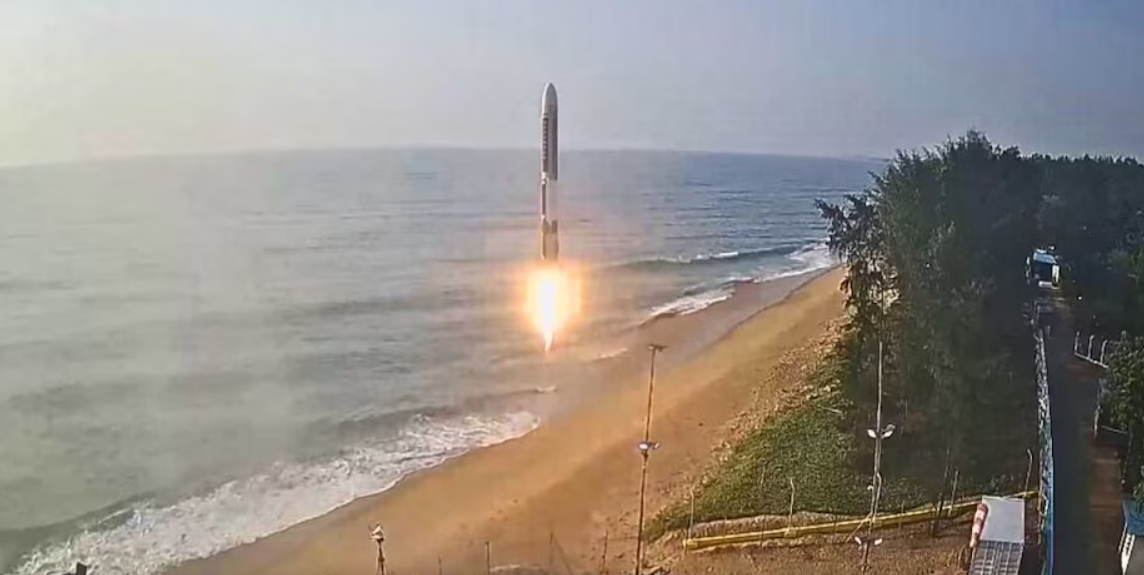
IIT Madras Makes History: World’s 1st Rocket With Fully 3D-Printed Engine
Launching “Agnibaan – SOrTeD,” the first rocket propelled by a completely 3D-printed engine, on May 31, 2024, Agnikul Cosmos, an innovative Indian company housed at IIT Madras, made history in the space industry. This ground-breaking accomplishment not only marks a turning point for the company but also attests to the creative energy and technical expertise that IIT Madras cultivates. The launch, from Sriharikota’s first-ever privately constructed launchpad, “Dhanush,” is a significant milestone for India’s developing commercial space sector. Read more, IIT Madras BS Data Science Application Registration Opens; Exam on July 7


IIT Madras: A Hub of Innovation
IIT Madras, one of India’s most prestigious engineering institutions, has long been at the forefront of research, technological advancements, and innovation. Established in 1959, the institute has consistently been ranked among the top engineering schools in India and has gained international acclaim for its rigorous academic programs and cutting-edge research.
The university is a humming community of academics, researchers, and businesspeople who all support an innovative and high-achieving culture. Startups in several industries have benefited greatly from the institute’s incubation cell. Innovative ideas may grow at IIT Madras because of its access to cutting edge facilities, professional mentoring, and financing options. One excellent illustration of this supportive atmosphere is Agnikul Cosmos, which turns academic research into real technical breakthroughs.
Agnibaan – SOrTeD: A Technological Marvel

Agnibaan – SOrTeD’s successful debut marks a major technical advance. Agnilet is the world’s first completely 3D-printed semi-cryogenic engine, powering the rocket. Agnilet is a single-piece rocket engine, which greatly reduces manufacturing costs and assembly time as compared to conventional rocket engines that are put together from many components.
Additionally reducing possible failure sites, this creative method increases rocket dependability. The engine runs on economical and effective sub-cooled liquid oxygen and kerosene as fuels. Rapid prototyping and testing made possible by Agnikul Cosmos’ 3D printing technology shortens the development cycle and gives the space sector new possibilities..
The Launch and Its Implications

With the launch from the “Dhanush” launchpad, which Agnikul also designed, India has its first privately run spaceport. This accomplishment is a big step closer to India’s space exploration being privatized and commercialized. The accomplishment of this mission places India as a major participant in the international space sector and shows the viability of 3D-printed rocket components.
Performance of the 3D-printed engine and launch system integration were two of the crucial technologies that the Agnibaan – SOrTeD mission was intended to test and confirm. The information obtained during this test flight will be very helpful for future missions as it will shed light on how 3D-printed materials behave in the harsh environment of space flight.

Future Projects and Innovations

SOrTeD, IIT Madras and the entrepreneurs it partners with are working on a number of new ground-breaking initiatives that will undoubtedly expand the frontiers of space technology::
- Micro-Satellite Launch Vehicles: Development of economical and successful small-scale launch vehicles intended for the deployment of micro-satellites is the goal of these initiatives. Application requiring these satellites include scientific study, environmental monitoring, and communication.
- Reusable Rocket Technology: One important area of emphasis is the creation of reusable rockets. Space exploration costs are greatly reduced and space operations are made more sustainable by the possibility to recover and repurpose these rockets for many flights.
- Hypersonic Propulsion Systems: Research is underway to create advanced propulsion technologies capable of achieving hypersonic speeds. These systems have the potential to revolutionize space travel, reducing the time required for interplanetary missions and expanding the possibilities of human exploration beyond Earth.
- Autonomous Spacecraft Navigation: Space exploration’s future depends critically on developments in autonomous navigation systems. Precision and safety of space missions are increased by these technologies, which let spacecraft to navigate and land on alien lands with little human involvement.
- Advanced Space Materials: An additional area of concentration is the creation of novel materials that can survive the severe conditions of space flight. Through the improvement of spacecraft component performance and durability, these cutting-edge materials will increase the dependability and effectiveness of missions.
The Role of IIT Madras in Shaping the Future of Space Exploration
A prime illustration of the influence academic institutions may have on technical innovation is the historic debut of Agnibaan – SOrTeD. Agnikul Cosmos now has the resources and support it needs, but IIT Madras has also established an excellent culture that inspires researchers and students to push the envelope of what is thought to be feasible. With so many programs targeted at assisting startups and entrepreneurial endeavors, the institution clearly is committed to promoting innovation.
One special institution that unites government, business, and academics to work on state-of-the-art research and development initiatives is the IIT Madras Research Park. Agnikul Cosmos and other firms have succeeded in large part because of this collaborative and innovative environment.This remarkable achievement underscores the potential of India’s private space sector and sets the stage for more groundbreaking advancements in the years to come.
Further Reading
For those interested in the details of the Agnibaan – SOrTeD launch and the future projects spearheaded by IIT Madras, the following sources provide comprehensive insights:
- Indian Express on Agnikul Cosmos’ Launch
- ISRO’s Official Statement
- Agnikul Cosmos’ Official Website
- IIT Madras Innovation and Entrepreneurship
Conclusion
The triumphant introduction of Agnibaan – SOrTeD by Agnikul Cosmos highlights the creative energy and technological know-how fostered at IIT Madras. This historic event encourages next generations of scientists and engineers to follow their aspirations and establishes India as a major participant in the international space sector. IIT Madras is a leader in aerospace engineering innovation and excellence with continuous initiatives targeted at furthering space technology. This amazing accomplishment is proof of what is possible when academic study is blended with innovative technology and an entrepreneurial drive.
Also, read

Related News

CTET September 2026 city intimation slip releasing soon at ctet.nic.in. Get live updates, exam pattern, passing marks

IIT Hyderabad Placements 2026: check average package, highest package (₹2.5 Cr), top recruiters, eligibility, and important dates

AP EAMCET 2026 final phase seat allotment releases Aug 26 at cap.apcfss.in. Get dates, eligibility, reporting steps,

UTEC and UNESCO IESALC Build New Microcredential Model for Future Skills

BITSAT Iteration 8 result 2026 is out at admissions.bits-pilani.ac.in. Check fee payment deadline, campus reporting date (Aug 26)
CTET September 2026 city intimation slip releasing soon at ctet.nic.in. Get live updates, exam pattern, passing marks

If you applied for the CTET September 2026 exam, there’s one document you need to keep checking your inbox and the official website for: the city intimation slip. The Central Board of Secondary Education (CBSE) is expected to release it soon at ctet.nic.in, and it’s the first real signal of where you’ll be sitting for the exam on September 6, 2026.
A lot of candidates confuse this slip with the admit card, download it late, or miss the login details entirely — small mistakes that can cause unnecessary panic right before exam day. This guide walks you through everything: when the slip is expected, how to download it once it’s live, the full CTET exam pattern, passing marks by category, eligibility rules, and the important dates you shouldn’t miss. Think of this as your one-stop reference so you’re not scrambling across ten browser tabs closer to the exam.
CTET City Intimation Slip?
The city intimation slip is a short, informational document CBSE releases before the admit card. It tells you two things:
- The city where your exam centre will be located
- The date of your exam (Paper 1, Paper 2, or both)
It does not mention the exact exam venue address, reporting time, or seat number — that information comes later, on the admit card. Think of it as an early heads-up so you’re not booking last-minute train tickets or scrambling for a hotel two days before the test.
City Slip Status
Here’s where things stand as of late August 2026:
- CBSE has not yet announced the exact release date for the city intimation slip, but multiple education portals report it is expected “soon.”
- The CTET September 2026 examination is scheduled to be conducted on September 6, 2026, in two shifts.
- Paper 1 will run from 9:30 am to 12 noon, and Paper 2 from 2:30 pm to 5 pm.
- CBSE generally releases the exam city slip around 10 days before the exam, so candidates should start checking the portal closely as September approaches.
- Once the link goes live, you’ll need your login credentials to view and download the slip from ctet.nic.in.
Keep in mind this is a “LIVE” situation — CBSE can activate the link on the portal any day without a prior public announcement, so it’s worth bookmarking the official site and checking it every couple of days once you’re within two weeks of the exam.
Why This Slip Matters (Importance)
It’s easy to dismiss the city slip as “just a formality,” but it genuinely saves you money and stress:
- Travel planning: If your allotted city is different from your hometown, you get a head start on booking trains, flights, or buses before prices spike.
- Accommodation: Early knowledge of the city means you can book a hotel or arrange a stay with relatives well in advance.
- Peace of mind: Knowing roughly where you’ll be tested removes one layer of exam-day anxiety.
- Error correction window: If there’s a factual mismatch (like a wrong name spelling carried over from your application), spotting it early on the city slip gives you time to raise it with CBSE before the admit card is finalized.
How to Download the City Intimation Slip
Once CBSE activates the link, here’s how to get your copy:
- Visit the official website — go to ctet.nic.in. Avoid third-party sites that ask for extra personal details.
- Find the city slip link on the homepage — it usually appears as “CTET September 2026 City Intimation Slip.”
- Enter your login details — this is typically your application number along with your date of birth or password, plus a security captcha.
- Submit the form — your slip will appear on screen showing your name, application number, exam city, and exam date.
- Download and save — save it as a PDF and also take a screenshot as backup. Don’t rely on just one saved copy.
- Print a hard copy — while it isn’t mandatory to carry it to the exam hall, having a printout helps if you’re using it for travel bookings or visa-style ID verification at a hotel.
City Intimation Slip vs Admit Card
Candidates often assume these two documents are the same thing. They’re not.
| Aspect | City Intimation Slip | Admit Card |
|---|---|---|
| Released | Before admit card (roughly 10 days pre-exam) | Closer to the exam date |
| Information | City and exam date only | Full venue address, reporting time, photo, signature, exam instructions |
| Valid for entry? | No | Yes, mandatory for exam hall entry |
| Purpose | Travel and stay planning | Identity verification and centre entry |
Never assume the city slip is your entry ticket — you must download the actual admit card separately when it’s released.
Exam Pattern
Understanding the exam structure helps you plan your final revision weeks better.
- The CTET paper consists of 150 multiple-choice questions carrying a total of 150 marks.
- The exam is conducted in offline, OMR-based mode.
- There are two papers:
- Paper 1 — for candidates aiming to teach Classes 1 to 5 (Primary level)
- Paper 2 — for candidates aiming to teach Classes 6 to 8 (Upper Primary level)
- Candidates who want to be eligible for both levels can appear for both papers on the same day, in two separate shifts.
- No negative marking applies, so it’s always safer to attempt every question rather than leave anything blank.
Subject-wise structure (broad view):
- Paper 1: Child Development & Pedagogy, Language I, Language II, Mathematics, Environmental Studies
- Paper 2: Child Development & Pedagogy, Language I, Language II, and either Mathematics & Science (for Maths/Science teachers) or Social Studies/Social Science (for Social Science teachers)
Each section generally carries 30 questions worth 30 marks, adding up to the total 150.
Passing Marks (Category-Wise)
Qualifying marks have stayed consistent across recent CTET cycles:
- General category: candidates need to score 90 out of 150 marks, which is 60%. This benchmark applies to both Paper 1 and Paper 2.
- OBC/SC/ST/PwD categories: candidates need 55%, or 82 marks out of 150.
- These thresholds apply equally regardless of gender — qualifying marks for female candidates are the same as for male candidates in each respective category.
- There is no seat reservation in CTET itself, but reserved category candidates are granted a 5% marks relaxation in the qualifying score.
- Clearing CTET doesn’t guarantee a teaching job — final recruitment depends on individual school or authority requirements. The certificate simply makes you eligible to apply.
A practical tip: aim to score at least 5–8 marks above the minimum cutoff as a safety buffer, since normalization or last-minute question drops (in rare disputed-question cases) can shift your effective score slightly.
Eligibility Criteria
Eligibility differs slightly depending on which paper you’re targeting.
For Paper 1 (Classes 1–5):
- Senior secondary (12th) pass with at least 50% marks, along with a 2-year Diploma in Elementary Education (D.El.Ed), OR
- Graduation with a minimum of 50% marks plus a 2-year D.El.Ed diploma
For Paper 2 (Classes 6–8):
- Graduation with a minimum 50% aggregate along with a B.Ed degree, OR
- Senior secondary with 50% marks plus a 4-year B.El.Ed / B.A-B.Ed / B.Sc-B.Ed integrated degree
General conditions:
- Minimum age to apply is 18 years, and there is no upper age limit.
- Candidates must be Indian citizens.
- There’s a 5% relaxation in qualifying marks for SC/ST/OBC/PwD candidates as per NCTE regulations.
- Candidates who wish to teach both primary and upper-primary levels must clear both Paper 1 and Paper 2.
If your qualification doesn’t perfectly match the list above (say, you have a postgraduate degree with a B.Ed-M.Ed integrated course), a minimum of 55% marks in post-graduation with a 3-year integrated B.Ed–M.Ed course from an NCTE-recognised institution also makes you eligible.
Important Dates
| Event | Date/Status |
|---|---|
| CTET September 2026 Exam | September 6, 2026 |
| Paper 1 Shift | 9:30 AM – 12:00 PM |
| Paper 2 Shift | 2:30 PM – 5:00 PM |
| City Intimation Slip | Expected soon (roughly 10 days before exam) |
| Admit Card | Expected a few days after the city slip |
Bookmark ctet.nic.in and set a recurring reminder to check it every alternate day once you’re two weeks out from the exam date.
Best Practices
- Keep your application number and password handy — store them in your phone notes so you’re not digging through old emails at the last minute.
- Register your correct mobile number and email on the CTET portal, since CBSE typically sends the city slip and admit card notifications directly there.
- Don’t wait until the last day to download documents — servers get overloaded closer to the exam when lakhs of candidates log in simultaneously.
- Cross-check your allotted city against your application form details. If there’s a mismatch, raise a grievance with CBSE through the official helpline immediately.
- Plan travel conservatively — if your city is far from home, book refundable tickets in case the final admit card shows a different reporting time than expected.
Common Mistakes
- Confusing the city slip with the admit card and assuming you’re ready for exam day once you’ve downloaded it.
- Ignoring spam or promotions folders — CBSE’s email notifications sometimes land there instead of your primary inbox.
- Using unofficial third-party websites that ask for extra personal or payment details — always use the official ctet.nic.in domain.
- Not saving a backup copy — a single browser crash or phone reset shouldn’t cost you your only saved slip.
- Panicking over “expected soon” status — CBSE doesn’t always pre-announce exact release dates, so repeatedly refreshing the page won’t speed things up. Check once or twice a day instead.
Key Takeaways
- The CTET September 2026 exam is scheduled for September 6, 2026, in two shifts.
- The city intimation slip is expected soon at ctet.nic.in and typically arrives about 10 days before the exam.
- It only confirms your city and date — not the venue address; that comes with the admit card.
- CTET has 150 questions for 150 marks, no negative marking, and two separate papers for Primary and Upper Primary teaching eligibility.
- Passing marks are 60% (90/150) for General and 55% (82/150) for OBC/SC/ST/PwD candidates.
- Eligibility depends on your academic qualification (12th + D.El.Ed for Paper 1; graduation + B.Ed for Paper 2), with a minimum age of 18 and no upper age cap.
Conclusion
The CTET city intimation slip might seem like a small administrative step, but it’s your earliest concrete signal for planning travel, accommodation, and mental preparation ahead of exam day. With the September 6, 2026 exam approaching, keep checking ctet.nic.in regularly, have your application details ready, and use the weeks before the slip’s release to revise the exam pattern and brush up on qualifying-mark expectations. Being organized about the small logistics now means one less thing to worry about when it’s time to focus purely on your performance in the exam hall.

Related News
CTET September 2026 city intimation slip releasing soon at ctet.nic.in. Get live updates, exam pattern, passing marks
IIT Hyderabad Placements 2026: check average package, highest package (₹2.5 Cr), top recruiters, eligibility, and important dates
AP EAMCET 2026 final phase seat allotment releases Aug 26 at cap.apcfss.in. Get dates, eligibility, reporting steps,
UTEC and UNESCO IESALC Build New Microcredential Model for Future Skills
BITSAT Iteration 8 result 2026 is out at admissions.bits-pilani.ac.in. Check fee payment deadline, campus reporting date (Aug 26)
Exam News
NEET UG 2026 Result Declared: 11.21 Lakh Qualify; Aryan Gupta and Panshul Bansal Score 715
17 Jul, 2026
CBSE Class 10 Second Board Result 2026 Expected Soon: Phase 2, Improvement and Supplementary Result Updates
11 Jul, 2026
WBJEE 2026 Round 1 Seat Allotment Result Today: Check Allotment Status, Fee Payment and Admission Process
7 Jul, 2026
Re-NEET UG 2026 Result Expected on or Before July 20; NTA Likely to Keep Medical Admission Schedule on Track
6 Jul, 2026
Featured News
Pandit Deendayal Upadhyaya Telecom Excellence Awards 2024: Apply by September 30 at awards.gov.in
12 Aug, 2024
Top 20 Management Colleges in Telangana
12 Aug, 2024
Top 20 Colleges for Psychology in India
11 Aug, 2024
Top IITs Launch Future-Proof Courses : New Tech-Savvy Courses in 2024
11 Aug, 2024
Hindenburg Research: A Crucial Study for Commerce Students
10 Aug, 2024
College News
Thirumurugan Sets Up Blockbuster Final as SRM Shines in TNTA Inter-College Tennis
18 Jul, 2026
SRMIST’s Sadhana Fenelon Wins Bronze in National Badminton Tournament
17 Jul, 2026
LPU Admission 2026: Fees, Dates, Courses & Eligibility, courses, and selection criteria. Everything you need before applying.
8 Jul, 2026
Gorakhpur University Dual MBA 2026: UP's First India-Malaysia MBA Programme Explained eligibility, dates, fees,
2 Jul, 2026