

IIT Mandi researchers made it once again as they have studied the potential of plants and fibres in combatting soil erosion.
The findings of this work by IIT Mandi researchers were recently published in the renowned Journal of Soil and Sediments, in a paper co-authored by Dr Kala Venkata Uday, Associate Professor, School of Civil and Environmental Engineering, IIT Mandi and Dr Arnav Bhavsar Vinayak Associate Professor, School of Computing and Electrical Engineering, IIT Mandi, and their research scholars Ms. Charu Chauhan, Mr. Manvendra Singh.
 Soil erosion
Soil erosion, a complex global environmental issue, has garnered significant worldwide attention. The FAO-led Global Soil Partnership reports an annual erosion of a staggering 75 billion tonnes of soil worldwide, resulting in an estimated financial loss of US$400 billion annually, say IIT Mandi researchers.
Also read – Stem MBA in India 2023: Top Colleges, Ranking, Benefits
This issue hits home in India, where nearly 60% of land faces soil erosion. Approximately 145 million hectares of land in the country demand immediate conservation efforts from a reported total area of 305.9 million hectares, say IIT Mandi researchers.
Capacity
Soil erosion has far-reaching consequences, including lost soil fertility, reduced water-holding capacity, lower crop yields, increased runoff, and environmental damage due to sedimentation in water bodies, say IIT Mandi researchers.
Additionally, soil erosion destabilizes the ground, making it more susceptible to landslides on steep slopes, say IIT Mandi researchers.
Plant roots
It has long been known that plant roots can effectively reduce soil erosion by enhancing soil properties, preventing detachment by raindrops, and reducing runoff.
The practice of bioengineering employs living plants and fibres to stabilize soil and mitigate erosion. Beyond saving the soil, bioengineering also promotes biodiversity by introducing native plant species.
The IIT Mandi reasearchers have devised methods to evaluate the effectiveness of bioengineering solutions in controlling erosion.
 Laboratory
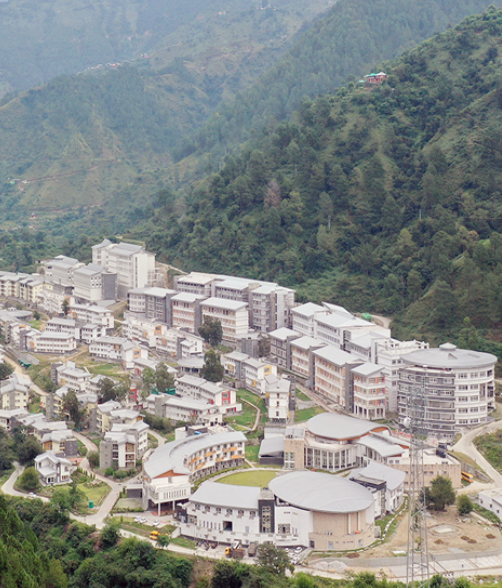
The IIT Mandi researchers have established a cost-effective laboratory setup for erosion studies under simulated rainfall conditions. This setup allows controlled testing of the effects of rainfall intensity, slope gradient, soil texture, and vegetation cover on soil erosion.
The team employs image analysis to quantify soil erosion and show the effectiveness of bioengineering methods in preventing it. Their study also provides insights into soil detachment, transport, and deposition mechanisms.
Image analysis
Dr Arnav Bhavsar Vinayak, said, “Image analysis works well for small areas like road embankments, slopes, and short natural stretches.
But for bigger areas, unmanned aerial vehicles (UAVs) and remote-sensing imaging are better Our approach which uses contour detection and filling, is better than existing techniques that are often complex and costly, he said.
The study showed that natural vegetation roots and added fibres can work together to significantly improve soil cohesion. The type of soil, moisture content, and reinforcement collectively influence erosion rates, offering insights into soil conservation strategies, say IIT Mandi researchers.
This multidisciplinary approach, combining bioengineering and image analysis, provides a promising path for addressing the challenge of soil erosion, say IIT Mandi researchers.
 Natural vegetation
The IIT Mandi researchers have shown how natural vegetation and added fibres of Indian goose grass can transform an intense erosion zone into one with practically “no erosion”.
The study shows that the choice of the right material (fibre or plants) and its amount will depend on the type of erosion (caused by splashes or runoff) and the form of erosion (sheet or rill), say IIT Mandi researchers.
Such research aims to make erosion control methods more effective and promote the use of natural materials.
Practical implications
In terms of the practical implications and future work, Dr K V Uday said, “We’ve developed a simple method to gauge the effectiveness of nature-based erosion mitigation solutions.
Our method can differentiate between splash-induced erosion and runoff-induced erosion, a capability lacking in current methodologies. Also, numerical studies help enhance specific strategies for soil erosion control in larger fields, said Dr Uday.