

Introduction
If you’ve been refreshing josaa.nic.in every hour today, you’re not alone. The Joint Seat Allocation Authority declared the JoSAA round 2 seat allotment result on June 30, 2026, on its official website at josaa.nic.in, and lakhs of JEE Main and JEE Advanced candidates are now checking whether they’ve moved closer to their dream BTech seat at an IIT, NIT, IIIT, or GFTI.
This article walks you through everything happening right now in JoSAA Counselling 2026: how to check your Round 2 result, what the reporting deadlines are, which documents you need ready, how cut-offs (opening and closing ranks) work, and the mistakes that cost candidates their seats every year. Whether you’re a first-time applicant trying to understand the process or someone already through Round 1 and deciding whether to Freeze, Float, or Slide, this guide has the practical detail you need.
Table of Contents
- JoSAA Counselling 2026: Quick Overview
- Round 2 Seat Allotment — What’s Happening Today
- Step-by-Step: How to Check Your Round 2 Result
- Reporting Process After Allotment
- Documents You Must Upload
- Understanding Opening and Closing Ranks (Cut-offs)
- Eligibility Criteria for JoSAA 2026
- Freeze, Float, or Slide — Which Should You Choose?
- Common Mistakes Candidates Make
- Tips and Best Practices
- Key Takeaways
- Conclusion
- FAQs
JoSAA Counselling 2026: Quick Overview
JoSAA is the single, centralised body that allocates BTech seats across more than 120 institutes — covering IITs, NITs, IIITs, IIEST Shibpur, and other GFTIs through JEE Main 2026 and JEE Advanced 2026 scores. Before JoSAA existed, students had to apply separately to each institute type; now everything runs through one portal and one merit-based algorithm.
This year’s timeline so far: registration and choice filling ran between June 2 and June 11, 2026, and the Round 1 seat allotment result was announced on June 13, 2026. Two mock allotment rounds were also conducted before the real process began, so candidates could test where their choice list stood. These mock rounds were run on June 8 and June 10, 2026, and were non-binding — purely a rehearsal to help you reorder your preferences before locking them
Round 2 Seat Allotment — What’s Happening Today
Today’s headline: Round 2 allotment for JoSAA 2026 is scheduled to be released on June 30, with IIT seats allocated based on JEE Advanced ranks and all other participating institutes using JEE Main ranks.
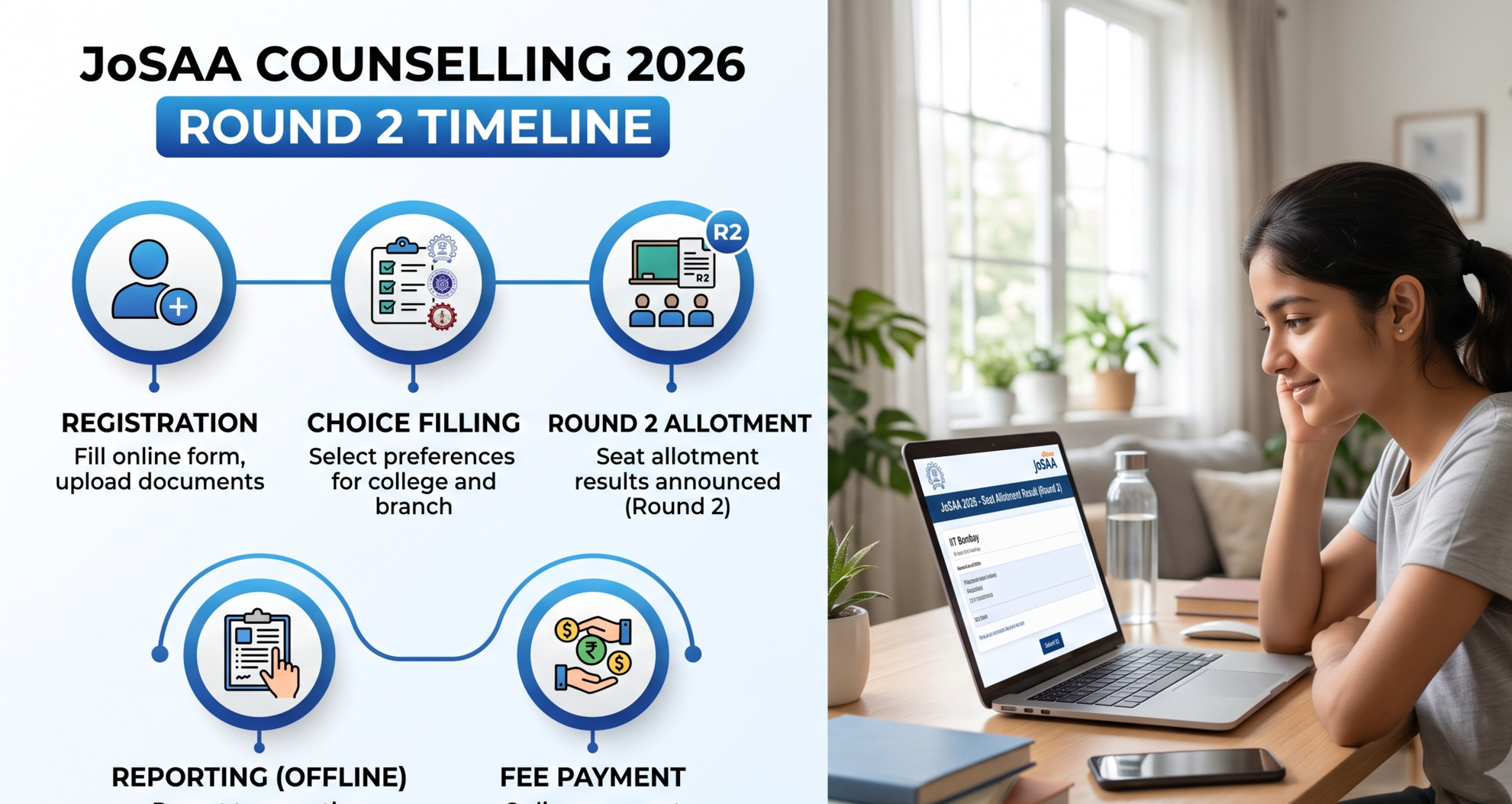
Five rounds are planned in total this season, and each one follows the same four-step rhythm: seat allotment, online confirmation by the candidate, document/reporting upload, and fee payment. There will be five counselling rounds in JoSAA 2026, and each round follows the standard four-step process of seat allotment, confirmation, online reporting, and fee payment. After Round 1, candidates who hadn’t responded to verification queries had until June 29 to clear them — the last date to respond to round 1 queries was June 29, immediately ahead of today’s Round 2 declaration.
Step-by-Step: How to Check Your Round 2 Result
You don’t need to wait for an SMS or email — JoSAA does not send individual notifications. Here’s exactly how to check:
- Visit the official website, josaa.nic.in.
- Click on the round 2 seat allotment result link available on the homepage.
- Log in using your JEE Main application number and password (plus security pin, where asked).
- View your allotted institute, branch, and category.
- If allotted a seat, download the Initial Seat Allotment Intimation Slip, which carries the details of your allotted seat.
A point worth repeating: it is the candidate’s own responsibility to log in and check whether a seat has been allocated in any given round — JoSAA does not send a separate intimation. Make checking the portal a daily habit during counselling season.
Reporting Process After Allotment
Getting allotted a seat is only half the job. You now have a tight reporting window to actually secure it.
For Round 2, candidates allotted seats can complete online reporting — seat acceptance fee payment, document upload, and replying to verification queries — between June 30 and July 3, 2026 (up to 5 pm). A few sub-deadlines sit inside this window:
- The last date to pay the seat acceptance fee is July 3 by 5 pm, with payment-related issues resolved by July 4 until 5 pm.
- Candidates wishing to withdraw can do so between July 1 (10 am) and July 3 (5 pm).
- The deadline to respond to withdrawal-related and other Round 2 verification queries is July 5, 2026, by 5 pm.
Following document verification, JoSAA issues a Provisional Seat Allotment Letter on the candidate portal, which remains provisional until all counselling fees are paid. Since this letter is required for physical reporting, save a digital copy immediately and keep a few printouts ready.
Documents You Must Upload
Document mismatches are one of the leading causes of seat cancellation, so prepare scans well in advance. Based on JoSAA’s standard requirement list, keep these ready in the prescribed format and size:
- JEE Main/Advanced admit card and scorecard
- Class 10 and Class 12 mark sheets and certificates
- Category certificate (SC/ST/OBC-NCL/EWS), where applicable
- PwD certificate, if applicable
- Provisional Seat Allotment Letter
- Passport-size photograph and signature
- Aadhaar card or other government photo ID
- Medical fitness certificate (for some institutes)
Once seats are allotted, documents must be uploaded on the JoSAA portal for verification, and if the verification officer raises a query, candidates must respond with a valid document and explanation within the deadline — failing which they’re eliminated from counselling. Treat every query notification as urgent; don’t let it sit in your inbox.
Understanding Opening and Closing Ranks (Cut-offs)
Cut-offs in JoSAA aren’t a single number — they’re a range published after every round for every course-category combination.
The opening rank is the first rank at which admission begins for a particular category, while the closing rank is the final rank up to which seats are allotted in that course. So if Computer Science at a particular NIT shows an opening rank of 500 and closing rank of 1,200 for the General category, that means the highest-ranked student admitted held rank 500, and the lowest-ranked one admitted to that seat held rank 1,200.
A practical tip: don’t just look at last year’s closing rank and assume this year will match exactly. Cut-offs shift based on the number of registered candidates, seat matrix changes, and how aggressively students fill choices. Use previous-year opening and closing ranks, available on josaa.nic.in, only to set realistic expectations — not as a guarantee.
One detail many first-time NIT aspirants miss: 50% of NIT seats are reserved for home-state candidates, so a comparatively lower rank may still secure a good branch at your home-state NIT than it would at an out-of-state institute.
Eligibility Criteria for JoSAA 2026
Before you even register, make sure you meet at least one of these conditions:
- For IIT seats: Qualify JEE Advanced 2026 and satisfy the age and academic eligibility criteria set by the IITs.
- For NIT, IIIT, and GFTI seats: Qualify JEE Main 2026 with a valid rank.
- Class 12 criteria: You can register without securing 75% in Class 12, but seat allotment will only be confirmed if you meet the required board marks or applicable top-percentile criterio
If you’re unsure whether your board percentage clears the threshold, check the JoSAA Information Brochure before relying on assumptions — eligibility checks happen at the document verification stage, not at registration.
Freeze, Float, or Slide — Which Should You Choose?
After every allotment round, you must choose one of three options, and this choice genuinely determines your fate in subsequent rounds:
- Freeze — You accept the current seat and exit the counselling process. No further upgrades possible.
- Float — You accept the current seat but remain eligible for an upgrade to a higher preference in later rounds.
- Slide — You stay within the same institute but remain open to a better branch.
A crucial rule to remember: even if you’re hoping for a better seat, always select Float — never leave the portal without accepting your allotted seat. Missing the confirmation deadline cancels your candidature outright. Many candidates lose a perfectly good seat simply by forgetting this step while deliberating too long.
Common Mistakes Candidates Make
- Treating mock rounds as final. Mock allotments are practice runs, not predictions — don’t panic or celebrate based on them.
- Submitting blurry or wrongly formatted scans. Poor-quality scans or incorrect file formats are a common cause of delay during document upload.
- Forgetting to pay the seat acceptance fee on time. Missing this single step, even after accepting a seat, voids the allotment.
- Ignoring verification queries. A query left unanswered past the deadline can eliminate you from the entire counselling process.
- Not understanding the NIT+ system Partial Admission Fee. After the final round, candidates allotted a seat in the NIT+ System must pay a Partial Admission Fee of ₹45,000 for General, General-EWS, and OBC-NCL candidates, which gets adjusted against the full admission fee later.
Tips and Best Practices
- Keep scanned documents ready in advance, in the exact format and file size JoSAA specifies — don’t scramble after allotment.
- Log in daily during the counselling window; results and queries don’t wait for you.
- Cross-check opening/closing ranks of the last 2–3 years rather than just one year, for a more stable trend.
- If you’re aiming for NITs, weigh home-state quota seats seriously — they often need a less competitive rank.
- Decide your Freeze/Float/Slide strategy before the result is even out, so you’re not making rushed decisions under deadline pressure.
Key Takeaways
- Round 2 result for JoSAA 2026 went live on June 30, with reporting open till July 3, 5 pm.
- Five counselling rounds are planned this season; any leftover seats go to CSAB counselling afterward.
- Always select Float unless you’re fully satisfied with your current allotment.
- Document accuracy and timely fee payment are the two biggest factors in securing your seat.
- Opening and closing ranks vary by category and round — track them on josaa.nic.in directly, not just secondary sources.
Conclusion
JoSAA Counselling can feel overwhelming with its rounds, deadlines, and constantly shifting cut-offs, but it’s a transparent, fully computerised process — your outcome largely depends on how carefully you track deadlines and respond to each step. With Round 2 results now out, the next few days matter most: check your allotment, complete reporting before July 3, and keep your documents in order. If your branch isn’t what you hoped for yet, remember Float keeps your options open for Rounds 3, 4, and 5 ahead.
FAQs
1. When was the JoSAA Round 2 seat allotment result released for 2026?
The result was declared on June 30, 2026, on josaa.nic.in.
2. What is the last date to pay the JoSAA Round 2 seat acceptance fee?
The seat acceptance fee must be paid by July 3, 2026, by 5 pm.
3. How many rounds does JoSAA Counselling 2026 have?
JoSAA 2026 has five rounds of seat allotment, after which leftover seats move to CSAB counselling.
4. What’s the difference between Freeze, Float, and Slide?
Freeze locks your current seat and exits counselling; Float keeps you eligible for a better institute/branch; Slide keeps you in the same institute while seeking a better branch.
5. Can I register for JoSAA without 75% in Class 12?
Yes, but final allotment confirmation depends on meeting the applicable board marks or top-percentile criterion.
6. What happens if I miss the document verification query deadline?
Your candidature for that round gets cancelled, though you may still participate in later rounds if eligible.
7. Is the JoSAA seat acceptance fee refundable?
It can be partially refundable depending on withdrawal stage and processing charges, as per JoSAA’s official rules.