
If you’re one of the four lakh-plus students who sat for the DHSE Kerala Class 11 exam this year, tomorrow is a big day. The Kerala Plus One Result 2026 is set to be declared on July 15, 2026, and the wait has been longer than usual this time around.
This guide walks you through everything you need before, during, and after result day — the official websites to check your score, the exact steps to download your marksheet, what the pass criteria actually mean, how to prepare for the possibility of a low score, and what to do next if you need revaluation or a photocopy of your answer sheet. Whether you’re a student refreshing the portal every five minutes or a parent trying to make sense of the process, this article has you covered.
Why the Result Was Delayed
Under normal circumstances, DHSE Kerala announces Plus One results in late May or early June. This year, however, the result got pushed from its original mid-June schedule. The delay is linked to the rescheduling of exams at overseas centres, particularly in Gulf regions where a large number of Kerala-syllabus students are enrolled. That rescheduling affected the overall evaluation and result-compilation timeline for all First Year candidates across the state, not just those abroad.
The takeaway here: this isn’t a technical glitch or a data error. It’s a scheduling ripple effect, and the board has confirmed July 15 as the new date.
Kerala Plus One Result 2026:
Event
Date
Plus One Exams Conducted
March 5 – March 27, 2026
Improvement Exams
Held separately (results already out, May 2026)
Original Expected Result Date
Mid-June 2026
Revised Result Date
July 15, 2026
Students Appeared
Over 4.11 lakh (regular)
Revaluation/Scrutiny Applications
Open shortly after result declaration
Keep in mind that exact timings (morning vs afternoon release) are usually confirmed by DHSE only a few hours before the result actually goes live, so it’s worth checking the official portal from mid-morning onward on result day.
3. Where to Check Your Result
Don’t rely on random WhatsApp forwards or unofficial “leak” websites — Kerala board results are notorious for attracting fake portals on result day that either crash under traffic or, worse, mislead students. Stick to these official and verified channels:
results.hse.kerala.gov.in — the primary DHSE result portal
keralaresults.nic.in — the NIC-hosted mirror site
dhsekerala.gov.in — official DHSE website
DigiLocker app/website — for a verified digital copy
SMS service — for students without stable internet access
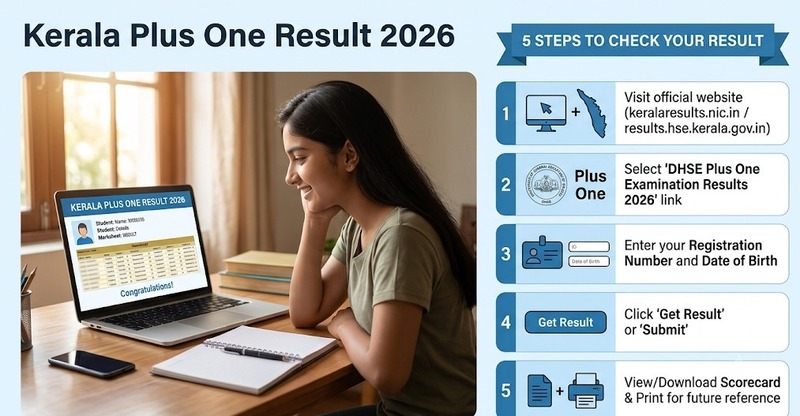
4. Step-by-Step: How to Download Your DHSE Marksheet
Here’s the simplest path to your result, whichever site you use:
Visit the official portal — results.hse.kerala.gov.in or keralaresults.nic.in.
Locate the link that says “Kerala Plus One Result 2026” or “DHSE First Year Result 2026.”
Enter your Register Number and Date of Birth exactly as printed on your admit card.
Click Submit. Your subject-wise marks and overall status will appear on screen.
Download the PDF and save it to your device immediately — don’t just take a screenshot, since a saved PDF is easier to print cleanly later.
Take a printout for your records until the school issues the original mark sheet.
Via SMS (useful if the website is down): Type KERALA11 <Registration Number> and send it to 56263. You’ll receive your result within seconds of delivery confirmation. Screenshot the message as a backup.
Via DigiLocker: Create or log in to your DigiLocker account, search for the Kerala Board of Higher Secondary document, enter your credentials, and your verified digital marksheet will populate automatically. This version is often more reliable during heavy traffic since DigiLocker syncs directly with the education department’s database.
Eligibility and Pass Criteria
This is where a lot of confusion happens every year, so let’s break it down clearly.
The Higher Secondary course in Kerala is a two-year programme. Your Plus One (First Year) marks are combined with your Plus Two (Second Year) marks for final subject clearance.
To clear a subject overall, you need a minimum of 30% (D+ grade) when both years are averaged together.
This means scoring low in an individual First Year subject does not automatically mean failure — it’s not treated as a standalone pass/fail exam the way board exams in some other states are.
Students are typically conditionally promoted to Plus Two even if they haven’t cleared every subject in the First Year, provided they clear the backlog before the final Plus Two certificate is issued.
What Your Provisional Marksheet Means
The document you download online on result day is a provisional marksheet — useful for immediate reference, admission purposes, and personal record, but not the final legal document.
The original mark sheet is issued by your school, usually within a few weeks of the result.
If you spot any error in your name, subject code, or marks on the provisional copy, report it to your school immediately — the school forwards correction requests to the board.
Colleges and universities generally accept the provisional marksheet for early admission processes, but you’ll need the original later for verification.
Preparing for Result Day: A Practical Checklist
A little preparation goes a long way in avoiding last-minute stress:
Keep your admit card handy — you’ll need your exact registration number.
Confirm your date of birth format as registered with the school (DD-MM-YYYY is standard).
Charge your phone/laptop and have stable internet or a backup mobile data plan ready.
Avoid peak-hour refreshing — try checking slightly later in the day if the site is overloaded right after the announcement.
Save your school code in case your school offers result verification through a school-wise portal.
Talk to someone — whether it’s a friend, sibling, or teacher, having someone to share the moment (good or tough) with helps, especially if the score isn’t what you expected.
If You Don’t Clear a Subject:
Because of the combined two-year evaluation system, a subject-level shortfall in Plus One isn’t the end of the road. Here’s what typically follows:
You get conditional promotion to Plus Two.
You must clear the backlog subject(s) through your Plus Two performance or supplementary opportunities offered by the board.
Schools often provide extra support or remedial classes for students who are borderline in specific subjects — it’s worth asking your subject teacher directly.
Revaluation, Scrutiny, and Photocopy:
If your score doesn’t match your expectations based on how the exam went, Kerala DHSE gives you three formal options:
Revaluation — your answer sheet is re-checked by an evaluator. If your marks increase by more than 10% after revaluation, the fee you paid is refunded.
Scrutiny — a re-verification of totals and transcription, useful if you suspect a calculation or entry error rather than an evaluation dispute.
Photocopy of Answer Sheet — request a copy of your evaluated answer script to review it yourself before deciding on revaluation.
How to apply: Applications must be submitted in the prescribed format to your school principal, along with the required fee paid through treasury channels. Principals then upload the details via the I-Exam portal — applications are not accepted directly at the Directorate office. Watch your school notice board or the DHSE portal for the exact application window, which usually opens within days of the result.
Common Mistakes Students Make on Result Day
Entering the wrong date of birth format — a frequent reason for “record not found” errors.
Relying only on unofficial websites that mirror real results but sometimes display outdated or incorrect data.
Not saving a downloaded copy and later struggling to re-access the site during high traffic.
Panicking over a single low subject score without understanding the combined-year evaluation system.
Missing the revaluation deadline because of not checking the school notice board promptly.
Latest Updates and Trends
A few things worth noting this year:
Over 4.11 lakh students appeared for the regular Plus One exam, alongside more than 3.41 lakh students who took First-Year Improvement exams — reflecting a steady rise in students opting for score improvement routes rather than accepting a lower first attempt.
The shift toward DigiLocker-verified marksheets continues to grow, reducing dependency on physical documents for early-stage admissions.
Kerala has increasingly leaned on multiple redundant portals (state site, NIC mirror, apps, SMS) specifically to reduce server crashes on result day — a lesson learned from previous years’ traffic overloads.
Key Takeaways
Kerala Plus One Result 2026 is expected on July 15, 2026, delayed from its original June schedule due to overseas exam rescheduling.
Check results only on official portals: results.hse.kerala.gov.in, keralaresults.nic.in, DigiLocker, or via SMS.
You need a minimum 30% combined score across Plus One and Plus Two to clear a subject — a single low Plus One mark isn’t a standalone failure.
The downloaded copy is provisional; get your original marksheet from school later.
Revaluation and scrutiny applications go through your school principal, not directly to DHSE.
Conclusion
Result day can feel overwhelming, especially after a longer-than-usual wait, but the process itself is straightforward once you know where to look and what the numbers actually mean. Keep your registration details ready, stick to official sources, and remember that Kerala’s two-year evaluation structure gives you room to recover even from a rough subject score. Whatever July 15 brings, there’s a clear next step waiting for you — use this guide to take it with confidence.
If you’re an MBBS or BDS graduate eyeing a PG seat at AIIMS, JIPMER, PGIMER, or NIMHANS, the INI CET November 2026 exam is probably the single biggest date on your calendar right now. This is the exam that decides who gets into some of India’s most competitive MD, MS, MDS, DM, and MCh programs — and with only a few hundred seats up for grabs against thousands of applicants, there’s no room for last-minute confusion.
In this guide, you’ll get a clear picture of the expected INI CET November 2026 timeline, registration process, eligibility criteria, exam pattern, and a preparation roadmap that actually works — based on how previous INI CET cycles have played out. Whether you’re just starting your prep or fine-tuning your final revision, this article is built to answer the questions you’re actually typing into Google.
Note: AIIMS typically releases the official notification for the November cycle only a few weeks before registration opens. Until then, the dates below are informed estimates based on the pattern of previous INI CET sessions (like November 2025 and May 2026). Always cross-check with aiimsexams.ac.in closer to the date.
Table of Contents
What Is INI CET and Why It Matters
INI CET November 2026: Expected Key Dates
Eligibility Criteria
Step-by-Step Registration Guide
Application Fee Structure
Exam Pattern and Syllabus
Preparation Tips That Actually Work
Common Mistakes to Avoid
Latest Trends and Updates
Key Takeaways
Conclusion
FAQs
What Is INI CET and Why It Matters
INI CET (Institute of National Importance Combined Entrance Test) is the single national-level entrance exam conducted by AIIMS, New Delhi, for admission to postgraduate medical and dental courses at India’s premier Institutes of National Importance. It replaced separate entrance tests that AIIMS, JIPMER, and PGIMER once ran independently, which means one exam now opens the door to all of them.
Participating institutes typically include:
All AIIMS campuses (New Delhi, Bhopal, Jodhpur, Rishikesh, Raipur, and others)
The exam runs twice a year — a November session (leading to the January admission cycle) and a May session (leading to the July cycle). This guide focuses on the November 2026 session.
INI CET November 2026: Expected Key Dates
Based on how the November 2025 and May 2026 cycles unfolded, here’s the tentative schedule for INI CET November 2026:
Event
Expected Timeline
Notification release
Late August – early September 2026
Basic registration opens
First week of September 2026
Registration closes
Late September / early October 2026 (2–3 weeks after opening)
Application correction window
Few days after registration closes
Admit card release
Late October 2026 (7–10 days before exam)
Exam date
Around 1 November 2026
Result declaration
Within a week of the exam (mid-November 2026)
Counselling begins
Late November / December 2026
A quick tip: bookmark and set calendar reminders for each stage. Missing the correction window, in particular, is a mistake that’s hard to undo once the exam is underway.
Eligibility Criteria
Before you plan your prep schedule, make sure you actually qualify. The eligibility rules for INI CET have stayed fairly consistent across recent cycles:
For MD/MS/DM/MCh courses:
A recognised MBBS degree from a university/institution approved by the National Medical Commission (NMC).
Completion of a 12-month rotatory internship by the cut-off date specified in the official notification (usually around six weeks before the exam or the start of the academic session).
Minimum qualifying marks as prescribed (this has generally been around 50% aggregate for General/OBC and relaxed for reserved categories).
For MDS courses:
A BDS degree from a recognised dental college, registered with the Dental Council of India.
Additional points:
No upper age limit for INI CET.
Indian nationals, OCI/PIO card holders, and foreign nationals (with a valid No-Objection Certificate) can apply.
Foreign nationals typically need a slightly higher qualifying percentage (around 55%) in their MBBS/BDS degree.
There’s no cap on the number of attempts — you can appear as many times as you meet the eligibility criteria.
If your internship completion date is borderline, don’t guess — check the exact cut-off date mentioned in the official INI CET November 2026 brochure once released, since this single detail disqualifies a surprising number of otherwise-strong candidates every cycle.
Registration Guide
INI CET registration is a two-stage process. Here’s how it typically works:
Step 1: Basic Registration
Visit aiimsexams.ac.in and create a One-Time Registration (OTR) account if you don’t already have one.
Fill in your basic personal, academic, and contact details.
Upload a passport-size photograph and signature in the prescribed format.
Submit for verification. Once approved, you’ll receive an Exam Unique Code (EUC).
Step 2: Final Registration
Log in with your EUC.
Select the INI CET November 2026 session under “Academic Courses.”
Fill in your academic qualification details, category, and institute preferences.
Upload additional documents (category certificate, internship proof, ID proof, etc., as applicable).
Pay the application fee online via debit card, credit card, or net banking.
Review everything carefully and submit.
Download and save the confirmation/registration slip — you’ll need it later.
Pro tip: Use the correction window (usually open for 2–3 days after registration closes) to fix errors in your category, photograph, or contact details. Exam city/centre preferences are usually locked once submitted, so choose carefully the first time.
Application Fee Structure
Fees have remained fairly stable across recent INI CET cycles. The expected fee structure for November 2026:
Category
Expected Fee
General / OBC
₹4,000
SC / ST / EWS
₹3,200
PwBD
Exempted
The fee is non-refundable once paid, so double-check your category and course selection before hitting submit.
Exam Pattern and Syllabus
Understanding the exam format is half the preparation battle.
Exam pattern at a glance:
Mode: Computer-based test (CBT)
Duration: 3 hours total
Structure: Divided into 4 sections, each with a sectional time limit of 45 minutes
Total questions: 200 MCQs (50 per section)
Marking scheme: Negative marking applies — typically ⅓ mark deducted for each wrong answer
Core subjects covered:
Anatomy, Physiology, Biochemistry
Pathology, Pharmacology, Microbiology
Forensic Medicine and Community Medicine (PSM)
All major clinical subjects: Medicine, Surgery, Obstetrics & Gynaecology, Paediatrics, Orthopaedics, ENT, Ophthalmology, Dermatology, Psychiatry, Radiology, Anaesthesia, and Community Medicine
Because the paper is sectional and time-boxed, you can’t simply “save time” from one section to spend on another — each 45-minute block is independent. That single design choice should shape how you practice.
Preparation Tips That Actually Work
Build a subject-wise timeline, not a topic-wise one
With four sectional time limits, your accuracy-per-minute in each subject cluster matters more than raw content coverage. Group your revision by how subjects are likely to appear in a section, and time yourself accordingly.
Prioritise high-yield clinical subjects
Medicine, Surgery, OBG, and Paediatrics typically carry the heaviest weightage. If your time is limited, these four deserve first claim on your study hours, followed by Community Medicine — a subject many candidates underestimate.
Practice with a strict 45-minute clock
Don’t just solve questions — solve them in the exact sectional time format. This trains your brain to triage difficult questions and move on, instead of getting stuck and losing the whole section.
Use previous years’ papers as diagnostic tools, not just practice
After each mock test, don’t just check your score. Break down errors into three buckets: conceptual gaps, silly mistakes, and time-pressure errors. Each needs a different fix.
Revise, don’t just read
In the final 6–8 weeks, shift almost entirely from textbooks to your own notes, flashcards, and question banks. Passive re-reading rarely improves recall under exam pressure.
Take care of your body, not just your syllabus
Sleep, hydration, and short breaks aren’t optional extras during a 3-month prep sprint — they directly affect your accuracy in a 3-hour exam. Many toppers credit consistent daily routines over marathon all-nighters.
Common Mistakes to Avoid
Registering at the last minute — server load spikes near the deadline, and technical glitches have derailed many applications in past cycles.
Ignoring the internship cut-off date — apply only if you meet it; a mismatch here can lead to disqualification even after clearing the exam.
Skipping the correction window — a wrong category or photograph upload can cause avoidable trouble during counselling.
Over-focusing on one or two subjects — the sectional format punishes uneven preparation across the four sections.
Not practicing full-length mocks under timed conditions — reading solved papers is not the same as attempting them cold, under the clock.
Neglecting document readiness — degree certificates, internship completion proof, and category certificates should be scanned and ready well before the final registration deadline.
Latest Trends and Updates
A few patterns worth watching for the November 2026 cycle:
Seat numbers fluctuate slightly each cycle as new AIIMS campuses stabilise their PG intake — recent cycles have offered under 1,000 combined seats across all institutes.
Counselling continues in a four-round format, including one mock round for choice-locking practice before the real allocation begins.
Digital-first registration remains the norm, with AIIMS increasingly pushing document verification and OTR-based logins to reduce duplicate applications.
Keep an eye on the official Key Dates and Notices sections of aiimsexams.ac.in — AIIMS has, in recent cycles, made minor mid-process adjustments to correction windows and admit card release timing.
Key Takeaways
INI CET November 2026 is expected to follow a familiar pattern: registration in September, exam around 1 November, results within a week, and counselling by December.
Eligibility requires a recognised MBBS/BDS degree, completed internship by the cut-off date, and minimum qualifying marks — with no upper age limit.
Registration is a two-step process: basic registration followed by final registration and fee payment.
The exam is a 3-hour, 200-question CBT split into four sectional blocks of 45 minutes each.
Sectional time limits mean your preparation strategy should be built around timed, subject-clustered practice — not just content revision.
Always verify final dates against the official AIIMS notification once released.
Conclusion
The INI CET November 2026 exam is a high-stakes, high-reward opportunity for every MBBS and BDS graduate aiming for a PG seat at India’s top medical institutes. While the exact dates will only be locked in once AIIMS releases its official notification, planning around the expected timeline now gives you a real head start — both in your application readiness and your subject preparation. Treat the next few months as your runway: get your documents in order, build a sectional-timed study plan, and revisit this guide once AIIMS confirms the official schedule.
FAQs
1. When is the INI CET November 2026 exam expected to be held? Based on previous cycles, the exam is tentatively expected around 1 November 2026, though AIIMS will confirm the exact date in its official notification.
2. When will INI CET November 2026 registration start? Registration is expected to open in the first week of September 2026 and remain open for about 2–3 weeks.
3. What is the eligibility criteria for INI CET November 2026? Candidates need a recognised MBBS degree (or BDS for MDS courses) with minimum qualifying marks and a completed 12-month internship by the specified cut-off date. There’s no upper age limit.
4. How many attempts are allowed for INI CET? There is no cap on attempts — candidates can appear as many times as they continue to meet the eligibility criteria.
5. What is the INI CET November 2026 application fee? The expected fee is around ₹4,000 for General/OBC candidates and ₹3,200 for SC/ST/EWS candidates, with PwBD candidates exempted, though this should be confirmed against the official notification.
6. What is the exam pattern for INI CET? It’s a 3-hour computer-based test with 200 MCQs divided into four sections of 50 questions each, with a 45-minute time limit per section and negative marking of ⅓ mark per wrong answer.
7. Which institutes accept INI CET scores? AIIMS campuses across India, JIPMER Puducherry, PGIMER Chandigarh, NIMHANS Bengaluru, and SCTIMST Thiruvananthapuram.