

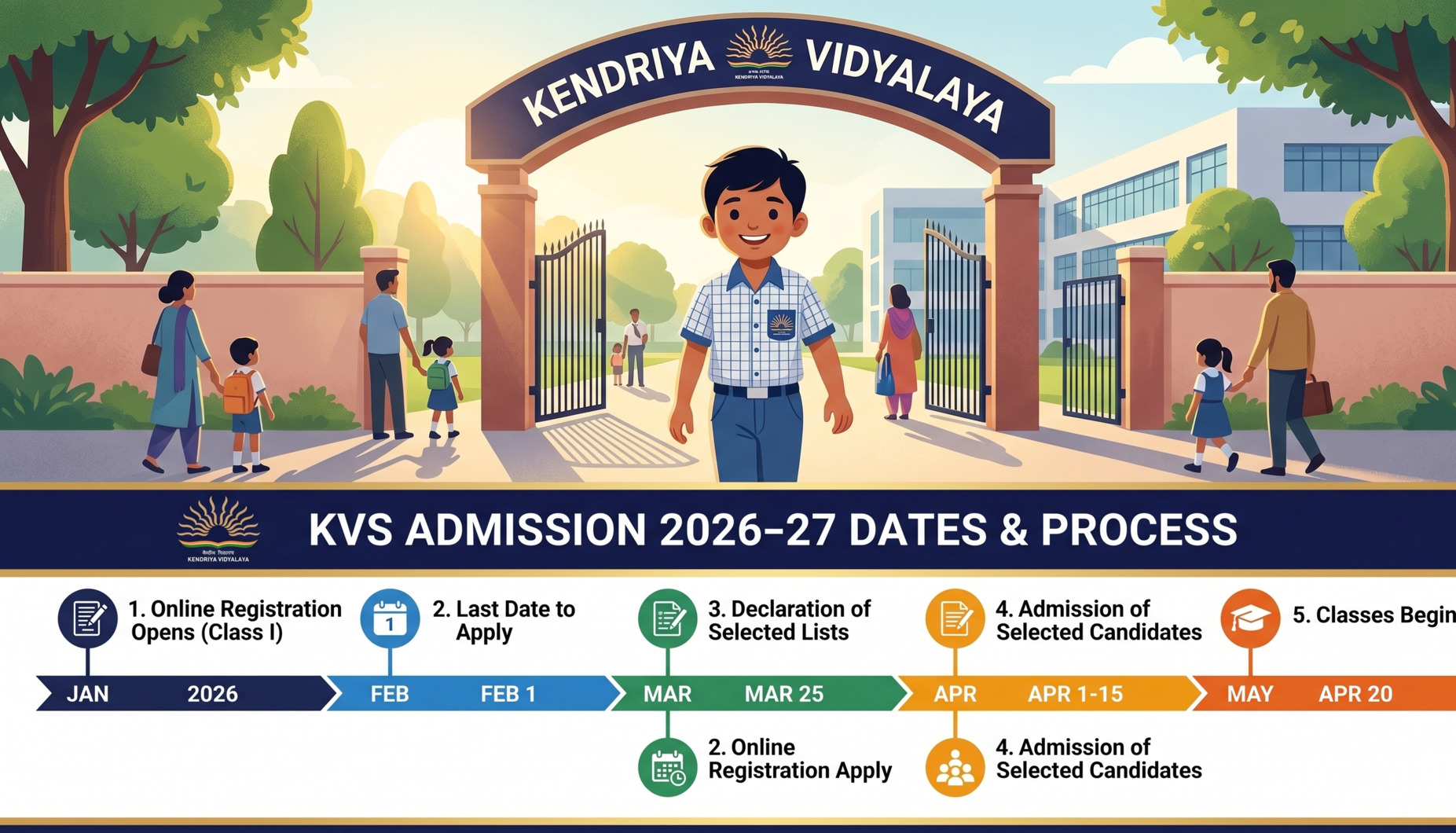
The KVS 2nd Provisional Selection List for Class 1 and Balvatika was officially released on April 16, 2026. The 3rd and final list (if seats remain) is expected on April 21, 2026. Act fast — document verification must be completed immediately.
If you applied for Kendriya Vidyalaya admission this year and your child’s name wasn’t on the first list, here’s what you need to know right now. The KVS second provisional list is out, seats are limited, and the clock is ticking on document verification.
Every year, lakhs of parents compete for a seat in one of India’s most respected government school networks. Kendriya Vidyalaya Sangathan (KVS) schools are known for their CBSE curriculum, affordable fees, and consistency — making admission one of the most sought-after processes in the country. This guide walks you through the second admission list details, eligibility rules, priority categories, required documents, and the exact steps to secure your child’s seat before it’s too late.
What Is the KVS Second Provisional List?
After the first provisional selection list is released, a number of seats remain vacant — either because selected candidates didn’t complete document verification on time, or because there were more applicants than available seats in certain categories. The second provisional list fills these gaps.
The KVS 2nd provisional merit list includes students selected for Class 1 admission for the 2026-27 session against vacant seats after the first round. Those who did not make it in the first list had a chance to be selected in this round.
The list is released in PDF format and published region-wise and school-wise across the official KVS portal.
1st List Released
April 9, 2026
2nd List Released
April 16, 2026
3rd List (if needed)
April 21, 2026
Official Portal
kvsangathan.nic.in
Important Dates for KVS Admission 2026-27
Missing a single deadline can cost your child their seat. Bookmark these dates and set reminders immediately.
| Event | Date | Status |
|---|---|---|
| Online registration opens (Class 1 & Balvatika) | March 20, 2026 | Done |
| Last date for Class 1 registration | April 2, 2026 | Done |
| Registration for Class 2 and above (offline) | April 2–8, 2026 | Done |
| 1st Provisional List — Balvatika & Class 1 | April 8–9, 2026 | Released |
| 2nd Provisional List — Balvatika & Class 1 | April 16, 2026 | Act Now |
| 3rd Provisional List — Class 1 (if seats vacant) | April 21, 2026 | Upcoming |
| Class 11 admissions (KV students) | 20 days after CBSE Class 10 result | May/June 2026 |
| Class 11 admissions (non-KV students) | After KV students are admitted | TBA |
Eligibility Criteria: Who Can Get KVS Admission?
One of the most common misconceptions is that KVS admission is only for government employees’ children. That’s simply not true.
KVS admissions are open to all children — not just children of Central Government employees. Children from any background can seek admission; they simply fall under the lowest priority category.
General Eligibility Rules
- The child must be an Indian national (children of foreign nationals residing in India are also eligible)
- Age limits must be met as on March 31 of the admission year — not the application date
- Children born on April 1st are also considered eligible
- The maximum age limit can be relaxed by two years in the case of differently-abled children by the Principal of the concerned school
- No entrance exam is required for Classes 1 to 8
- Class 9 requires passing an entrance test with a minimum of 33% aggregate marks
- Class 11 admission is based on Class 10 CBSE board marks — no exam required
Age Limit for Each Class
| Class | Minimum Age | Maximum Age |
|---|---|---|
| Class 1 | 6 years | 8 years |
| Class 2 | 7 years | 9 years |
| Class 3 | 8 years | 10 years |
| Class 4 | 9 years | 11 years |
| Class 5 | 10 years | 12 years |
| Class 6 | 11 years | 13 years |
| Class 7 | 12 years | 14 years |
| Class 8 | 13 years | 15 years |
| Class 9 | 14 years | 16 years |
| Class 10 | 15 years | 17 years |
| Class 11 | No fixed limit — must be passing Class 10 that year | |
| Class 12 | No limit — no break in study after Class 11 | |
Reservation Breakdown
15% of seats are allocated for Scheduled Caste, 7.5% for Scheduled Tribes, and 27% for Other Backward Classes (OBC-NCL) in all new admissions across all Kendriya Vidyalayas. Additionally, 3% of total seats are reserved horizontally for Children with Special Needs (CwSN).
Under the Right to Education (RTE) Act, 25% of Class 1 seats are reserved for economically weaker sections, and children admitted under this quota pay no tuition fee up to Class 8.
How to Check the KVS Second Provisional List
The list is available online in PDF format, published school-wise and region-wise. Here’s exactly how to find it:
Visit the official KVS website: kvsangathan.nic.in
Look for the “Class 1 Admission 2026-27” link on the homepage or under the Admissions section.
Click on “Second Provisional List” or “Lottery Result 2026-27.”
Select your region, state, and specific Kendriya Vidyalaya from the dropdown.
A PDF will open. Search for your child’s name using Ctrl+F (Cmd+F on Mac).
Download and print the PDF for your records. Bring it to the school during document verification.
You can also log into your parent dashboard on admission.kvs.gov.in to check the status directly against your application number.
Documents Required for KVS Admission
Document verification is not a formality — missing or incorrect documents can result in seat cancellation. Prepare these in advance.
Mandatory Documents (All Categories)
- Birth Certificate — Issued by Municipal Corporation, Panchayat, or hospital; must show date of birth
- Address Proof — Aadhaar card, electricity bill, or rent agreement
- Passport-size photographs — Recent, clear photos of the child
- Completed Application Form — Printout from the portal with Application Submission Code
Category-Specific Documents
- SC/ST/OBC Certificate — Issued by competent authority (for reserved category applicants)
- EWS/BPL Certificate — Income certificate from competent authority (for RTE applicants)
- Service Certificate — Signed by Head of Office showing employee status and number of transfers in the last 7 years (Priority 1–4 mandatory)
- CwSN Certificate — Medical certificate from government hospital for children with special needs
- Distance Declaration Form — Required under RTE quota, stating distance from home to school
- Relationship Proof — If grandparents are the guardians, proof of relationship with child’s parents
Critical Warning The service certificate (showing transfer count) is the most commonly missing document. Getting it signed and stamped by your Head of Office can take several days. Do not leave this for last — start collecting it the moment your child’s name appears on any list.
What to Do If Your Child’s Name Appears on the Second List
Speed is everything here. If your child’s name is on the provisional list, you must complete the admissions process and document verification within the allocated period. If this isn’t done, the seat will be automatically forfeited.
Verify the details in the PDF list carefully — check name spelling, date of birth, and category against what you submitted.
Download and print the second provisional list PDF for the allotted school.
Gather all original documents and their photocopies immediately (see document list above).
Visit the allotted KV school in person for document verification within the given deadline.
Pay the admission fee (if applicable) as per the school’s payment instructions, online or offline.
What If Your Child’s Name Is NOT on the Second List?
Candidates who do not find their names in the second list may not be discouraged, as there is one more chance. KVS is expected to publish the third and final provisional list on April 21, 2026, subject to seat availability. Seats often become available if selected candidates fail to complete document verification or choose not to take admission.
Common Mistakes Parents Make — And How to Avoid Them
- Assuming only Govt. employees can apply — Anyone can apply; category just determines seat priority.
- Calculating age incorrectly — Always calculate as on March 31, not the application date or today’s date.
- Missing the document verification window — Even one day late can result in the seat being given to the next candidate.
- Applying to only one KV — You can register at multiple KVs to maximize chances (check KVS guidelines for limits).
- Not having the service certificate ready — This needs to be signed by your Head of Office; request it well in advance.
- Relying on social media for dates — Always check the official portal at kvsangathan.nic.in for verified information.
- Ignoring the waitlist — Being on the waitlist is not a rejection. If selected candidates don’t claim their seat, waitlisted students move up.
Key Takeaways
- The KVS 2nd Provisional List for Class 1 and Balvatika was released on April 16, 2026
- A 3rd and final list is expected on April 21, 2026 if seats remain vacant
- Document verification must be completed immediately after the list is published — delays forfeit the seat
- KVS admission is open to all children; priority categories determine order, not eligibility
- Class 1 age eligibility: 6 to 8 years as on March 31, 2026. April 1 birthdays also count.
- SC: 15%, ST: 7.5%, OBC-NCL: 27%, CwSN: 3% reservation in all fresh admissions
- The service certificate (transfer count, signed by Head of Office) is the most commonly missing document
- No entrance exam for Classes 1–8; Class 9 requires an entrance test; Class 11 is marks-based
- Always use kvsangathan.nic.in or admission.kvs.gov.in as your primary information source
Conclusion
Securing a seat in a Kendriya Vidyalaya is genuinely competitive, but the process is transparent and well-structured once you understand it. The KVS second provisional list for 2026-27 is now out, and if your child’s name appears, your immediate priority is document verification — no delays, no exceptions.
If you’re still waiting, the third list on April 21 represents one final opportunity in this admission cycle. Stay glued to the official portal, keep your documents ready, and act the moment results are published. For those applying for Class 9, prepare for the entrance test. For Class 11, focus on your CBSE Class 10 result — that score is everything.
The KV system was built to serve Indian families, especially those who move frequently. If you’re eligible, the effort is absolutely worth it.