

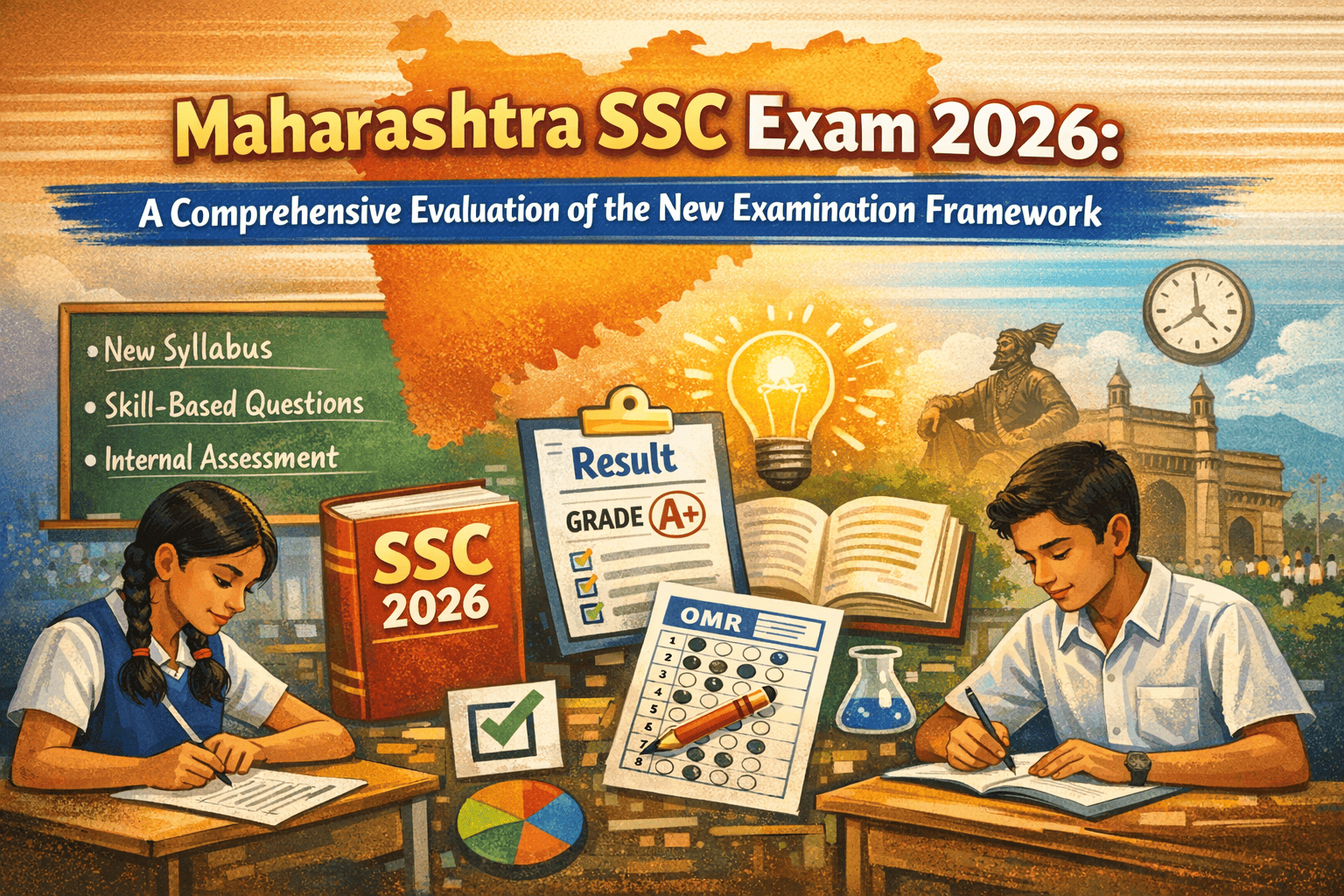
The Maharashtra SSC – (SSC) Examination 2026 , conducted by the Maharashtra State Board of Secondary and Higher Secondary Education – (MSBSHSE) , represents a major leap in the evolution of India’s massive academic assessment system. This year, with around 1.6 million students taking the examinations, the board has made several key changes in the system with the aim of promoting greater transparency, reducing pressure on students and ensuring greater academic integrity.
This year’s examination cycle reflects a shift from rote memorization toward a more conceptual and student – centric learning approach, aligning with modern educational standards and the broader vision of the National Education Policy – (NEP) 2020.
Early Planning and Structured Timeline
One of the most notable changes in the 2026 SSC framework was the early release of the examination schedule in advance in October 2025 . This has helped students, schools, and parents to plan effectively, reducing last – minute stress and improving preparation strategies.
The theory examinations were held from February 20th to March 18th, 2026, while practical exams and internal assessments took place between February 2 and February 18, 2026 . This structured timeline ensured adequate preparation time, especially for core subjects such as Mathematics and Science, which were scheduled later in the exam cycle.
Examination Pattern and Shift System
The board continued its two – shift examination system:
- Morning Shift : 11:00 AM to 2:00 PM (core subjects)
- Evening Shift : 3:00 PM to 6:00 PM (languages and electives)
This system optimized infrastructure usage and accommodated the wide range of subjects offered under the SSC curriculum . The strategic scheduling of challenging subjects toward the end allowed students more time for revision.
Syllabus Rationalization and Student-Centric Approach
A key highlight of the 2026 SSC exams was the 25% syllabus reduction, aimed at minimizing academic burden and enhancing conceptual clarity.
Instead of merely removing content, the board focused on :
- Eliminating redundant topics
- Simplifying complex concepts
- Aligning content with real – world applications
For instance :
- Mathematics saw reduced complexity in algebra and geometry derivations
- Science focused more on fundamental principles rather than advanced theories
- Social Science eliminated repetitive case studies and overly detailed sections
This shift represents a move toward application – based learning, rather than memorization.
Assessment Structure : 80:20 Evaluation Model
The SSC 2026 followed an 80:20 assessment structure :
- 80 Marks : Theory Examination
- 20 Marks : Internal Assessment
Internal assessments included :
- Periodic tests
- Project work
- Practical activities
- Portfolio submissions
This model ensures that a student’s overall performance is evaluated beyond just written exams, promoting continuous learning and skill development.
Passing Criteria and “Best of 5” Rule
To reduce academic pressure, MSBSHSE continues to implement the “Best of 5” rule, where the highest-scoring five subjects are considered for final percentage calculation.
Passing Requirements :
- Minimum 35% marks per subject
- Combined passing provision for Mathematics and Science
- Minimum 52 marks out of 150 for STEM subjects
This flexible approach benefits students who may struggle in specific subjects while excelling in others.
Encouraging Holistic Development
The board has also integrated extracurricular achievements into academic evaluation. Students participating in :
- State or national – level sports
- Republic Day parade
can receive up to 20 grace marks. This initiative encourages overall personality development beyond academics.
Strengthened Security: “Copy-Free” Campaign
To ensure fair examinations, the 2026 SSC exams were conducted under a strict “Copy – Free Examination” campaign.
Key Measures :
- Mandatory CCTV surveillance in all exam centers
- Derecognition of 100+ centers with past malpractice records
- Deployment of drone monitoring in sensitive areas
- Enforcement of Section 144 around exam centers
These measures significantly improved the credibility and fairness of the examination process.
Handling Exam Incidents and Fraud Attempts
Despite strong security, two major incidents were reported:
1. Sangola Question Paper Theft
A localized theft of Geography question papers occurred in Solapur district. However, the board acted swiftly, ensuring no disruption to the exam schedule and suspending responsible authorities.
2. Telegram Paper Leak Scams
Fake “paper leak” scams circulated on Telegram, demanding money from students. Investigations revealed these were financial frauds, not actual leaks. Authorities filed FIRs and warned students against such scams.
Post – Exam Transparency and Revaluation Process
The MSBSHSE provides a transparent post – exam system for students :
Verification Process :
- Apply within 15 days of results
- ₹50 for marks verification
- ₹300 – ₹400 for answer sheet photocopy
Revaluation:
- Requires teacher’s written recommendation
- Minimum 5% mark change needed for revision
- Final marks cannot be challenged further
This structured system ensures fairness while preventing unnecessary claims.
Supplementary Exams : A Second Chance
Students failing in one or two subjects can appear for supplementary exams in June/July. This allows them to :
- Avoid losing an academic year
- Continue admission to Class 11
Results are declared in August, ensuring minimal disruption in academic progression.
Conclusion
The Maharashtra SSC Examination 2026 serves as an example for conducting examinations in the modern era of education. By adopting early planning, optimization of the syllabus, flexible assessment, and stringent security arrangements, the MSBSHSE has achieved a perfect blend of balancing excellence and student welfare.
With a clear focus on transparency and concept – oriented learning, the 2026 scheme has set a standard for all state boards in India. As the education sector progresses, such developments are crucial in designing a better and student – centric assessment system.
FAQs
1. What is the exam pattern for Maharashtra SSC 2026?
The examination pattern is 80:20 pattern, with 80 marks for theory and 20 marks for internal assessment, including projects and practicals.
2. What is the passing criteria for SSC 2026?
The passing criteria for the students are that they must obtain at least 35% in each subject, and the combined passing criteria apply to Mathematics and Science.
3. What is the “Best of 5” rule in SSC exams?
The “Best of 5” rule allows students to calculate their final percentage using their top five subject scores, excluding the lowest.
4. How can students apply for revaluation?
Students must first obtain a photocopy of their answer sheet, then apply for revaluation with a teacher’s recommendation within the given timeframe.
5. Are there supplementary exams for failed students?
Yes, students failing in one or two subjects can appear for supplementary exams in June/July to continue their academic year without delay.
Next article
NSUT Admission 2026 guide eligibility, JEE Main entrance details, JAC Delhi counselling dates, selection process, cutoffs & documents