MHT CET Result 2026 expected in June for PCM & PCB. Get scorecard download steps, eligibility, CAP counselling dates, and preparation tips. Direct link inside.
Millions of Maharashtra engineering and pharmacy aspirants are refreshing their screens daily — and for good reason. The MHT CET Result 2026 is one of the most anticipated announcements of the year, holding the key to seats in top engineering colleges across Maharashtra.
Whether you appeared for the PCM group (Physics, Chemistry, Mathematics), the PCB group (Physics, Chemistry, Biology), or both sessions, this comprehensive guide tells you exactly what to expect, when to expect it, and what steps to take the moment results go live.
By the end of this article, you will know:
When MHT CET 2026 results are expected for Session 1 and Session 2
How to download your scorecard in minutes
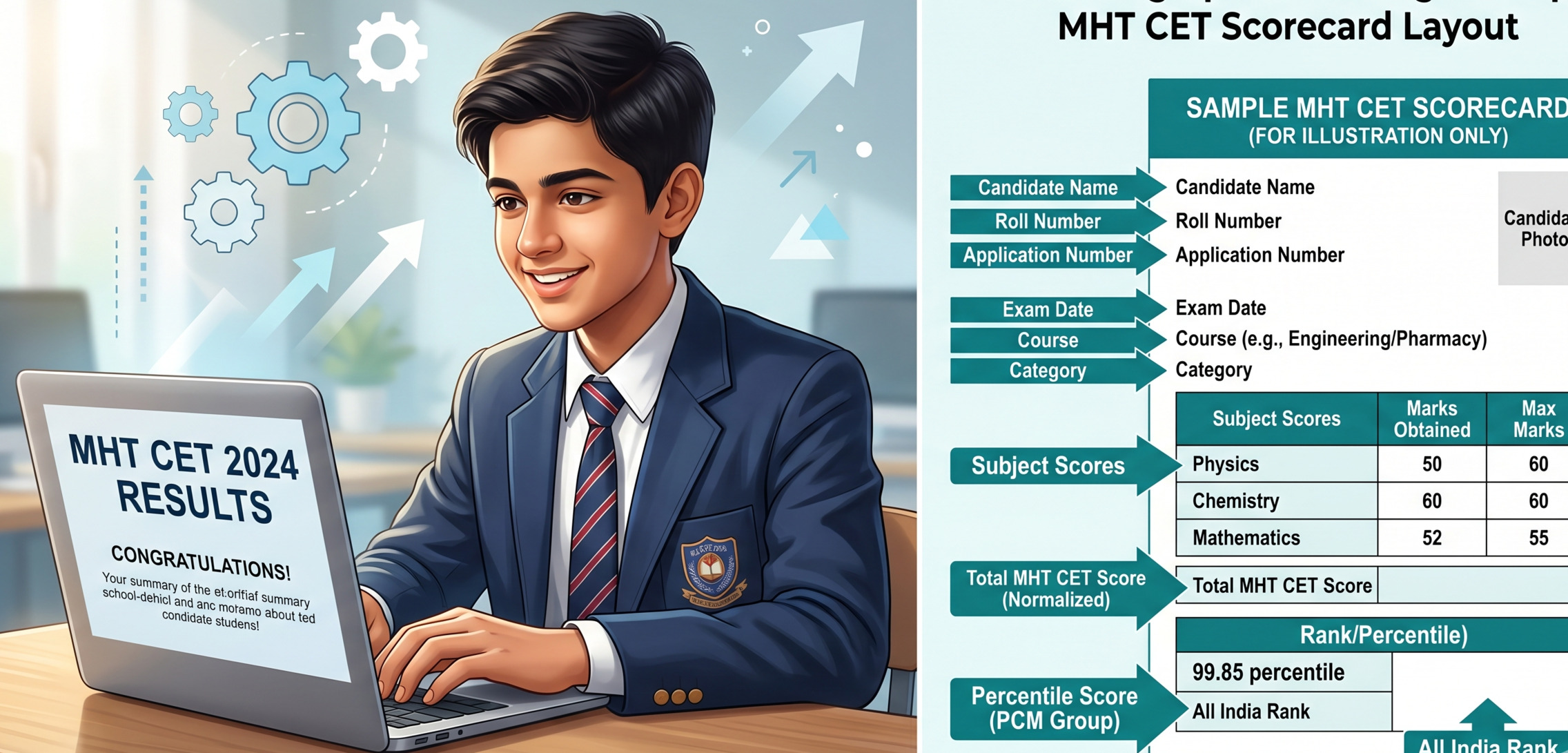
What the scorecard shows and how normalisation works
Eligibility for CAP counselling and important date milestones
How to prepare for the admission process right now
Overview
The Maharashtra State Common Entrance Test (MHT CET) is conducted by the State Common Entrance Test Cell, Maharashtra. It is a gateway to over 1.3 lakh seats in government, aided, private, autonomous, and minority colleges across the state for B.Tech, B.Pharma, and agricultural courses.
2026 Key Highlights at a Glance:
Detail
Information
Conducting Authority
State CET Cell, Maharashtra
Official Website
cetcell.mahacet.org
Groups
PCM (Engineering/Pharmacy) and PCB (Pharmacy/Agriculture)
Exam Format
Computer-Based Test (CBT), MCQ
Sessions in 2026
Two (first time ever — Session 1 & Session 2)
Result Portal
cetcell.mahacet.org
Expected Result Dates: Session 1 & Session 2
The CET Cell has not yet announced a confirmed result date, but based on recent developments and historical trends, here is what to expect.
Session 1 Exam Dates:
PCM Group: April 11–20, 2026
PCB Group: April 21–26, 2026
Session 2 Exam Dates:
PCB Group: May 10–11, 2026
PCM Group: May 12–21, 2026
Final Answer Key Released: May 30, 2026 (for both PCM and PCB groups across both sessions)
Expected Result Dates:
Session 1 Result: 1st to 3rd week of June 2026
Session 2 Result: Mid-June to 1st week of July 2026
Expert Tip: In 2025, MHT CET PCM results were declared on June 16 and PCB results on June 17. Following the same timeline, results may drop between June 10–20, 2026. Keep checking cetcell.mahacet.org regularly from June 10 onwards.
How to Check and Download Your Scorecard
Downloading the scorecard is a straightforward process, but you need to act fast — the portal often experiences heavy traffic right after result declaration.
Step-by-Step Process:
Visit the official website: cetcell.mahacet.org
Look for the “MHT CET 2026 Result” or “PCM/PCB Scorecard 2026” link on the homepage
Click the link — a login window will open
Enter your Registered Email ID and Password (the same credentials used during application). Some portals may ask for Application Number + Date of Birth + Captcha
Click “Submit” or “Login”
Your MHT CET 2026 scorecard will appear on the screen
Verify all details carefully
Download the PDF and print at least 4–5 physical copies
Important: The CET Cell does NOT send physical scorecards by post. You must save your digital copy immediately and keep multiple printouts safe for counselling rounds.
The scorecard shows your percentile score, not a rank. Your rank within the merit list is calculated later during CAP counselling registration.
Understanding Normalisation and Percentile
Since MHT CET 2026 was conducted across multiple shifts and two sessions, raw scores cannot be compared directly. The CET Cell uses a normalisation process to ensure fairness.
Here is how it works in simple terms:
Your raw marks are compared against the difficulty level of your specific shift
The normalised score is then converted into a percentile rank out of 100, calculated to seven decimal points for precision
This percentile represents your performance relative to all other test-takers, not just those in your shift
Example: If your percentile is 95.1234567, it means you performed better than approximately 95.12% of all candidates who appeared for the exam.
This system ensures that a candidate who got a tougher paper is not unfairly penalised compar
Eligibility Criteria for MHT CET 2026
To be eligible for MHT CET admission and CAP counselling, candidates must satisfy the following criteria:
Academic Qualification:
Passed HSC (Class 12) or equivalent examination
For PCM (Engineering/B.Pharma): Physics and Mathematics are compulsory subjects, along with Chemistry/Biology/Biotechnology/Technical Vocational subjects
For PCB (Pharmacy/Agriculture): Physics, Chemistry, and Biology required
Minimum Marks: Generally 45% aggregate in PCM/PCB subjects (40% for reserved categories)
Age Criteria:
Candidates must have completed 17 years of age by December 31 of the admission year
No upper age limit for engineering courses
Domicile/Residency:
Maharashtra State Candidates: Strong preference in seat allocation under State quota
Outside Maharashtra: Can appear for MHT CET but are typically not eligible for State quota seats. Many prefer JEE Main scores instead
J&K/Ladakh Migrant Candidates: Special category with separate eligibility rules
For CAP Counselling Specifically:
Must have a valid, non-zero MHT CET 2026 percentile
Name must appear on the MHT CET merit list
Important Dates & Process
The Centralised Admission Process (CAP) is where your MHT CET percentile is actually used. Understanding this timeline helps you avoid missing critical deadlines.
Expected CAP Counselling 2026 Timeline:
Event
Expected Date
CAP Registration Begins
June 2026 (post result)
Last Date for CAP Registration
July 2026
Document Verification (e-scrutiny)
June–July 2026
Provisional Merit List Display
July 2026
Grievance Window
July 2026
Final Merit List
July 2026
Seat Matrix (CAP Round 1)
July 2026
Option Form Submission (CAP Round 1)
July 2026
CAP Round 1 Seat Allotment
July 2026
Seat Acceptance & Reporting
August 2026
CAP Round 2
August 2026
CAP Round 3 (if applicable)
August–September 2026
Note: The seat acceptance fee for MHT CET 2026 has been increased from ₹1,000 to ₹2,000 per CAP round. Keep this in mind when budgeting.
CAP Process Overview:
The CAP process involves these key stages:
Online Registration — Create your CAP profile on cetcell.mahacet.org
Document Upload & Verification — E-scrutiny mode; physical verification at authorised centres if required
Merit List Publication — Based on your final MHT CET percentile + reservation category
Option Form Filling — Choose your preferred colleges and branches in priority order
Seat Allotment — Based on merit rank, category, and choices filled
Seat Acceptance & Reporting — Pay the acceptance fee and report to allotted institute
MHT CET counselling covers 3 main CAP rounds. If seats remain vacant after Round 3, an additional institutional round is conducted.
Documents Required for Counselling
Start collecting these documents now — don’t wait for results to begin the process.
Academic Documents:
Class 10 Marksheet & Certificate (for age proof)
Class 12 Marksheet
HSC Board Certificate / Passing Certificate
MHT CET 2026 Scorecard (download as soon as results are declared)
Caste Validity Certificate (issued by relevant authority)
Other Documents:
Gap Certificate (if applicable — if there was a year gap after Class 12)
Migration Certificate (for candidates from other boards)
Passport-size photographs (minimum 6–8 copies)
Left thumb impression on a white paper
Pro Tip: Get all documents attested and prepare both original and self-attested photocopies well in advance. Missing even one document can delay your admission.
Preparation Tips After Results
Getting your result is not the end — it’s the starting gun for the next phase. Here is how to prepare strategically:
Immediately After Results:
Download and save your scorecard in at least 2 cloud storage locations
Take 5–6 printouts and store them safely
Note your percentile accurately — this determines which colleges you can target
Research Colleges Now:
Use your percentile to shortlist colleges using previous year’s MHT CET cutoffs
Focus on college NIRF ranking, placement data, faculty strength, and infrastructure
Prioritise government and autonomous colleges if your percentile allows
Option Form Strategy:
Fill as many choices as possible — more choices means more allotment options
Start with your dream colleges but include realistic backup options
Don’t leave the option form with only 2–3 choices; experts recommend filling 15–20 options
Conclusion
The MHT CET Result 2026 is just around the corner, and being prepared is your biggest advantage. Whether your percentile is 99 or 75, every candidate has a seat waiting — it is just a matter of finding the right match through the CAP counselling process.
Keep the official portal bookmarked, get your documents ready today, and do not wait for the results to start researching colleges. The candidates who move quickly, fill their option forms thoughtfully, and stay alert to every CAP deadline are the ones who consistently land in their preferred institutions.
Check cetcell.mahacet.org daily from June 10, 2026 onwards. Best of luck!