

Imagine finishing your degree — three or four years of hard work — only to discover that your college certificate alone is no longer enough to land your first job.
That’s the reality thousands of graduates across India now face. And Mumbai University, one of India’s oldest and most prestigious institutions with over 780 affiliated colleges and more than 700,000 enrolled students, has decided to act.
In a landmark move that signals a major shift in how Indian universities measure student readiness, the University of Mumbai has partnered with an ed-tech firm to introduce a mandatory AI-powered job skills test for its undergraduate (UG) and postgraduate (PG) students. This test is designed to go beyond bookish knowledge and measure the real-world competencies employers actually look for.
In this article, you’ll learn exactly what this test involves, who must take it, the important dates, how to prepare, and why this step could genuinely shape your career trajectory.
What Is the Mumbai University AI Job Skills Test
The Mumbai University AI Job Skills Test is an AI-powered employability assessment that the university has made compulsory for students across its affiliated UG and PG programmes. It is administered in partnership with a recognized ed-tech assessment firm and uses adaptive testing technology — meaning the difficulty of questions adjusts in real time based on how a student performs.
Unlike traditional university exams that test subject-specific knowledge, this test evaluates what employers actually assess during campus placements:
- Quantitative aptitude — numerical reasoning and data interpretation
- Logical reasoning — pattern recognition, analytical thinking
- English communication — verbal comprehension, written expression
- Domain-specific skills — relevant to your field of study
- Personality and workplace behaviour — soft skills, teamwork, and adaptability
The AI component means the system can generate a detailed, personalized performance report for each student, pinpointing strengths and identifying areas that need improvement — something traditional pen-and-paper exams simply cannot do.
Why Has Mumbai University Made This Mandatory?
The answer lies in a sobering statistic. According to the India Skills Report 2026, India’s overall graduate employability stands at just 56.35% — meaning nearly half of all graduates are not considered job-ready by industry standards. Even in Maharashtra, one of the top-ranked states for employability, the gap between degree and job-readiness remains significant.
Mumbai University’s decision to tie up with an ed-tech firm for an AI-based assessment directly addresses this gap. Here’s the reasoning:
Employers have changed the hiring game. Companies like Infosys, Wipro, Accenture, TCS, and hundreds of others now use standardized third-party assessments — platforms like AMCAT, Wheebox, and MeritTrac — to screen candidates before interviews. Universities that prepare students for these assessments give graduates a measurable head start.
NEP 2020 demands outcome-based education. India’s National Education Policy 2020 emphasizes skill development, competency-based learning, and industry alignment. A mandatory job skills test is a direct implementation of this philosophy.
The AI talent gap is real. The India Skills Report 2026 notes that AI, data analytics, cloud computing, and cybersecurity are the most in-demand skills nationally, yet the supply of job-ready talent in these areas remains critically low.
By making this test compulsory, Mumbai University is essentially saying: a degree is the beginning, not the end.
Who Is Eligible? (UG & PG Requirements)
The test applies broadly to students enrolled in Mumbai University’s affiliated colleges. Here is the general eligibility framework:
Undergraduate (UG) Students
- Must be currently enrolled in a UG programme at a Mumbai University-affiliated college (BA, BCom, BSc, BMS, BMM, BCA, BEngg, and related programmes)
- Students in their final year or penultimate year are the primary target group
- Minimum qualification for admission: HSC (10+2) pass certificate with 45% marks (general category); 40% for reserved categories (SC/ST/OBC as applicable under Maharashtra norms)
Postgraduate (PG) Students
- Must be enrolled in an MU-affiliated PG programme (MA, MCom, MSc, MBA, MCA, MEd, and related programmes)
- Students appearing in their final semester or year are prioritised
- Minimum UG degree requirement: 50% aggregate marks from a recognised university (45% for reserved categories)
General Requirements for All Candidates
- Valid college enrolment / admission number
- Active registration on the University of Mumbai’s student portal (Samarth portal:
muugadmission.samarth.edu.in) - A functioning device with internet access for online proctored test formats
Note: Students should verify with their individual affiliated college for any course-specific eligibility conditions, as requirements may vary by stream and programme level.
Key Dates & Important Deadlines
While the university is expected to release the final official schedule on its portal (mu.ac.in), here is the framework for the 2025–26 and 2026–27 academic cycles based on available information:
| Event | Expected Timeline |
|---|---|
| Official Notification / Circular | To be announced on mu.ac.in |
| Student Registration for Test | Before semester-end (check Samarth portal) |
| Test Window (UG Final Year) | April–June (aligned with semester exams) |
| Test Window (PG Final Year) | March–May (aligned with PG semester schedule) |
| Score Reports Released | Within 2–3 weeks of test completion |
| Score Submission Deadline | As per college-specific instructions |
| MU UG Admission Application Last Date (2026–27) | 25th August 2026 (confirmed via Samarth portal) |
Critical reminder: Always check the official Mumbai University website (mu.ac.in) and your affiliated college’s notice board for the exact and updated test schedule. Dates can shift based on academic calendar revisions.
What Does the Test Actually Assess?
Understanding the test structure helps you prepare smartly. AI-powered employability assessments used by platforms partnering with universities typically cover:
Compulsory Modules (for all students)
- English Language: Reading comprehension, grammar, vocabulary, written communication
- Quantitative Aptitude: Arithmetic, percentages, ratios, data sufficiency, basic algebra
- Logical Reasoning: Analogies, syllogisms, coding-decoding, pattern series, blood relations
Domain-Specific Modules (based on your programme)
- Commerce students: Accounting fundamentals, financial reasoning
- Science students: Subject-specific problem solving
- Engineering/IT students: Computer programming basics, database concepts, algorithms
- Management students: Business communication, HR/marketing fundamentals
AI-Adaptive Feature
The test software adjusts difficulty dynamically. If you answer a question correctly, the next one is harder. Answer incorrectly, and the difficulty recalibrates downward. This adaptive design produces a far more accurate picture of your actual skill level than a fixed-format exam.
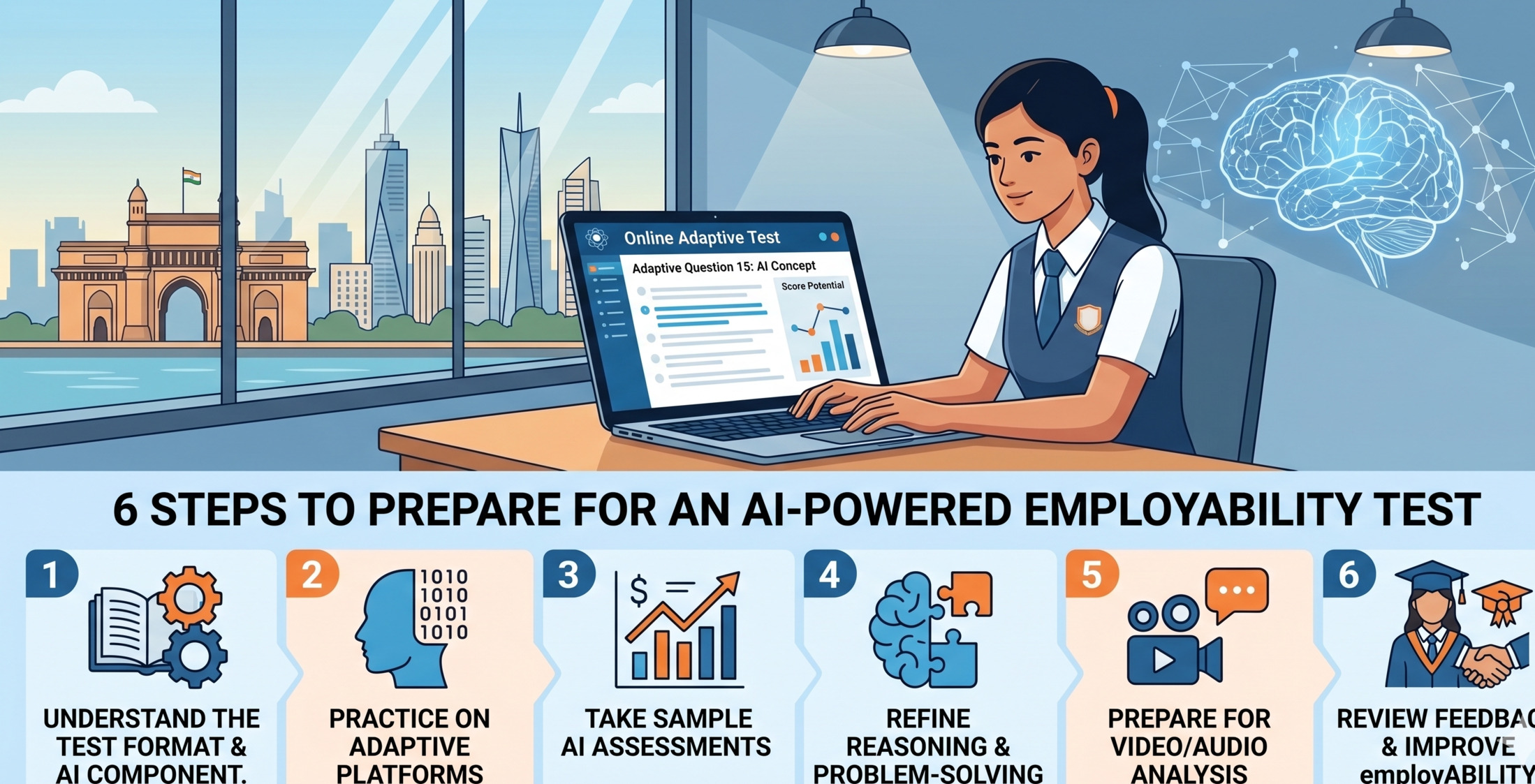
How to Prepare: Step-by-Step Guide
Step 1: Register and Confirm Your Test Date
Log into the Samarth portal (muugadmission.samarth.edu.in) and check for any notifications regarding the AI skills test. Confirm your test window with your college’s exam department.
Step 2: Take a Diagnostic Mock Test
Before diving into preparation, take a free mock test — platforms like AMCAT, Wheebox, or PrepInsta offer free practice papers. Identify your weakest sections immediately.
Step 3: Build Core Skills Over 4–6 Weeks
- Week 1–2: Focus on quantitative aptitude. Revise percentage, ratio, profit-loss, and data interpretation using books like R.S. Aggarwal’s Quantitative Aptitude.
- Week 3: Sharpen logical reasoning — practice syllogisms, analogies, and series completion daily.
- Week 4: Work on English — read editorials, practice comprehension passages, and review grammar rules.
- Week 5–6: Attempt full-length timed mock tests to build exam stamina and improve speed.
Step 4: Practice on an Adaptive Platform
Since the MU test is AI-adaptive, practising on similar platforms (AMCAT’s official mock test, for example) helps you get comfortable with difficulty shifts mid-exam.
Step 5: Work on Domain Modules
Revise fundamentals specific to your field. Engineering students should brush up on programming basics; commerce students should revisit accounting ratios and financial terms.
Step 6: Review and Re-test
Use the diagnostic reports from mock tests to revisit weak areas. One week before your test date, switch to light revision and time management practice only.
Benefits for Students
This mandatory test isn’t just a bureaucratic hurdle — it offers tangible advantages:
A credentialled skill score alongside your degree. Your score acts as a standardised benchmark that employers and recruiters recognise, reducing the need for separate pre-placement tests at every company.
Personalised feedback report. Unlike a pass/fail exam, the AI assessment gives a detailed breakdown of your performance — telling you exactly where you stand in English, aptitude, and reasoning against a national benchmark.
Better placement readiness. Students who perform well in this test are statistically better positioned for campus placements, since the test mirrors the exact format companies use for shortlisting.
A head start for competitive exams. The skills tested overlap significantly with government job exams (SSC, banking, railways) and MBA entrance tests (CAT, MAT, CMAT), making your preparation doubly useful.
Common Mistakes to Avoid
- Ignoring it until the last week. The adaptive nature of the test rewards consistent preparation, not last-minute cramming.
- Skipping domain modules. Students often over-focus on aptitude and neglect the domain section, which carries significant weight.
- Not practising under timed conditions. Speed is critical. Practice every mock test with a timer running.
- Assuming your degree score is enough. The test specifically measures skills your academic percentage does not reflect.
- Missing the registration deadline. Late registration may result in missing the test window, which could affect your graduation requirements.
Latest Trends: Universities & Employability Testing in India
Mumbai University’s initiative is part of a sweeping national trend. Consider these developments:
India’s national employability rate reached 56.35% in 2026, up from 54.81% the previous year, according to the India Skills Report 2026. While that improvement is encouraging, it still means nearly half of graduates are not considered ready for employment.
More than 90% of Indian employees have already begun working with generative AI tools, making digital fluency and AI awareness a baseline expectation, not a differentiator.
Over 45% of employers in the India Skills Report 2025 identified digital proficiency as a top hiring priority, signalling that universities that don’t align their outputs with this expectation are increasingly out of step with industry needs.
Mumbai University, with its vast network of over 780 affiliated colleges, is uniquely positioned to scale this kind of skills-first assessment. Other state universities across Maharashtra and India are expected to follow suit.
Key Takeaways
- Mumbai University has introduced a mandatory AI-powered job skills test for UG and PG students, in partnership with an ed-tech assessment firm.
- The test is adaptive — difficulty adjusts based on your real-time performance, producing a highly accurate skills profile.
- Eligible students include those enrolled in MU-affiliated UG and PG programmes; final-year and penultimate-year students are the primary cohort.
- Key dates are announced via the official MU portal (
mu.ac.in) and the Samarth admission portal. - Preparation should begin 4–6 weeks before the test, covering quantitative aptitude, logical reasoning, English, and domain-specific modules.
- Scoring well gives you a portable skill credential that strengthens your candidacy with employers who use similar third-party assessments.
- This initiative reflects India’s shift toward a skills-first hiring economy, supported by NEP 2020 and rising employer demand for demonstrable competencies.
Conclusion
Mumbai University’s decision to make an AI-powered job skills test mandatory is not just an administrative update — it’s a philosophical shift in how one of India’s largest universities defines student success. A degree has never been more accessible. What’s increasingly rare is the proven ability to apply what you’ve learned in a real workplace.
If you’re a UG or PG student at an MU-affiliated college, treat this test seriously. It isn’t one more exam to pass and forget. It’s a mirror that shows you — and future employers — exactly where you stand. Use the preparation process to close the gaps, and you’ll walk away with something far more valuable than another marksheet: a concrete, AI-verified proof of employability.
Keep checking mu.ac.in for the latest official notifications, and register on time. Your career readiness starts now.
FAQs
1. Is the Mumbai University AI job skills test mandatory for all students?
It is being implemented as a compulsory component for UG and PG students enrolled in Mumbai University’s affiliated colleges, with a focus on final-year and penultimate-year students. Check with your specific college for programme-level applicability.
2. What happens if a student fails or scores poorly in the test?
The test is primarily designed as an employability assessment and skill diagnostic tool. Individual colleges and the university may have their own policies on retakes or minimum score requirements. Students are encouraged to check the official circular for pass/fail implications.
3. Which ed-tech firm has partnered with Mumbai University for this test?
The university has partnered with a recognised ed-tech assessment provider to deploy the AI-adaptive platform. Students should watch for the official announcement on mu.ac.in for the confirmed partner name and platform details.
4. How long does the AI job skills test take?
Most AI-adaptive employability assessments of this type run between 90 to 120 minutes, covering multiple modules. The exact duration will be confirmed in the official test instructions.
5. Will the test score appear on the final degree certificate or marksheet?
This is subject to university policy. Some institutions use it as a graduation requirement or attach a separate skills certificate. Refer to the official circular on mu.ac.in for the definitive answer.
6. Can students retake the test to improve their score?
Retake policy varies by the platform used. Many employability assessment platforms allow one reattempt after a waiting period (typically 30–45 days). The university notification will specify the applicable policy.
7. Is this test only for Mumbai University campus students, or does it apply to distance education (IDOL) students too?
The current mandate primarily targets regular-mode students at MU-affiliated colleges. Distance education students enrolled through IDOL (Centre for Distance and Open Education) should check separately, as the policy may differ for their programme structure.