

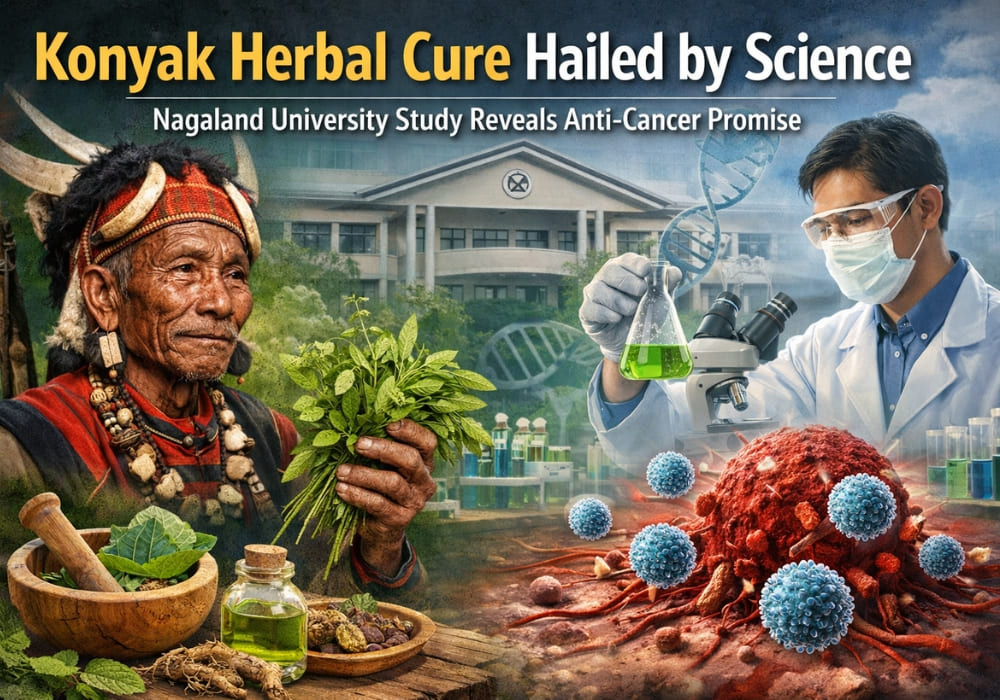
Author – Ritesh Ranjan: Nagaland University – In a remarkable blend of traditional wisdom and modern science, a recent study led by Nagaland University has uncovered promising anti-cancer properties in a herbal formulation used by the Konyak tribe of Nagaland. This groundbreaking research, conducted in collaboration with Berhampur University and Saveetha Medical College, highlights the untapped potential of indigenous medicinal practices in modern drug discovery.
The findings, published in the Microchemical Journal, provide scientific validation for a traditional five-plant remedy that has been used by Konyak healers for generations. This development could mark a significant step toward safer, nature-based cancer treatments.
Bridging Traditional Knowledge and Modern Science
India has a long-standing heritage of herbal medicine, deeply rooted in tribal and indigenous communities. However, many of these traditional remedies have not been thoroughly studied using modern scientific techniques.
This research stands out because it bridges that gap. By combining advanced methods such as GC-MS analysis, molecular simulations, and computational screening, scientists were able to identify the bioactive compounds present in the herbal formulation.
Dr. G. Bupesh, Assistant Professor at Nagaland University, emphasized that this is the first scientific evaluation of a specific five-plant formulation used by Konyak tribal healers. The study demonstrates how traditional knowledge can be validated and enhanced through scientific inquiry.
What the Study Found
Targeting Cancer at the Molecular Level
One of the most significant findings of the study is the formulation’s ability to target VEGFR2 (Vascular Endothelial Growth Factor Receptor 2). This protein plays a crucial role in angiogenesis, the process by which tumors develop new blood vessels to sustain their growth.
By inhibiting VEGFR2, the herbal compounds may help restrict tumor growth and progression, making them promising candidates for anti-cancer therapies.
Key Highlights of the Findings
- Effective targeting of VEGFR2: Helps potentially slow down tumor growth
- Stable molecular interactions: Indicates strong binding with cancer-related proteins
- Low toxicity levels: Suggests safer alternatives compared to conventional drugs
- Favorable pharmacokinetics: Better absorption and distribution in the body
- Selective targeting: Reduces risk of side effects by avoiding similar proteins
These findings indicate that the herbal formulation may offer a balanced combination of effectiveness and safety—an essential factor in cancer treatment.
Why This Study is a Breakthrough
First-of-Its-Kind Research
This is the first time a specific Konyak tribal herbal formulation has been scientifically analyzed in such detail. The study not only validates traditional practices but also opens new pathways for research in natural-product-based drug development.
The research team included experts such as Longnyu M. Konyak, Giridharan Bupesh, Parthasarathy Sudharsan, Nokenketla Jamir, and Sidhartha Saikia, along with collaborators from partner institutions.
Comparable to Existing Drugs
According to the study, the herbal compounds performed comparably to existing anti-cancer drugs in computational models. More importantly, they demonstrated lower toxicity levels, which is a major challenge in current cancer treatments.
Importance for India’s Healthcare and Research
Unlocking Indigenous Knowledge
India is home to diverse tribal communities with rich medicinal knowledge. Studies like this highlight the importance of preserving and scientifically evaluating these traditions.
By integrating indigenous knowledge with modern research, India can:
- Discover cost-effective treatments
- Promote sustainable healthcare solutions
- Strengthen its position in global biomedical research
Affordable and Safer Therapies
Cancer treatment is often expensive and comes with severe side effects. Natural formulations with lower toxicity could offer more accessible and patient-friendly alternatives, especially in developing countries.
Prof. Jagadish K. Patnaik, Vice Chancellor of Nagaland University, praised the research for its innovative approach and its potential to contribute to global healthcare advancements.
The Road Ahead: What Comes Next?
While the findings are promising, the researchers have clearly stated that this is only the beginning.
Further Research Required
The study is currently based on computational analysis. Before the formulation can be used in real-world treatments, it must go through:
- Laboratory testing (in vitro studies)
- Animal testing (in vivo studies)
- Clinical trials on humans
These steps are crucial to confirm safety, effectiveness, and dosage requirements.
Focus on Colon Cancer
The research team has indicated a particular interest in exploring the formulation’s potential in treating colon cancer. Future studies will aim to validate these findings through experimental and clinical research.
Preserving Culture While Advancing Science
Beyond its medical implications, this study also plays an important role in preserving the cultural heritage of the Konyak tribe. By documenting and validating traditional practices, researchers are ensuring that this knowledge is not lost over time.
This collaboration between tribal wisdom and modern science serves as a powerful example of how different knowledge systems can work together for the greater good.
Conclusion
The discovery of anti-cancer potential in a Konyak tribal herbal formulation marks an exciting milestone in the field of natural medicine. Led by Nagaland University, this study demonstrates the immense value of integrating indigenous knowledge with advanced scientific techniques.
While more research is needed before clinical use, the findings offer hope for developing safer, more affordable cancer treatments in the future. At the same time, they reinforce the importance of preserving India’s rich heritage of traditional medicine.
As science continues to explore nature’s pharmacy, such breakthroughs remind us that some of the most powerful solutions may already exist within ancient practices.
FAQs
1. What is the Konyak herbal formulation?
It is a traditional five-plant remedy used by the Konyak tribe of Nagaland, now being studied for its potential anti-cancer properties.
2. What makes this study important?
The study scientifically validates a tribal remedy using modern techniques, bridging the gap between traditional medicine and contemporary research.
3. How does the formulation help fight cancer?
The compounds target VEGFR2, a protein involved in tumor blood vessel growth, potentially slowing down cancer progression.
4. Is this treatment available for patients now?
No, the research is still in preliminary stages and requires further laboratory and clinical testing before medical use.
5. Why is indigenous knowledge important in medicine?
Indigenous knowledge offers valuable insights into natural remedies that can lead to safer, affordable, and effective treatments.
Next article
NSUT Admission 2026 guide eligibility, JEE Main entrance details, JAC Delhi counselling dates, selection process, cutoffs & documents