

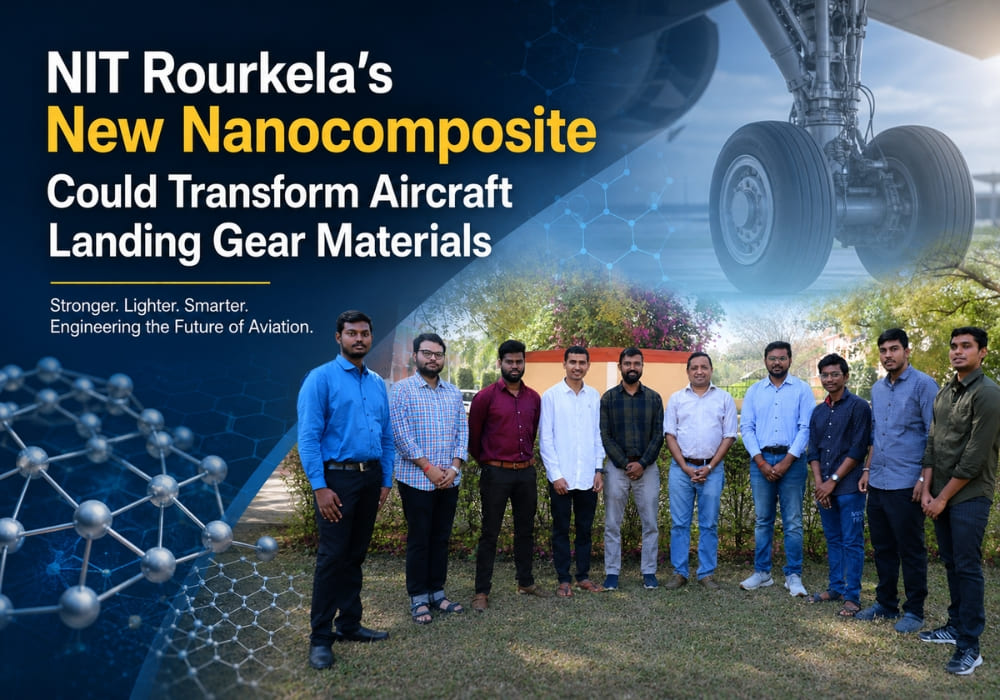
Author – Ritesh Ranjan: NIT Rourkela – Researchers at the National Institute of Technology Rourkela have developed a lightweight aluminium-based hybrid nanocomposite that could make aircraft landing gear stronger, more durable and more cost-efficient. The material has been designed to solve one of the most important challenges in aerospace engineering: creating aircraft components that are light enough to improve fuel efficiency, but strong enough to survive repeated impact, friction and wear.
Aircraft landing gear is one of the most stressed parts of an aircraft. Every landing places enormous load on the landing system. During taxiing, take-off and landing, the landing gear faces repeated contact with the runway surface, heavy compression, vibration and friction. Because of this, the material used in landing gear must be strong, tough, wear-resistant and reliable.
Traditionally, landing gear components are made from ultra-high-strength steel, titanium alloys or high-strength aluminium alloys. Aluminium and aluminium alloys are widely used because they are lightweight, which helps reduce aircraft weight and improve fuel efficiency. However, they can wear out faster under extreme stress. This increases maintenance requirements and may reduce the service life of the component.
The new material developed at NIT Rourkela aims to overcome this limitation. By combining aluminium with nanoscale reinforcements, researchers have created a material that offers low weight, high wear resistance, better strength and improved cost efficiency. This makes it a promising option for future aerospace systems, especially defence aircraft and unmanned aerial vehicles.
How the New Material Was Developed
The research was led by Prof. Syed Nasimul Alam from the Department of Metallurgical and Materials Engineering at NIT Rourkela. The team included Dr. Arka Ghosh, Dr. Ashutosh Das, Dr. Pankaj Shrivastava, Mr. Nityananda Sahoo and Mr. Parth Patel, along with Dr. Velaphi Msomi from the University of South Africa. Their findings were published in the journal Materials Letters.
The team developed an aluminium-based hybrid nanocomposite using three important nanoscale reinforcements: carbon nanotubes, graphite nanoplatelets and hexagonal boron nitride.
Carbon nanotubes were added to improve compressive strength and load-bearing capacity. These nanotubes are known for their excellent mechanical properties and can help the material carry heavy loads more effectively.
Graphite nanoplatelets were used to improve wear performance. Since landing gear components are exposed to repeated friction, better wear resistance is essential for longer life and reduced maintenance.
Hexagonal boron nitride was added to enhance thermal stability and toughness. Aircraft components can experience temperature variation and mechanical stress, so thermal stability is an important factor in aerospace material design.
To ensure that these nanofillers were properly mixed with the aluminium matrix, the researchers used high-frequency sound waves. This process helped disperse the particles more evenly. After that, the material was compacted and heated in an oxygen-free environment using spark plasma sintering.
Spark plasma sintering is a modern manufacturing technique that uses heat and pressure to produce dense and strongly bonded materials. In this case, it helped create a compact nanocomposite with a uniform distribution of reinforcement particles.
According to Prof. Alam, the process helped form a three-dimensional reinforcing network inside the aluminium matrix. This network improves load transfer, structural stability and wear resistance. In simple terms, the nanofillers work together to strengthen the material from within.
Why Landing Gear Needs Better Materials
Aircraft landing gear must perform under some of the most demanding operating conditions in aviation. It must absorb impact during landing, support the aircraft’s weight on the ground and withstand repeated movement during taxiing and take-off.
If the landing gear material wears down too quickly, it can increase inspection frequency, maintenance cost and replacement needs. For commercial aviation, this can affect operational efficiency. For defence aircraft and UAVs, the challenge is even more critical because these platforms often operate in harsh environments and require high reliability.
Weight is another major concern. In aircraft design, every kilogram matters. Lighter materials help reduce fuel consumption and improve performance. For UAVs, lighter structures can improve range, payload capacity and endurance. For defence aircraft, reduced weight can support better manoeuvrability and mission efficiency.
This is why materials that combine strength, toughness, low weight and wear resistance are highly valuable in aerospace engineering.
Stronger, Lighter and More Cost-Efficient
The NIT Rourkela nanocomposite is being presented as a practical alternative to ultra-high-strength steel, titanium alloys and existing high-strength aluminium alloys. These conventional materials are effective, but they may be expensive, heavy or less efficient in terms of long-term wear performance.
The newly developed composite could offer around 40 to 60 percent better overall cost efficiency compared with some existing high-performance materials. This is significant because aerospace materials are often costly to produce, process and maintain.
The material also showed around 65 percent improvement in wear resistance, strength and overall lifespan compared with conventional metal options. This improvement is mainly due to the formation of a thin protective layer on the surface of the material during operation. This layer helps protect the material from direct abrasion and damage.
Such a protective surface can increase service life and reduce the frequency of component replacement. For aircraft operators, this can mean lower maintenance costs, improved reliability and better operational readiness.
Importance for Defence Aircraft and UAVs
The material has strong potential for defence aircraft and unmanned aerial vehicles. These platforms require compact, lightweight and durable components that can perform reliably under demanding conditions.
For UAVs, lightweight materials are especially important. Reduced weight can improve flight time, range and payload capacity. A stronger landing gear material can also help UAVs operate from rougher surfaces or under repeated mission cycles.
For defence aircraft, landing gear strength and durability are essential for safety and mission performance. Aircraft used in defence applications may face tougher landing conditions, frequent operations and demanding environments. A material that can reduce wear and improve lifespan without adding major weight could be highly useful.
The innovation may also support future aerospace systems where advanced materials will play a major role in improving efficiency, safety and cost-effectiveness.
Supporting India’s Aerospace Self-Reliance
This development also aligns with India’s Atmanirbhar Bharat mission, which focuses on strengthening indigenous capabilities in key sectors, including defence and aerospace.
Advanced aerospace materials are often expensive and may depend on imported technologies or alloys. If the NIT Rourkela nanocomposite can be scaled successfully, it could help India develop high-performance landing gear materials domestically.
This would not only reduce dependence on imported materials but also support Indian research, manufacturing and defence innovation. It could open new possibilities for collaboration between academic institutions, aerospace industries and defence organisations.
What Comes Next?
The research is currently an important lab-scale success. The next step is to scale up the material and develop larger components using the powder metallurgy route.
Scaling is a crucial stage in materials engineering. A material that performs well in laboratory samples must also prove that it can be manufactured consistently in larger sizes and complex shapes. For aircraft landing gear applications, the material will need further testing, certification and industry validation before it can be used in real aircraft systems.
However, the early results are promising. The combination of aluminium, carbon nanotubes, graphite nanoplatelets and hexagonal boron nitride shows how advanced materials science can solve real engineering problems.
Conclusion
NIT Rourkela’s lightweight aluminium-based hybrid nanocomposite is a promising step forward for aerospace materials. By improving wear resistance, strength, toughness and cost efficiency, the material could help create stronger and more durable aircraft landing gear.
Its potential use in defence aircraft and UAVs makes the innovation especially important for India’s aerospace and defence sectors. If successfully scaled and industrialised, the material could contribute to safer aircraft systems, lower maintenance costs and greater self-reliance in advanced aerospace manufacturing.
This research highlights how Indian institutions are contributing to the future of aviation through materials science, innovation and engineering excellence.
FAQs
1. What has NIT Rourkela developed for aircraft landing gear?
NIT Rourkela researchers have developed a lightweight aluminium-based hybrid nanocomposite material that can improve the strength, wear resistance and durability of aircraft landing gear.
2. Why is this nanocomposite important for aviation?
The material is important because landing gear must withstand repeated impact, friction and heavy loads. This nanocomposite offers better wear resistance while keeping the component lightweight, which can improve aircraft efficiency and reduce maintenance needs.
3. What materials were used in the NIT Rourkela nanocomposite?
The nanocomposite uses aluminium as the base material and includes carbon nanotubes, graphite nanoplatelets and hexagonal boron nitride as nanoscale reinforcements.
4. How much improvement did the new material show?
According to the research, the material showed around 65 percent improvement in wear resistance, strength and overall lifespan compared with conventional metal options.
5. Where can this material be used?
The material has potential applications in aircraft landing gear, defence aircraft, unmanned aerial vehicles and other aerospace systems that require lightweight, strong and wear-resistant components.
Next article
NSUT Admission 2026 guide eligibility, JEE Main entrance details, JAC Delhi counselling dates, selection process, cutoffs & documents