

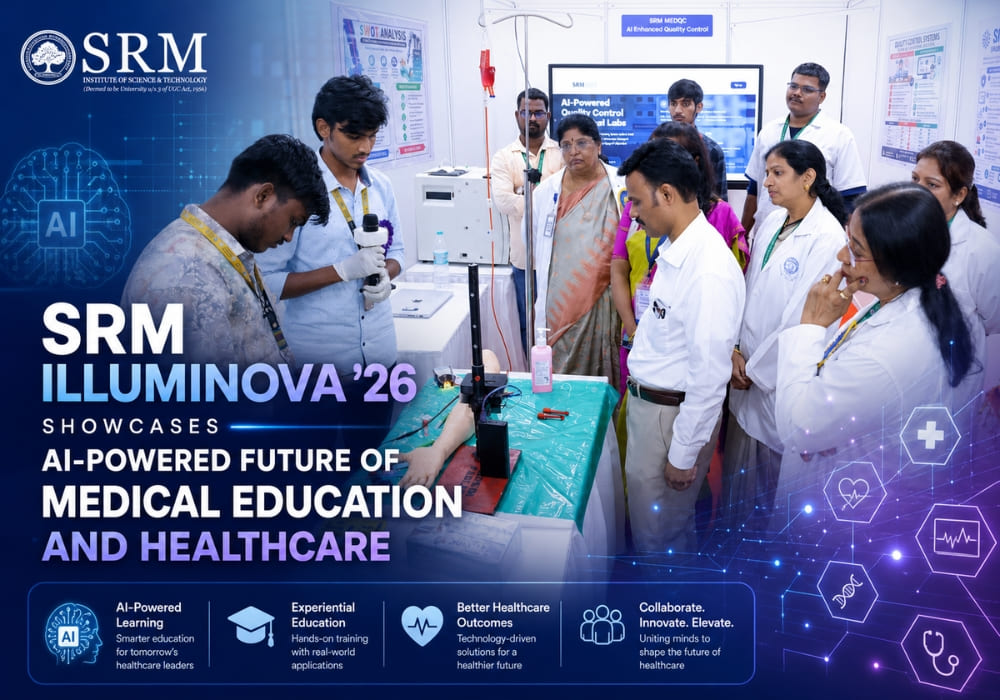
Author – Ritesh Ranjan: The future of healthcare is no longer a distant concept—it is already taking shape in medical colleges and hospitals across India. A strong example of this transformation was seen at Illuminova ’26, hosted by SRM Medical College Hospital and Research Centre on April 28, 2026. Designed as an undergraduate MBBS research expo, the event brought together innovation, artificial intelligence (AI), and student-led research under the theme “SRM Futuristic: Advancing Healthcare with AI.”
This forward-looking initiative showcased how AI is gradually becoming an integral part of medical education, clinical practice, and hospital management. It also highlighted how institutions like SRM Institute of Science and Technology are preparing the next generation of doctors to thrive in a tech-driven healthcare ecosystem.
A Platform for Innovation and Learning
Illuminova ’26 was not just a research exhibition—it was a dynamic platform where undergraduate medical students could present their ideas, interact with faculty, and explore real-world applications of emerging technologies. The event emphasized interdisciplinary collaboration, bringing together expertise from medicine, engineering, and digital sciences.
In today’s rapidly evolving healthcare environment, such exposure is invaluable. Students are no longer confined to textbooks; instead, they are encouraged to think critically, solve clinical challenges, and integrate digital tools into patient care. Events like Illuminova help bridge the gap between theoretical knowledge and practical implementation.
AI Meets Medical Training
One of the biggest highlights of Illuminova ’26 was the showcase of AI-powered healthcare studios. These innovative setups demonstrated how artificial intelligence can be seamlessly integrated into various aspects of healthcare delivery.
Key AI-Powered Installations:
- AI-Assisted Rapid Mobile Response Unit – Focused on emergency care with faster response times and real-time data analysis.
- AI-Enabled Outpatient Department (OPD) – Streamlining patient flow, diagnosis, and consultation processes.
- AI-Integrated Operation Theatre – Enhancing surgical precision and minimizing risks using intelligent systems.
- AI Smart Central Laboratory – Improving diagnostic accuracy and reducing turnaround time.
- AI-Powered Medical Education Unit – Transforming how students learn through simulations and data-driven insights.
Each of these models was developed through collaboration across departments within SRMIST, reflecting how academic research can translate into practical healthcare solutions. These innovations aim to improve diagnosis, patient management, and overall clinical outcomes.
Student Research Takes Center Stage
A major component of the event was the undergraduate poster exhibition, which featured 104 research posters across 18 medical departments. The projects ranged from conceptual ideas to ongoing and completed research, demonstrating the depth and diversity of academic work among students.
This kind of exposure plays a crucial role in shaping future doctors. Early involvement in research helps students:
- Develop analytical and critical thinking skills
- Understand evidence-based medicine
- Connect classroom learning with real-world healthcare challenges
By participating in such initiatives, students gain confidence and experience that will benefit them throughout their medical careers.
Visionary Leadership and Insights
Illuminova ’26 also featured thought-provoking insights from academic and healthcare leaders.
Dr. P. Sathyanarayan, Pro Chancellor (Academics) at SRMIST, emphasized that integrating AI into undergraduate research empowers students to actively shape the future of healthcare. He highlighted the importance of combining knowledge with innovation and purpose.
Dr. Jayanthi, Dean (Medical) at SRMMCHRC, stressed that research should go beyond academic metrics. According to her, meaningful research must create a real impact on communities and improve patient outcomes.
The Human Side of AI in Healthcare
While the event celebrated technological advancements, it also acknowledged the limitations of AI. Prantar Chakrabarti, a special guest at the event, described AI as a “double-edged weapon.”
He cautioned students not to lose sight of empathy, communication, and human judgment. According to him, AI can support healthcare professionals, but it cannot replace the human element that is essential in patient care.
This perspective is critical as hospitals worldwide increasingly adopt digital tools. The future of healthcare lies in balancing technology with compassion, ensuring that patient care remains holistic and ethical.
Building Future-Ready Doctors
Another key highlight of Illuminova ’26 was the emphasis on holistic development. K. Narayanasamy encouraged students to embrace the “four I’s”:
- Interest
- Involvement
- Innovation
- (Implicit growth mindset)
He urged students to go beyond the curriculum and build a strong professional identity. This approach aligns with the evolving expectations of the medical field, where continuous learning and adaptability are essential.
SRM’s Growing Reputation in Medical Education
Illuminova ’26 also reinforced the reputation of SRMMCHRC as a leading medical institution in India. The college has achieved significant milestones, including:
- Ranking 18th in NIRF 2025
- More than 1,600 hospital beds
- Over 30 specialty and super-specialty departments
- 22 modular operation theatres
- NABL-accredited diagnostic facilities
These achievements reflect the institution’s commitment to excellence in education, research, and patient care.
Why Illuminova ’26 Matters
Events like Illuminova ’26 highlight a major shift in medical education. Traditional teaching methods are being complemented by innovation, research, and technology-driven learning.
By integrating AI into undergraduate education, SRM Medical College Hospital and Research Centre is:
- Preparing students for future healthcare challenges
- Encouraging interdisciplinary collaboration
- Promoting real-world problem solving
- Enhancing patient-centered care
The healthcare system of tomorrow will be more data-driven, efficient, and personalized. However, it will also require doctors who are empathetic, ethical, and adaptable.
Illuminova ’26 is a step in that direction—creating a generation of doctors who are not only skilled in medicine but also equipped to harness the power of technology responsibly.
Conclusion
Illuminova ’26 stands as a testament to how medical education is evolving in the age of artificial intelligence. By combining research, innovation, and clinical insight, SRM Medical College Hospital and Research Centre is setting a benchmark for future-ready healthcare education.
As AI continues to reshape the medical field, initiatives like this ensure that students are not just passive learners but active contributors to the future of healthcare.
FAQs
1. What is Illuminova ’26?
Illuminova ’26 is an undergraduate MBBS research expo hosted by SRM Medical College Hospital and Research Centre, focusing on AI-driven healthcare innovation.
2. What was the theme of Illuminova ’26?
The theme was “SRM Futuristic: Advancing Healthcare with AI,” highlighting the role of artificial intelligence in medicine.
3. How many research projects were presented?
The event featured 104 research posters across 18 medical departments.
4. What role does AI play in medical education?
AI enhances diagnosis, improves patient management, supports clinical decision-making, and enables advanced learning through simulations.
5. Can AI replace doctors in the future?
No, AI cannot replace doctors. It can assist in analysis and efficiency, but human judgment, empathy, and ethical decision-making remain essential.