

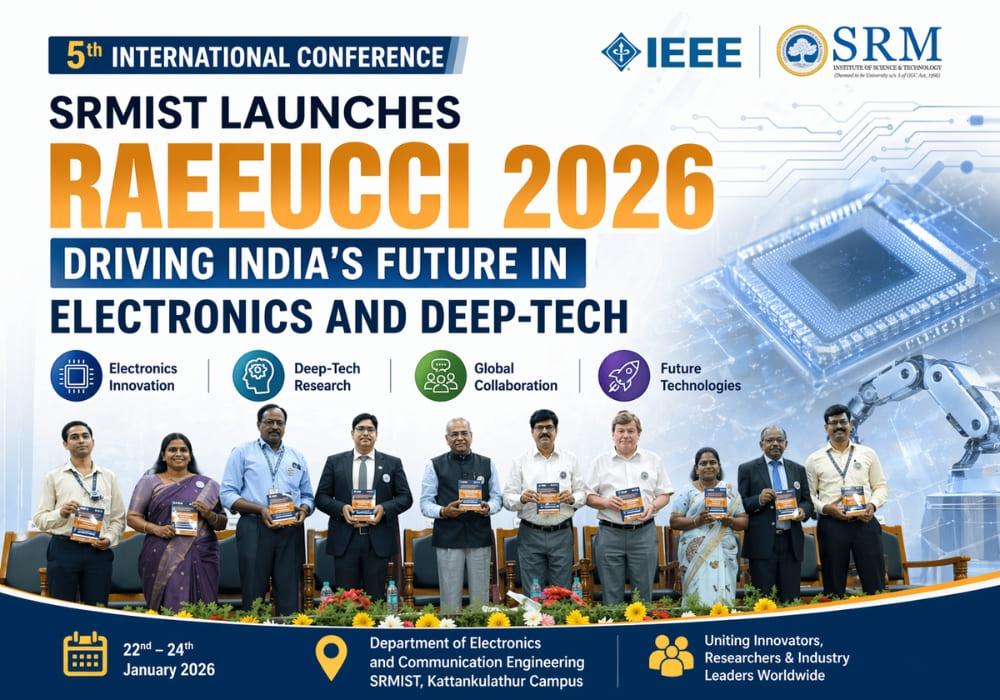
Author – Ritesh Ranjan: SRMIST – India’s ambition to become a global technology powerhouse is gaining momentum, and academic institutions are playing a crucial role in shaping this transformation. One such initiative is the launch of the 5th edition of the International Conference on Recent Advances in Electrical, Electronics, Ubiquitous Communication and Computational Intelligence (RAEEUCCI 2026) by SRM Institute of Science and Technology.
Held from April 22 to 24, 2026, this IEEE-backed global conference brings together leading researchers, industry experts, policymakers, and students to discuss cutting-edge innovations in electronics, communication, and computational intelligence. With a strong focus on real-world impact, RAEEUCCI 2026 is positioning itself as a key platform for shaping India’s deep-tech future.
A Global Platform for Innovation and Collaboration
RAEEUCCI 2026 is not just another academic conference—it is a dynamic ecosystem for knowledge exchange and collaboration. Organized by the Department of Electronics and Communication Engineering at SRMIST, the event has steadily grown into an internationally recognized forum.
With technical co-sponsorship from IEEE, the conference maintains high academic and research standards. IEEE’s involvement ensures that the research presented aligns with global benchmarks and contributes meaningfully to technological advancement.
The event has attracted participation from across the globe, including universities, research institutions, startups, and established corporations. This diverse participation highlights the conference’s importance in bridging the gap between academia and industry.
Focus on Emerging and Future Technologies
One of the key strengths of RAEEUCCI 2026 is its focus on next-generation technologies that are expected to shape the future. The conference covers a wide range of domains, including:
- 6G communication systems
- Quantum communication technologies
- Semiconductor design and manufacturing
- VLSI (Very Large Scale Integration)
- Embedded systems
- E-mobility solutions
- Signal and image processing
These areas are critical to India’s long-term technology roadmap, especially as the country aims to strengthen its position in semiconductor manufacturing and advanced communication networks.
The emphasis on proof-of-concept demonstrations also sets RAEEUCCI apart. It is not limited to theoretical discussions but encourages practical innovation that can be translated into real-world applications.
High Academic Standards and Competitive Selection
The scale and competitiveness of RAEEUCCI 2026 reflect its growing reputation. This year, the conference received an impressive 1,945 research paper submissions. Out of these, only 236 papers were accepted after a rigorous peer-review process.
This low acceptance rate highlights the quality of research being showcased and reinforces the conference’s credibility. It also ensures that participants are exposed to high-impact, cutting-edge work in their respective fields.
Such standards are essential for building a strong research culture in India, where innovation must be driven by both quality and relevance.
Industry Leaders Emphasize Product Innovation
A major highlight of RAEEUCCI 2026 was the strong message from industry leaders about the need for India to transition into a product-driven economy.
Dr. V. Veerappan, Chairman of the India Electronics and Semiconductor Association and Co-founder of Tessolve Semiconductor, emphasized that India must move beyond ideation and focus on product development, research, and intellectual property creation.
His message resonates with the current global scenario, where countries are competing not just in innovation but in ownership of technology. For India, this means building capabilities in semiconductor design, manufacturing, and deep-tech product development.
Strategic Importance of Semiconductors
Another key theme of the conference was the importance of semiconductors in national development. With global supply chains undergoing major shifts, India is actively working to establish itself as a semiconductor hub.
Padma Bhushan awardee Dr. A. Sivathanu Pillai highlighted the need for knowledge-driven self-reliance. He stressed that innovation in semiconductor technology is not just an economic priority but also a strategic necessity.
India’s push for semiconductor self-sufficiency aligns with initiatives like “Make in India” and the broader vision of technological independence.
Strengthening Industry-Academia Collaboration
RAEEUCCI 2026 strongly emphasizes collaboration between academia and industry. Prof. C. Muthamizhchelvan, Vice Chancellor of SRMIST, pointed out that academic institutions must evolve to meet industry demands.
This includes:
- Updating curricula to match emerging technologies
- Encouraging interdisciplinary learning
- Promoting industry-linked research projects
- Providing hands-on experience to students
Such collaboration ensures that graduates are not only academically strong but also industry-ready.
Dr. M. Sangeetha, Head of the ECE Department, reinforced this idea by highlighting SRMIST’s commitment to research-led education and practical learning. This approach prepares students to thrive in fast-changing technological environments.
SRMIST as a Hub for Innovation
Over the years, SRM Institute of Science and Technology has established itself as a leading institution in engineering education and research. Events like RAEEUCCI further strengthen its reputation as a hub for innovation.
By hosting global conferences, SRMIST provides students and researchers with opportunities to:
- Present their work on international platforms
- Network with industry leaders
- Collaborate on research projects
- Gain exposure to global trends
This ecosystem is essential for fostering innovation and entrepreneurship among students.
Why RAEEUCCI 2026 Matters
RAEEUCCI 2026 is more than just a conference—it is a reflection of India’s evolving technological landscape. It highlights the country’s readiness to lead in areas like semiconductors, communication technologies, and computational intelligence.
Key takeaways include:
- Growing importance of deep-tech research
- Need for product-driven innovation
- Role of academia in shaping industry-ready talent
- Importance of global collaboration
- Focus on self-reliance in critical technologies
As India moves towards its vision of becoming a developed nation by 2047, initiatives like RAEEUCCI play a crucial role in building the foundation for technological leadership.
Conclusion
The launch of RAEEUCCI 2026 by SRM Institute of Science and Technology marks another significant step in India’s journey toward becoming a global innovation leader. By bringing together academia, industry, and policymakers, the conference creates a powerful platform for collaboration and knowledge exchange.
With its focus on emerging technologies, high research standards, and real-world impact, RAEEUCCI 2026 is helping shape the future of electronics and communication engineering in India. It serves as a reminder that innovation is not just about ideas—but about execution, collaboration, and long-term vision.
FAQs
1. What is RAEEUCCI 2026?
RAEEUCCI 2026 is an international conference organized by SRMIST focusing on recent advances in electronics, communication, and computational intelligence.
2. Who organizes RAEEUCCI 2026?
The conference is organized by the Department of Electronics and Communication Engineering at SRM Institute of Science and Technology with technical support from IEEE.
3. What are the key topics covered in the conference?
Key topics include 6G, quantum communication, semiconductors, VLSI, embedded systems, e-mobility, and signal processing.
4. Why is RAEEUCCI important for India?
It supports India’s goals in semiconductor development, deep-tech innovation, and industry-academia collaboration.
5. How competitive is the conference?
Out of 1,945 submissions, only 236 papers were accepted, making it highly competitive and quality-driven.