

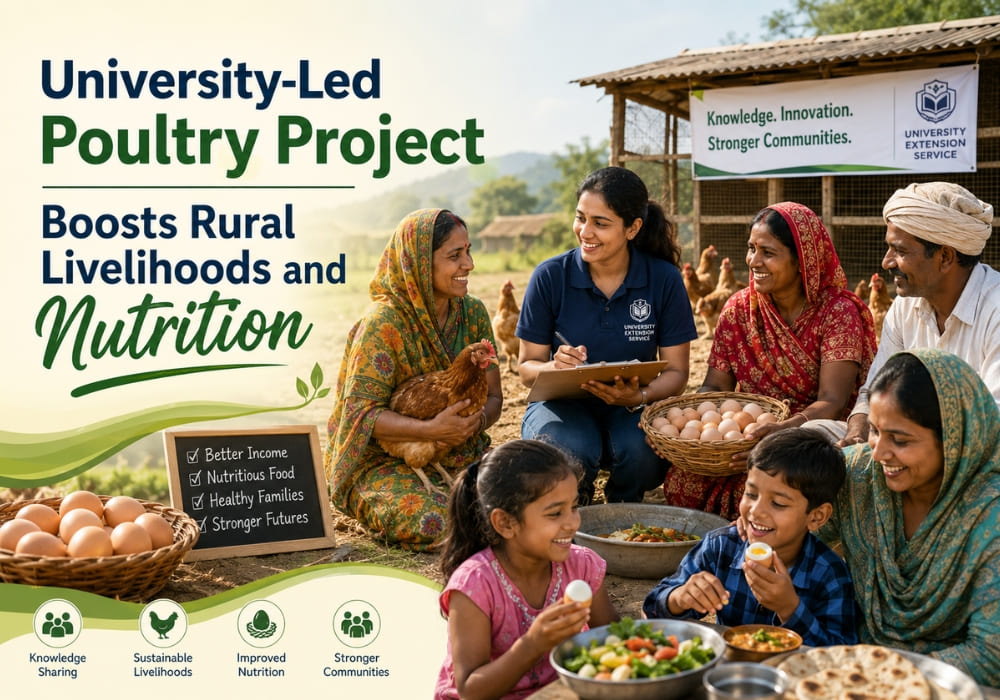
Author – Ritesh Ranjan: Universities are increasingly moving beyond classrooms and laboratories to address practical challenges faced by rural communities. A new university-led poultry project is demonstrating how academic research, quality agricultural inputs and technical support can work together to improve household incomes, strengthen nutrition and promote inclusive rural development.
The initiative responds to a common problem among small-scale poultry farmers: limited access to healthy chicks, balanced feed, vaccines, veterinary services and reliable technical guidance. Without these essential resources, farmers often experience disease outbreaks, poor flock growth, high mortality rates and low financial returns.
By connecting rural households with scientific knowledge and dependable poultry inputs, the project is helping transform poultry farming from a high-risk activity into a more productive and sustainable livelihood opportunity.
Turning Academic Research into Rural Solutions
University-Led – One of the project’s most important features is its university-led extension model. Agricultural extension programmes connect researchers, faculty members and students with farmers, allowing knowledge developed within academic institutions to reach communities that can benefit from it.
Research alone cannot create meaningful change unless its findings are translated into practical solutions. Through farmer training, field demonstrations, regular consultations and technical assistance, the university ensures that poultry-related research is converted into methods that rural households can understand and adopt.
Farmers are guided on important areas such as:
- Selecting healthy and productive poultry breeds
- Constructing safe and affordable poultry housing
- Maintaining cleanliness and farm hygiene
- Providing balanced feed and clean drinking water
- Following vaccination schedules
- Identifying early symptoms of poultry diseases
- Managing chicks during their most vulnerable stages
- Improving egg and meat production
- Maintaining basic farm and income records
This practical approach helps farmers make informed decisions while reducing avoidable losses.
Addressing Challenges Faced by Small Poultry Farmers
Small-scale poultry farmers frequently operate with limited resources. Many purchase chicks from unreliable suppliers, use poorly formulated feed or depend on informal advice when birds become sick. In some villages, professional veterinary support may not be easily accessible.
These challenges can make poultry farming unpredictable. A single disease outbreak may destroy an entire flock, resulting in a serious financial setback for a low-income household.
The university-led project addresses these difficulties by creating a structured support system. Farmers receive access to better-quality inputs along with information on how to use them correctly. This combination is important because distributing chicks or feed without proper training may not deliver lasting results.
When farmers understand poultry health, feeding, housing and disease prevention, they are better prepared to manage their farms independently. Over time, this improves productivity, builds confidence and encourages households to expand their poultry activities.
Why Poultry Farming Matters for Rural Livelihoods
Poultry farming is one of the most accessible livestock-based livelihood opportunities for rural families. Compared with larger livestock such as cattle or buffaloes, poultry requires less land, lower initial investment and relatively simple infrastructure.
Birds also grow quickly and can provide returns within a shorter period. Families can earn income by selling eggs, chicks, mature birds and poultry manure. This regular flow of small earnings can help households meet daily expenses, pay school fees, purchase medicines or manage emergencies.
For landless households and marginal farmers, poultry can be particularly valuable because it does not require large agricultural fields. A small unit can be operated near the home, making it suitable for families with limited land and capital.
The project therefore supports not only agricultural production but also income diversification. Households that depend entirely on seasonal crops are vulnerable to droughts, floods, market fluctuations and crop failures. Poultry farming can provide an additional source of income and reduce dependence on a single livelihood.
Supporting Better Household Nutrition
The initiative also has significant nutritional value. Eggs and chicken are rich sources of high-quality protein and contain essential nutrients required for growth, immunity and overall health.
In communities where diets are heavily dependent on cereals and lack adequate protein, household poultry farming can improve access to nutritious food. Families can consume part of their egg and meat production while selling the remaining quantity in local markets.
Regular access to eggs can be especially beneficial for children, pregnant women, nursing mothers and older adults. By making nutrient-rich food more available at the household level, poultry farming can contribute to improved dietary diversity.
This is what makes the project more than an income-generation programme. It addresses economic and nutritional challenges together, creating benefits that can influence the health and well-being of entire families.
Agricultural Extension as a Bridge Between Science and Society
Agricultural extension serves as a bridge connecting scientific institutions with farming communities. Universities are well positioned to lead this process because they have access to researchers, laboratories, students, demonstration farms and subject experts.
Through extension activities, universities can test poultry innovations under local conditions before recommending them to farmers. They can also monitor results, collect feedback and improve their recommendations based on the experiences of rural households.
This two-way exchange benefits both farmers and academic institutions. Farmers receive practical solutions, while researchers gain a better understanding of real-world agricultural problems.
Students also benefit from field-based learning. By interacting with poultry farmers, students can observe how scientific principles are applied outside the classroom. Such exposure can encourage them to develop practical innovations that are affordable, locally relevant and easy to adopt.
Building Trust Through Local Engagement
Trust plays a major role in the adoption of new farming practices. Rural households may hesitate to invest in unfamiliar breeds, feeds or technologies, particularly when previous experiences have resulted in financial losses.
University-led programmes can help overcome this hesitation by providing credible, evidence-based guidance. Farmers are more likely to try new methods when they can observe demonstrations, speak directly with experts and see successful results within their own communities.
Demonstration farms and local farmer groups can strengthen this process. When one household successfully improves egg production or reduces bird mortality, neighbouring farmers are more likely to adopt similar practices.
This community-based learning creates a multiplier effect. Knowledge shared with a limited number of participants can gradually spread across villages, expanding the project’s impact.
Creating Opportunities for Rural Women
Poultry farming can be particularly effective in supporting women’s economic participation. In many rural households, women already manage backyard poultry while also handling domestic responsibilities.
With access to training, quality inputs and market connections, these activities can develop into reliable microenterprises. Women can earn and manage income from the sale of eggs and birds, strengthening their role in household financial decisions.
Women-led poultry groups and self-help groups can also purchase inputs collectively, access credit and negotiate better market prices. Group-based models reduce individual risk while creating opportunities for shared learning and cooperation.
As women gain greater control over household income, spending on food, education and healthcare may also improve. Therefore, investment in poultry development can support wider goals related to gender inclusion and community well-being.
Promoting Rural Entrepreneurship and Local Markets
The benefits of the project extend beyond individual poultry farmers. A growing poultry sector can create demand for chick suppliers, feed sellers, vaccinators, transport providers, equipment manufacturers and local traders.
Young people can explore business opportunities in feed production, hatchery management, veterinary support, egg collection, poultry processing and direct marketing. These activities help generate employment within rural areas and reduce the need for migration in search of work.
Local institutions can also support farmers in forming producer groups or cooperatives. Collective marketing allows smallholders to combine their output, reduce transportation costs and negotiate more effectively with buyers.
Digital platforms may further help farmers access market information, technical advice and customers. By linking scientific support with entrepreneurship and market development, university-led poultry projects can contribute to stronger rural economies.
A Scalable Model for Inclusive Rural Development
The poultry initiative offers a practical model that can be adapted by universities, agricultural institutions, government departments and development organisations in other regions.
However, successful expansion requires more than distributing poultry inputs. Long-term impact depends on continuous training, disease surveillance, veterinary support, market access and regular monitoring.
Programmes must also be designed according to local conditions. Poultry breeds, housing systems and feeding practices should reflect the region’s climate, available resources, cultural preferences and market demand.
Partnerships can make these initiatives more effective. Universities can collaborate with local governments, farmer organisations, veterinary departments, financial institutions and private poultry companies to build a complete support system.
When these stakeholders work together, small-scale poultry farming can become safer, more profitable and more sustainable.
Conclusion
The university-led poultry project shows how academic knowledge can generate meaningful change when it reaches the grassroots. By improving access to quality chicks, feed, vaccines, training and technical guidance, the initiative is helping rural households reduce poultry losses, increase production and create additional income.
Its impact extends beyond farming. The project supports household nutrition, rural entrepreneurship, women’s participation, student learning and local economic development.
As institutions search for effective ways to address rural poverty and food insecurity, university-driven agricultural extension provides a strong and scalable solution. When research is combined with community engagement and dependable support, poultry farming can become a powerful tool for economic empowerment, nutritional security and resilient rural development.
Frequently Asked Questions
1. What is a university-led poultry project?
A university-led poultry project is an agricultural extension initiative through which university researchers, faculty members and students provide poultry farmers with scientific training, technical guidance, improved inputs and field-level support.
2. How does poultry farming improve rural livelihoods?
Poultry farming provides income through the sale of eggs, chicks, mature birds and manure. It requires relatively low investment, offers quicker returns than many other livestock activities and can be operated by households with limited land.
3. How can poultry farming improve household nutrition?
Eggs and chicken provide high-quality protein and essential nutrients. Families that raise poultry can consume some of their production, improving dietary diversity and access to nutritious food, particularly for children and women.
4. Why is technical support important for poultry farmers?
Technical support helps farmers choose suitable breeds, provide balanced feed, maintain proper housing, follow vaccination schedules and detect diseases early. These practices reduce bird mortality and improve farm profitability.
5. How can university poultry projects support rural women?
Such projects can provide women with training, quality inputs, access to credit and market connections. Since many rural women already manage backyard poultry, structured support can help them turn small household activities into sustainable income-generating enterprises.
Next article
NSUT Admission 2026 guide eligibility, JEE Main entrance details, JAC Delhi counselling dates, selection process, cutoffs & documents