
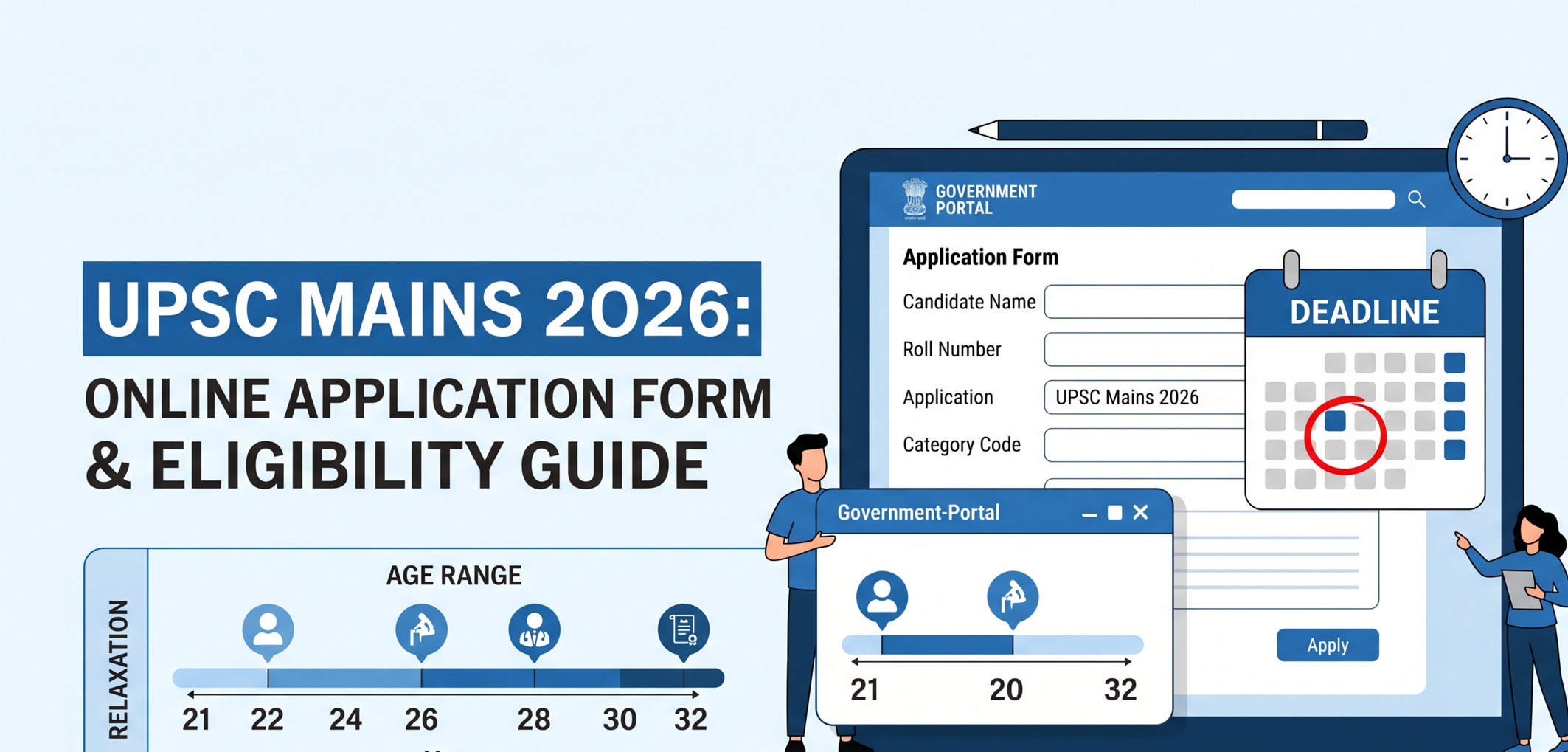
If you cleared UPSC Prelims 2026, the real race has just begun — and right now, the most urgent task on your desk is the UPSC Civil Services IAS Mains Online Form 2026. The application link went live on 19 June 2026, and the window closes on 29 June 2026. Miss this date, and there’s no second chance, no matter how hard you’ve worked for Prelims.
This guide walks you through everything you need: the exact dates, eligibility rules, step-by-step form-filling process, document checklist, common mistakes candidates make, and a realistic preparation roadmap for the two months leading up to the Mains exam on 21 August 2026. Whether you’re a first-time aspirant or a repeat candidate fine-tuning your strategy, this article gives you the practical, no-fluff information you actually need.
UPSC Civil Services Mains Exam 2026?
The UPSC Civil Services Examination is conducted in three stages: Preliminary, Mains, and Interview (Personality Test). Only candidates who clear the Prelims cut-off are invited to fill the Mains application — this is called the Detailed Application Form (DAF-I).
The Mains exam tests depth, not just recall. It includes nine descriptive papers — Essay, four General Studies papers, two Optional Subject papers, and two qualifying language papers — designed to evaluate analytical thinking, writing ability, and command over a chosen subject. This stage decides who moves on to the interview round and, eventually, who gets a service allocation in IAS, IPS, IFS, or one of the other Central Civil Services.
Important Dates
Here’s the complete timeline candidates should track closely:
Event
Date
UPSC Prelims 2026 Exam
24 May 2026
Mains Online Form (DAF) Activation
19 June 2026
Last Date to Submit Mains Form
29 June 2026
UPSC Mains 2026 Exam
Starting 21 August 2026 (5 days)
Mains Admit Card Release
Around 15–20 days before the exam
A few points worth noting:
The Mains form is only for candidates who cleared the Prelims cut-off. There’s no separate notification — UPSC directly emails or messages qualified candidates, but it’s safer to check your status yourself on the official portal rather than wait for a notification.
The exam window typically spans five days, so plan personal leave, travel, and accommodation early — hotel and travel costs near exam centers spike close to the date.
Always cross-check dates on upsc.gov.in or upsconline.nic.in, since UPSC occasionally extends deadlines by a day or two due to technical issues.
Eligibility Criteria
Eligibility for the Mains stage mirrors the original Prelims notification, but it’s worth re-confirming before you submit the form.
Age Limit
Minimum Age: 21 years
Maximum Age: 32 years (for the General category)
Candidates must be born not earlier than 2 August 1994 and not later than 1 August 2005
Age Relaxation (as per standard UPSC norms)
OBC: up to 3 years
SC/ST: up to 5 years
PwBD candidates: up to 10 years
Additional relaxations apply for defence personnel, ex-servicemen, and certain J&K domicile candidates for specific exam years
Educational Qualification
A degree from a recognized university, or an equivalent qualification recognized by the Government of India
Final-year students awaiting results can apply provisionally, but must produce proof of having passed the qualifying exam at the time of DAF submission
Number of Attempts
General: 6 attempts
OBC: 9 attempts
SC/ST: Unlimited attempts (within the age limit)
PwBD: Relaxed attempt limits as per category
Practical tip: Many candidates assume the Mains form has separate eligibility from Prelims — it doesn’t. If you had any discrepancy in your Prelims application (like a category certificate issue), resolve it now, because DAF scrutiny is far stricter than Prelims scrutiny.
Fill the Mains Form
Visit the official portal: Go to upsconline.nic.in and log in using your existing One-Time Registration (OTR) credentials — you don’t need to register again.
Check qualification status: Only Prelims-qualified candidates can access the Mains DAF link.
Fill Part I of DAF: Enter personal details, communication address, and confirm your photograph/signature uploaded earlier.
Select your Optional Subject: This is one of the most important choices in the entire exam — choose carefully based on your background, interest, and availability of study material.
Choose exam centre: Pick from the list of available Mains centres; options are usually fewer than Prelims centres, so check availability early.
Fill service and cadre preferences (if applicable): Some cycles allow preliminary preference filling at this stage; follow the on-screen instructions exactly.
Upload required documents: Category certificate, PwBD certificate, or other relevant proofs if applicable.
Review and submit: Double-check every field — once submitted, corrections are extremely limited or not allowed at all for Mains.
Download and save confirmation: Always save a PDF copy of your submitted DAF for your records.
Practical example: A candidate from Lucknow applying for the first time should keep scanned copies of their graduation degree, category certificate (if applicable), and a recent passport-size photo ready before starting the form — this alone saves 30–40 minutes of last-minute scrambling.
Application Fee Details
General/EWS/OBC candidates: ₹100
SC/ST/PwBD/Women candidates: No fee
Payment can be made online via net banking, debit/credit card, or through SBI challan at designated branches (cash mode, where applicable)
Fee once paid is non-refundable, so verify all your details before making the payment.
Documents You’ll Need
Keep these ready in scanned, UPSC-compliant format before you start:
Recent passport-size photograph (as per UPSC’s prescribed size and format)
Scanned signature
Graduation degree / provisional certificate
Category certificate (SC/ST/OBC-NCL, if applicable)
PwBD certificate (if applicable)
Ex-servicemen certificate (if applicable)
Valid ID proof (Aadhaar, PAN, passport, etc.)
DAF — What It Really Means
The Detailed Application Form (DAF) isn’t just a formality — it’s the document UPSC interview boards use to ask you personal questions later. Every detail you fill here, from your hobbies to your work experience, can become an interview question months later.
Insight from successful candidates: Treat the DAF as a mini-introduction to your interview board. Don’t list hobbies or achievements you can’t speak confidently about — interview panels often probe exactly these details.
Common Mistakes to Avoid
Waiting until the last day: Server load spikes in the final 24–48 hours, causing failed submissions. Apply at least 3–4 days early.
Choosing the wrong optional subject under pressure: Don’t pick an optional just because a friend is scoring well in it — match it to your own strengths.
Mismatched details between Prelims and Mains forms: Even minor spelling differences in your name or date of birth can trigger DAF scrutiny issues later.
Ignoring document format guidelines: Photos or signatures that don’t match UPSC’s size/format specs often get rejected during upload.
Not saving the confirmation page: Always download your final submitted form — UPSC support requests often need this as proof.
Forgetting to verify exam centre availability: Mains centres fill up; if your preferred city isn’t selectable, you may be allotted a distant centre.
Preparation Strategy for the Next 60 Days
With roughly two months between the form submission and the actual exam, structure your time wisely:
Weeks 1–3: Foundation and Optional Subject
Revise your optional subject syllabus thoroughly — this carries 500 marks (two papers of 250 each)
Start daily answer writing practice, even if it’s just 2–3 questions a day
Weeks 4–6: General Studies Deep Dive
Focus on GS papers (Governance, Ethics, Economy, International Relations, Environment)
Use current affairs from the last 12 months — link them to static syllabus topics
Weeks 7–8: Mock Tests and Revision
Join a structured Mains test series for at least 8–10 full-length mocks
Get answers evaluated by mentors or peer groups — self-evaluation alone won’t reveal blind spots
Revise the Essay paper separately; many candidates underprepare for it
Daily Habits That Matter
Newspaper reading focused on editorial analysis, not just headlines
Answer writing under timed conditions (this builds speed for the actual 3-hour papers)
Short daily revision of static portions (Polity, Geography, History) to avoid last-minute cramming
Conclusion
The UPSC Civil Services Mains Online Form 2026 is a narrow but critical window — ten days that decide whether your months of Prelims preparation translate into a real shot at the services. Fill the form carefully, keep your documents ready, and don’t leave submission to the last moment. More importantly, use the weeks between now and the Mains exam on 21 August 2026 wisely: prioritize answer writing, revise your optional subject, and stay consistent with current affairs. Civil services success rarely comes from cramming in the final week — it comes from steady, focused preparation starting today.
The National Medical Commission (NMC) has released the approved MBBS seat matrix for the academic year 2026–27, bringing an important update for students preparing for NEET UG 2026 counselling. According to the matrix, India now has 1,36,939 MBBS seats across 823 medical colleges, excluding seats offered by Institutes of National Importance such as AIIMS and JIPMER.
The seat matrix was issued by the Medical Assessment and Rating Board (MARB) through a public notice dated July 14, 2026, based on the approved position as of July 13. It includes renewed seats, newly approved medical colleges and increases in the intake capacity of existing institutions.
NMC MBBS Seat Matrix 2026: Key Highlights
Here are the most important numbers announced for the 2026–27 admission session:
Particular
Details
Total medical colleges
823
Total MBBS seats
1,36,939
Government medical colleges
441
Private medical colleges
382
Government MBBS seats
63,296
Private MBBS seats
73,643
Renewed seats
1,27,028
Newly approved seats
9,911
New medical colleges
25
Seats added through new colleges
2,400
The overall MBBS capacity has increased from 1,27,028 seats to 1,36,939 seats, representing the addition of 9,911 seats. This is an increase of approximately 7.8% over the previous approved capacity.
Private Medical Colleges Account for Most New Seats
Private medical institutions have contributed the largest share of the expansion announced for 2026–27.
Government medical colleges now offer 63,296 seats, including 2,111 newly approved seats. Private medical colleges account for 73,643 seats, including 7,800 newly approved seats. Therefore, nearly four out of every five additional seats in the latest expansion have come from private institutions.
Although the increase provides students with more options, candidates must carefully examine the tuition fees, hostel charges, bond requirements, location, hospital facilities and recognition status of private institutions before filling their counselling choices.
25 New Medical Colleges Approved
NMC has approved 25 new medical colleges for the 2026–27 academic year. These colleges together contribute 2,400 MBBS seats.
Of the newly approved institutions:
Seven are government medical colleges offering 400 seats.
Eighteen are private medical colleges offering 2,000 seats.
States receiving new colleges include Chhattisgarh, Rajasthan, Karnataka, Maharashtra, Bihar, Andhra Pradesh, Uttar Pradesh, Haryana, Jharkhand, Sikkim, Tamil Nadu, Telangana and West Bengal.
The expansion is expected to provide more regional opportunities for medical aspirants, particularly in states where the number of candidates competing for MBBS admission is significantly higher than the available government seats.
State-Wise MBBS Seats: Leading States in 2026
Karnataka continues to have the highest number of MBBS seats in India. Uttar Pradesh has the highest number of medical colleges, while Tamil Nadu and Maharashtra also remain among the country’s largest medical-education hubs.
The leading states according to the NMC MBBS seat matrix 2026–27 are:
State
Total MBBS Seats
Karnataka
15,395
Uttar Pradesh
14,000
Tamil Nadu
13,999
Maharashtra
13,099
Telangana
10,250
Rajasthan
8,080
Gujarat
7,750
Andhra Pradesh
7,465
West Bengal
7,200
Madhya Pradesh
6,020
Karnataka has 15,395 seats across 75 colleges. Uttar Pradesh offers 14,000 seats across 88 colleges, the highest number of medical institutions among all states. Tamil Nadu offers 13,999 seats, followed closely by Maharashtra with 13,099 seats.
States Recording Major Seat Increases
Karnataka has received the largest increase, with 1,300 additional seats. Tamil Nadu has added 950 seats, Rajasthan 900, West Bengal 825, Telangana 810 and Uttar Pradesh 800.
Bihar has gained 740 seats, while Madhya Pradesh, Maharashtra, Andhra Pradesh and Jharkhand have also recorded notable increases in MBBS capacity.
For students, the increase could create additional possibilities during later counselling rounds. However, it does not guarantee a uniform decline in admission cut-offs. NEET cut-offs will continue to depend on factors such as examination difficulty, candidate performance, category, domicile rules, reservation policies, college preferences and tuition fees.
What Does the Seat Increase Mean for NEET UG 2026 Aspirants?
The addition of nearly 10,000 seats is positive news for candidates seeking MBBS admission in India. More seats can lead to a greater number of choices during All India Quota and state counselling, especially for candidates willing to consider multiple states and different types of institutions.
Students should nevertheless distinguish between the NMC-approved intake and the seats displayed during an individual counselling round. The NMC matrix establishes the approved capacity of medical colleges. Actual seat allocation will be conducted by the Medical Counselling Committee for eligible central and All India Quota seats and by the respective state counselling authorities for state-quota and private-college seats.
Candidates should monitor the official counselling matrix before submitting their choices because seats may be added, removed or modified before or during counselling.
Is the NMC MBBS Seat Matrix 2026 Final?
The July 14 notice provides the approved matrix that counselling authorities are expected to follow. However, NMC has specifically clarified that the matrix may be revised based on decisions taken by the Appeal Committee or another competent authority.
Private colleges approved for a new institution or increased intake have also been asked to submit the required Electronic Bank Guarantee. Their Letter of Permission will be issued after the guarantee is received and found to be in order.
Therefore, students should consider the present matrix an official approved list, but they must check the latest NMC, MCC and state-counselling notifications before finalising their college preferences.
Conclusion
The NMC MBBS seat matrix 2026–27 marks a major expansion in India’s undergraduate medical-education capacity. With 1,36,939 seats across 823 colleges, aspirants have more opportunities than in the previous admission cycle.
Karnataka, Uttar Pradesh, Tamil Nadu and Maharashtra continue to offer the largest number of seats, while private colleges have driven most of the latest growth. Candidates should now compare colleges carefully, understand government and private fee structures, follow counselling deadlines and prepare a realistic choice-filling strategy based on their NEET UG rank.
Frequently Asked Questions
1. How many MBBS seats are available in India for 2026–27?
The NMC-approved matrix lists 1,36,939 MBBS seats across 823 medical colleges. The figure excludes seats offered by Institutes of National Importance such as AIIMS and JIPMER.
2. How many government MBBS seats are available in 2026?
There are 63,296 MBBS seats across 441 government medical colleges in the NMC matrix for 2026–27.
3. How many private MBBS seats are available in 2026?
Private medical colleges account for 73,643 seats across 382 institutions. This is higher than the number of seats available in government colleges.
4. Which state has the highest number of MBBS seats?
Karnataka has the highest number, with 15,395 MBBS seats. Uttar Pradesh follows with 14,000 seats, while Tamil Nadu has 13,999 seats.
5. Can the NMC MBBS seat matrix be revised?
Yes. NMC has stated that the approved matrix may be revised following decisions of the Appeal Committee or another competent authority. Candidates should check the latest counselling seat matrix before choice filling.