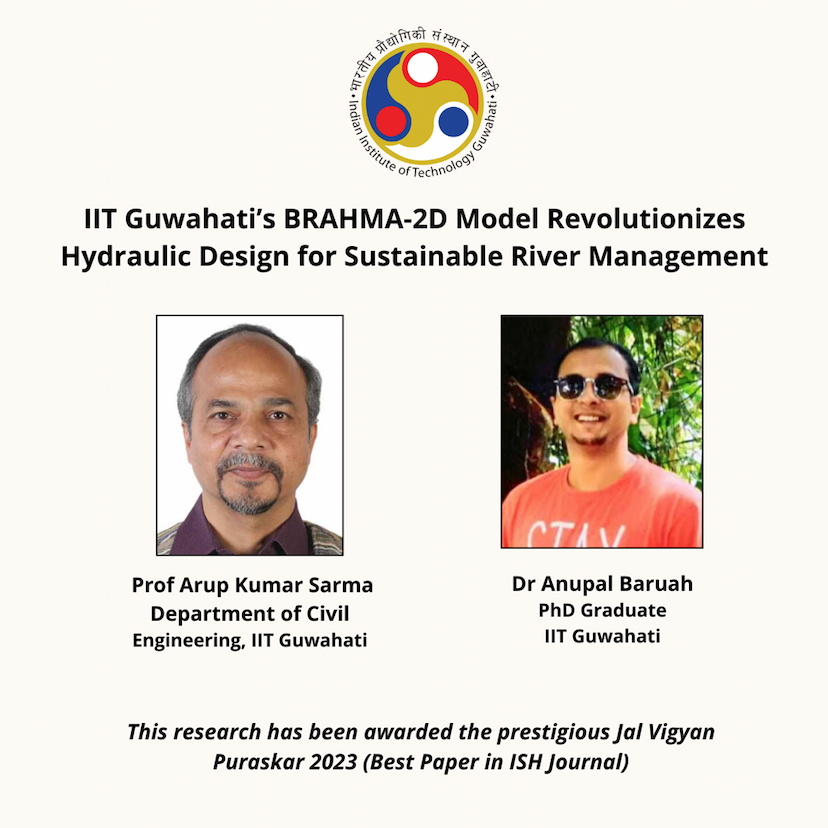
IIT Guwahati researchers led by Prof. Arup Kr Sarma in collaboration with the Brahmaputra Board, Ministry of Jal Shakti, Government of India have developed an indigenous river model BRAHMA-2D (Braided River Aid: Hydro-Morphological Analyzer).
This comprehensive mathematical model can help to understand flow of large braided rivers like Brahmaputra, providing valuable insights to field engineers to design sustainable hydraulic structures like Spurs, Revetment and other river bank protection measures.
Prediction
Predicting river flow variations across depth is crucial for flood and erosion control, agriculture and water supply intake design, and zero head energy production, say sources from IIT Guwahati.
Traditional measurement methods of flow velocity in deep, large rivers during high monsoons is risky and extremely difficult, prompting the use of mathematical models, say IIT Guwahati researchers.
However, existing models provide only average velocity, underestimating undercurrents at different depths, say IIT Guwahati researchers.
In braided rivers, the presence of sandbars further complicates accurate three-dimensional velocity computation.
Model
Speaking about the BRAHMA-2D model, Prof Arup Kr Sarma, Department of Civil Engineering, IIT Guwahati, said their mathematical model combines highly complex mathematical modelling with challenging field-based research on large braided rivers.
With this quasi-3D river flow model, we can understand how fast the water moves at different depths inside a river and its circulation around a structure like a spur installed for prevent river bank erosion, said Prof Arup of IIT Guwahati.
Integration
BRAHMA-2D integrates a two-dimensional model of water movement with a theory about entropy, a measure of disorder or randomness, say sources from IIT Guwahati.
The research also delves into how features like river banks, spurs, and sandbars affect the way water moves.
Specifically, it observes a dip phenomenon near spurs where the flow of water underneath increases, a phenomenon absent in points away from these structures.
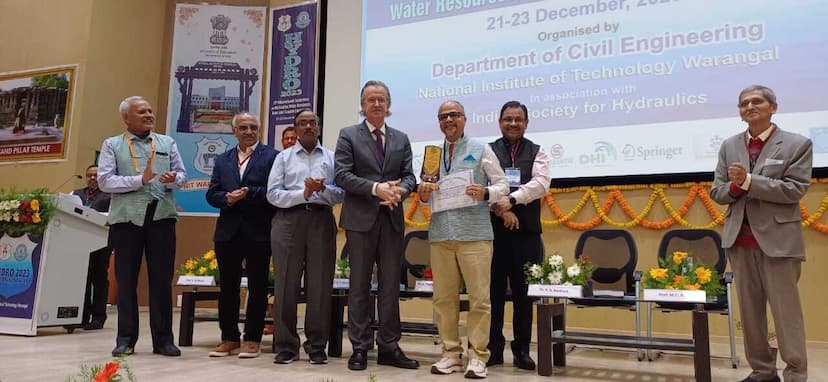
The award ceremony took place on 21st December 2023 at the Hydro-2023 conference hosted at NIT, Warangal. The paper has been co-authored by Prof Arup Kr Sarma and his former research scholar Dr Anupal Barua.
Validation
The model was successfully validated on the Brahmaputra River near Majuli Island, the second largest freshwater river Island in the world, prone to river bank erosion, say sources from IIT Guwahati.
Application
Dr Anupal Baruah, at present working as post-doctoral fellow at the University of Alabama, USA, highlighted the model’s successful application with the river survey data.
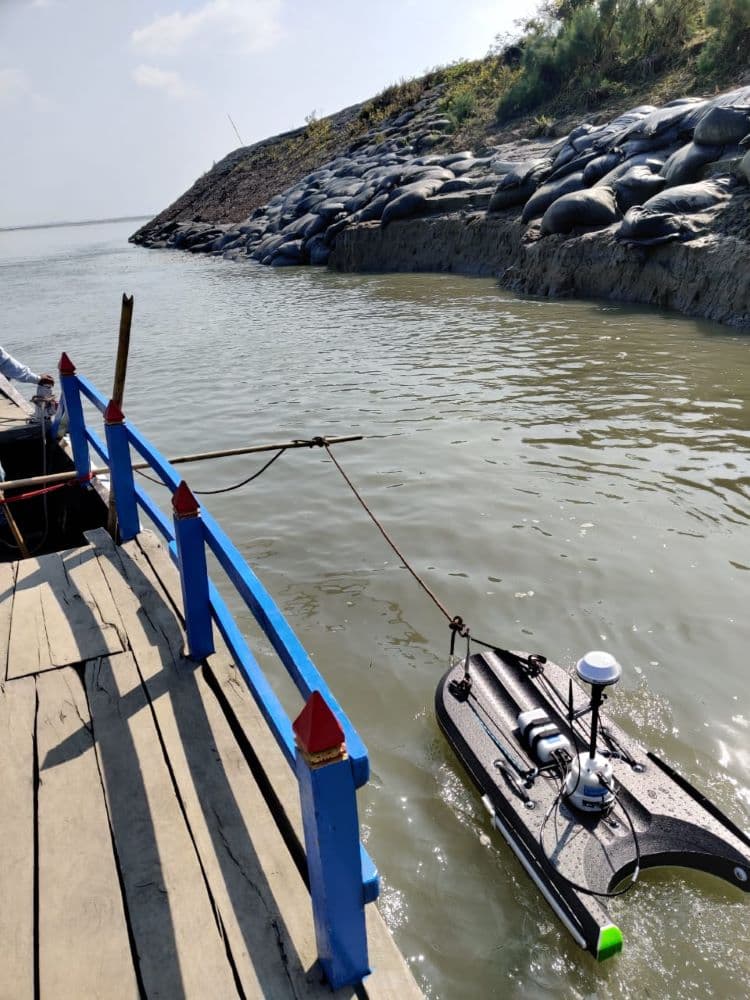
It uses GPS Echo-Sounder for depth and Acoustic Doppler Current Profiler, along with current meters for velocity measurement.
He emphasized, “During my research at IIT Guwahati field measurements near the spurs revealed a strong agreement with our model results.
The versatile model has further helped to design bioengineering methods for controlling river bank erosion, say sources from IIT Guwahati.
It has also been applied to understand habitat suitability of aquatic species, especially endangered species, based on the availability of required depth and flow velocity.
This breakthrough can now be applied to compute the vertical velocity profile at any desired location, say sources from IIT Guwahati.
Indian Institute of Technology Guwahati, established in 1994, completed 25 years of glorious existence in 2019.
At present, the Institute has eleven departments, nine interdisciplinary academic centres and five schools covering all the major engineering, science, healthcare, management, and humanities disciplines.
It offers BTech, BDes, BSc(Hons), MA, MDes, MTech, MSc, MS(R), MBA and PhD programmes. The institute offers a residential campus to 439 faculty members and more than 8,600 students at present.
S Vishnu Sharmaa now works with collegechalo.com in the news team. His work involves writing articles related to the education sector in India with a keen focus on higher education issues. Journalism has always been a passion for him. He has more than 10 years of enriching experience with various media organizations like Eenadu, Webdunia, News Today, Infodea. He also has a strong interest in writing about defence and railway related issues.
Choosing the right university is one of the biggest decisions a student makes, and if CGC University Mohali is on your shortlist for 2026, you probably have a dozen questions running through your head. How much does it actually cost? Am I even eligible? What’s this CGCUET exam everyone keeps mentioning? And most importantly — how much time do you have left?
This guide answers all of that in one place. We’ll walk through the CGC University Admission 2026 process step by step — fees, eligibility criteria, important dates, the entrance exam pattern, selection process, and practical preparation tips — so you can apply with confidence instead of guessing your way through it.
Table of Contents
What is CGC University, Mohali?
CGC University Admission 2026: Key Dates
Eligibility Criteria for 2026
CGCUET 2026: Exam Pattern Explained
Fee Structure 2026
Step-by-Step Application Process
Selection Process
How to Prepare for CGCUET
Common Mistakes to Avoid
Latest Trends & Updates
Key Takeaways
Conclusion
FAQs
What is CGC University, Mohali?
<cite index=”9-1″>CGC University was formerly known as Chandigarh Group of Colleges, Jhanjeri, and has now evolved into a full-fledged university located in Mohali, recognised by AICTE and UGC.</cite> It offers programs across engineering, management, law, science, pharmacy, and allied health sciences.
The university has built a reputation around industry connections and global exposure. <cite index=”10-1″>It has academic partnerships with over 150 institutions worldwide, including Fontys University in the Netherlands, the University of the Fraser Valley in Canada, Birmingham City University in the UK, Thomas More University in Belgium, and Arkansas State University in the USA.</cite>
On the rankings front, <cite index=”9-1″>CGC University has been listed among India’s Best Colleges by The Week-Hansa Research Survey 2026, and it ranked between 101–125 in the Management category in the NIRF 2025 rankings.</cite>
If you’re comparing universities purely on “will this help my career,” placements are worth a look too. <cite index=”10-1″>The highest package offered at CGC Mohali reached INR 1 crore per annum, with an average package around INR 10 LPA during the 2026 placement season.</cite> Keep in mind averages and highest packages vary by stream — engineering and management typically pull these numbers up, so always check department-wise placement data before assuming it applies to your course.
CGC University Admission 2026: Key Dates
Admission timelines at CGC University move in phases, and deadlines have been extended more than once this cycle — so treat any date below as time-sensitive and always cross-check on the official portal before you plan around it.
Event
Status / Date (2026)
Application form release
Ongoing
CGCUET Phase I
Tentatively June 2026
CGCUET Stage 2 registration
Extended to 22nd July 2026
BTech application closing (extended)
Around 30th March 2026 (varies by source)
B.Sc. application closing
14th April 2026
Scholarship redemption window
Within 30 days of result declaration
A few things worth noting:
<cite index=”13-1″>The CGCUET Stage 2 last date has been pushed to 22nd July 2026, with limited seats remaining for scholarships worth up to 50 crore in total.</cite>
<cite index=”9-1″>The last date to register for CGCUET has been extended multiple times this admission cycle, most recently to Jul 22, 2026.</cite>
<cite index=”11-1″>Students who qualify for scholarships through CGCUET must claim them within 30 days from the date the result is declared</cite> — miss that window and you could lose the benefit entirely, so don’t sit on your results.
Practical tip: Because CGC runs a rolling, phase-wise admission cycle rather than one fixed deadline, applying early almost always works in your favor — earlier applicants get first pick of exam slots, hostel seats, and specialization choices before they fill up.
Eligibility Criteria for 2026
Eligibility depends on the level of study you’re applying for.
Undergraduate (UG) Programs
<cite index=”2-1″>UG programs generally require 45–50% marks in 10+2</cite>, though the exact percentage and subject combination depend on your chosen course. For example, engineering aspirants need specific science subjects at the 12th-grade level.
For B.Tech specifically: <cite index=”3-1″>candidates need Class 12 with Physics and Mathematics as mandatory subjects, along with one of the following — Chemistry, Computer Science, Electronics, IT, Biology, Informatics Practices, Biotechnology, Agriculture, Engineering Graphics, or Business Studies.</cite>
Postgraduate (PG) Programs
<cite index=”2-1″>PG programs demand a relevant bachelor’s degree with 50–60% marks</cite>, depending on the specialization — MBA, MCA, and M.Tech each have their own subject-relevance requirements.
Doctoral (Ph.D.) Programs
<cite index=”2-1″>Ph.D. admissions require a master’s degree with at least 55% marks, supported by NET/JRF qualification or a valid CGCUET score.</cite>
Entrance Exams Accepted
CGC University doesn’t force everyone through a single exam. <cite index=”9-1″>The college accepts national-level entrance exams like JEE Main for BTech courses, and for MBA, it accepts CMAT, PTU MBA scores, along with CGCUET.</cite> Similarly, <cite index=”1-1″>BTech admissions require valid JEE Main scores, while GATE is a prerequisite specifically for M.Tech admissions — though CGCUET scores are accepted as an alternative route.</cite>
Quick way to think about it: if you already have a JEE Main, CAT, MAT, CMAT, or GATE score, you can likely use it directly. If not, CGCUET becomes your entry point — and it doubles as a scholarship test.
CGCUET 2026: Exam Pattern Explained
CGCUET (CGC University Entrance Test) is the university’s own scholarship-linked entrance exam, and understanding its format matters if you’re aiming for a fee waiver.
<cite index=”1-1″>It is an online, computer-based exam with 50 multiple-choice questions to be completed in 50 minutes.</cite>
<cite index=”1-1″>Every correct answer earns +2 marks, and there is no negative marking.</cite>
<cite index=”1-1″>No minimum qualifying percentage is required just to appear for the test.</cite>
<cite index=”1-1″>Results are typically declared within 24 hours of taking the test.</cite>
<cite index=”1-1″>Scoring well can earn candidates up to a 100% waiver on tuition fees.</cite>
That last point is the real draw — CGCUET isn’t just an admission gate, it’s a scholarship mechanism. A strong score can meaningfully reduce your total fee outlay over the course duration.
Registration process: <cite index=”14-1″>After registering on the CGCUET portal, you receive a username and password via SMS and email, after which you book your preferred test slot and pay a registration fee of ₹1,000, which covers both the prospectus and the test fee.</cite> <cite index=”14-1″>Applications open in two phases, and you can apply anytime within either phase.</cite>
Fee Structure 2026
Fees vary widely by program, specialization, and whether you qualify for a CGCUET scholarship. Here’s a general picture:
Program
Approximate Total Tuition Fee
B.Tech (4 years)
<cite index=”8-1″>Between INR 4.9 lakh and INR 9.2 lakh</cite>
The MBA figure covers tuition only — <cite index=”8-1″>the full MBA fee structure also includes examination fees and training fees as separate components</cite>, so budget for more than just the headline tuition number.
B.Tech fees range so widely (₹4.9L–₹9.2L) because it depends heavily on the specialization — newer, high-demand branches like AI & ML, Cyber Security, or Quantum Computing often sit at the higher end.
Fee figures published by aggregator sites are indicative, not final. Always confirm the exact figure for your specific course and year directly on the official CGC University fee structure page before making any financial commitment.
If you qualify for a CGCUET scholarship, your effective fee could drop significantly — some promotional offers this cycle mention an additional 10% scholarship on top of CGCUET-based waivers for early applicants.
Step-by-Step Application Process
The application itself is designed to be quick. <cite index=”2-1″>CGC University offers a fully online, quick, and transparent admission system that takes just 10–15 minutes to complete.</cite>
Here’s how it works in practice:
Register online on the official CGC University or CGCUET portal with your basic details.
Receive login credentials via SMS and email.
Choose your program and fill in academic details.
Upload documents — mark sheets, ID proof, photographs, and category certificates if applicable.
Pay the application fee (₹1,000 for CGCUET registration).
Book your CGCUET slot (date and time) if the exam applies to your program, or submit your existing entrance score (JEE Main, CAT, MAT, CMAT, GATE).
Appear for CGCUET or wait for merit list depending on your program’s process.
Check results — usually within 24 hours for CGCUET.
Complete document verification and pay the admission fee to confirm your seat.
<cite index=”2-1″>Applicants who apply online upload scanned copies of their documents, while those applying offline must present original documents during physical verification. Missing documents can delay or hold up the admission process</cite> — so double-check your document checklist before you start.
Selection Process
<cite index=”3-1″>Admission at CGC University is based on both merit and entrance exam performance, depending on the programme, and applications are accepted in both online and offline modes.</cite>
Broadly, the process splits into two tracks:
Merit-based track: <cite index=”3-1″>For programs like M.P.Ed and BPT, the university selects students purely based on Class 12 qualifying exam marks.</cite>
Entrance-based track: <cite index=”3-1″>For most other programs, admission is based on the CGCUET score or another accepted national-level entrance exam.</cite>
<cite index=”1-1″>For certain professional courses, the process also includes a group discussion and personal interview round after the initial merit or entrance stage</cite> — so if you’re applying to management or law programs, prepare for that additional round beyond just the written test.
Once selected, <cite index=”3-1″>candidates must pay the course fee to confirm their admission after completing all selection rounds.</cite>
How to Prepare for CGCUET
Since CGCUET has no negative marking and a relatively short 50-minute window for 50 questions, your prep strategy should focus on speed and accuracy rather than depth alone. A few practical tips:
Attempt every question. With no negative marking, leaving a question blank only costs you potential marks — there’s no downside to an educated guess.
Time yourself. 50 minutes for 50 questions gives you roughly one minute per question. Practice with a timer so pacing becomes automatic.
Focus on Class 11–12 fundamentals. The test typically draws on core subject knowledge relevant to your chosen stream (science, commerce, or humanities), so revisit your board syllabus rather than chasing unrelated competitive-exam material.
Take it early in the application window. Since results come out within 24 hours and scholarships are tied to your score, an early attempt gives you room to retake or improve if a second phase is available.
Don’t skip the interview prep for professional courses. If your program includes a group discussion or personal interview, practice articulating your “why this course, why this university” answer clearly — interviewers often weigh clarity of intent as much as academic scores.
Common Mistakes to Avoid
Waiting until the last date. Deadlines have already been extended multiple times this cycle, but relying on another extension is risky — apply as soon as you’re ready.
Ignoring the scholarship redemption window. A great CGCUET score is wasted if you don’t claim your scholarship within the 30-day window after results.
Submitting incomplete documents. Missing paperwork is one of the most common reasons applications get delayed or held.
Assuming one fee figure applies to all specializations. B.Tech fees alone range across several lakhs depending on the branch — always check the exact figure for your specific specialization.
Not comparing entrance exam options. If you already have a JEE Main, CAT, or GATE score, you may not need to take CGCUET at all — check which route is faster for your situation.
Latest Trends & Updates
CGC University has been actively expanding its course catalog to match industry demand. <cite index=”12-1″>Newer offerings include B.Tech CSE with a Generative AI specialization, B.Tech Electronics & Communication with minors in Data Science and AI, B.Tech CSE in Quantum Computing, and an MBA in Fintech developed with KPMG.</cite>
<cite index=”9-1″>The university has also introduced new programs in medical and science fields, including a Bachelor of Radiation Therapy Technology (B.RTT).</cite>
This pattern — new specializations tied to AI, data science, and fintech — reflects a broader shift across Indian private universities toward industry-aligned, future-ready curricula. If you’re choosing a specialization purely on employability, these newer, tech-forward branches are worth evaluating alongside traditional ones.
Key Takeaways
CGC University Admission 2026 is open now, with rolling deadlines that have already been extended multiple times.
CGCUET is a 50-question, 50-minute test with no negative marking, and a good score can unlock up to a 100% tuition waiver.
Eligibility ranges from 45–50% in 10+2 for UG, 50–60% for PG, and a master’s degree with 55%+ (plus NET/JRF) for Ph.D.
B.Tech tuition ranges roughly from ₹4.9 lakh to ₹9.2 lakh depending on specialization; MBA tuition is around ₹1.20 lakh.
The full application takes about 10–15 minutes online but requires accurate documents to avoid delays.
Scholarships must be claimed within 30 days of result declaration — don’t let that window pass.
Conclusion
CGC University’s 2026 admission process is fairly straightforward once you break it into stages: check your eligibility, decide whether you’ll use CGCUET or an existing entrance score, apply within the current phase, and follow through on document verification and fee payment. The biggest risk isn’t the difficulty of the process — it’s procrastination. With deadlines already extended and scholarship windows time-bound, your best move is to start your application now, keep your documents ready, and treat CGCUET as both an entry test and a real opportunity to cut your tuition costs. Always confirm the latest fees, dates, and eligibility on the official CGC University website before making any final decisions, since these details can shift during an active admission cycle.
FAQs
1. What is the last date for CGC University Admission 2026? Application deadlines vary by program and have been extended several times this cycle — CGCUET Stage 2 registration was recently extended to 22nd July 2026. Always confirm the current deadline on the official portal.
2. Is CGCUET compulsory for CGC University admission? Not always. Students with valid JEE Main, CAT, MAT, CMAT, or GATE scores can use those instead, depending on the program. CGCUET is required mainly for students seeking a scholarship or without another accepted entrance score.
3. What is the eligibility for B.Tech at CGC University? Candidates need Class 12 with Physics and Mathematics as compulsory subjects, plus one additional subject such as Chemistry, Computer Science, or Biology, along with the minimum required percentage.
4. How much does B.Tech cost at CGC University? Total tuition fees for B.Tech range approximately between ₹4.9 lakh and ₹9.2 lakh across the full course duration, depending on the specialization chosen.
5. Can CGCUET scores get me a full scholarship? Yes, a strong CGCUET score can earn up to a 100% tuition fee waiver, though the exact scholarship slab depends on your score and the specific program.
6. How long does the CGC University application take to complete? The fully online process typically takes about 10 to 15 minutes, provided you have your documents and academic details ready in advance.
7. What happens after I qualify for a CGCUET scholars
You must redeem the scholarship within 30 days of the result declaration date, or you risk losing the benefit.