

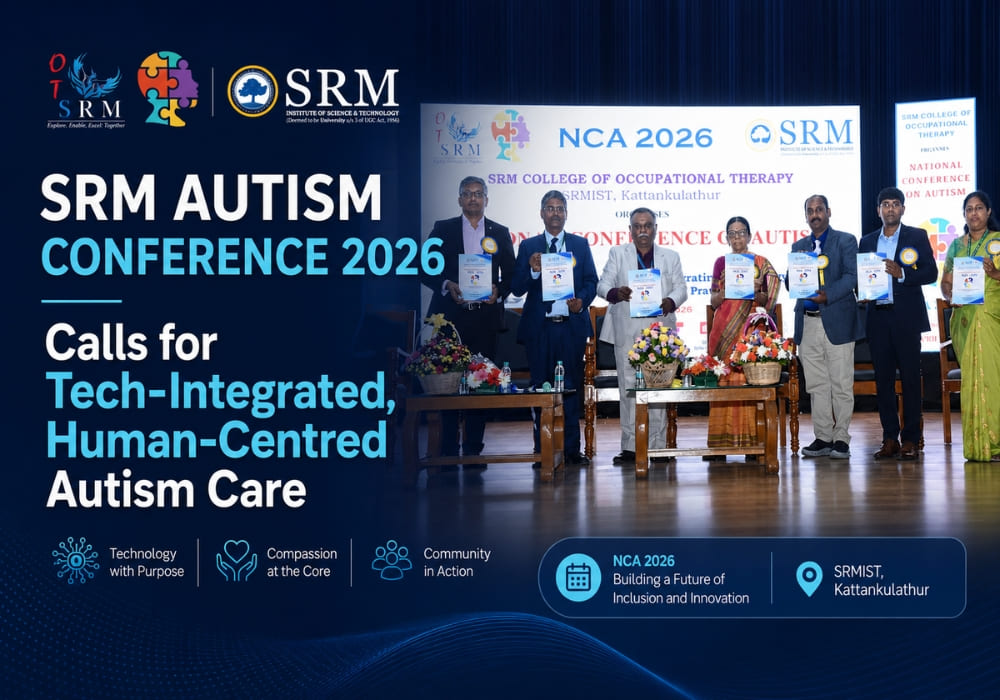
Author – Ritesh Ranjan: The National Conference on Autism 2026, hosted by the SRM College of Occupational Therapy at SRM Institute of Science and Technology, marked an important step in the ongoing conversation around autism care, rehabilitation sciences and allied healthcare education in India. The conference brought together clinicians, academicians, researchers and healthcare professionals to discuss how technology, research and compassionate practice can work together to improve support for children with autism and their families.
Centred on the theme “Transforming Autism Care: Integrating Technology with Human-Centred Practice,” the event highlighted a crucial message: innovation in healthcare must enhance empathy, not replace it. As artificial intelligence and machine learning become increasingly relevant in diagnosis, therapy planning and intervention models, the conference stressed that autism care must remain deeply personalised, family-centred and emotionally sensitive.
A Timely Discussion on Autism Care in India
Autism awareness has grown steadily in India, but families still face major challenges in accessing early diagnosis, skilled therapy support and coordinated care. Many children with autism require support from occupational therapists, speech therapists, psychologists, physiotherapists, special educators and medical professionals. This makes interdisciplinary collaboration essential.
The SRM Autism Conference 2026 addressed this need by focusing on modern, evidence-based and technology-enabled approaches to autism care. The discussions reflected a wider shift in healthcare: autism support is no longer limited to isolated therapy sessions. Instead, it is increasingly being viewed as a long-term, collaborative process involving families, professionals, institutions and communities.
The conference also drew attention to the importance of allied healthcare education. As the demand for trained professionals rises, institutions must prepare students with both technical skills and human values. SRMIST’s focus on occupational therapy, rehabilitation sciences and research-led practice made the event especially relevant for the future of autism care in India.
SRM’s Autism Care Ecosystem
In the welcome address, Dr. U. Ganapathy Sankar, Dean of the SRM College of Occupational Therapy, highlighted the institution’s long-standing commitment to education, service and research since 1996. He spoke about SRM’s role in building a strong ecosystem for occupational therapy and rehabilitation services.
A major highlight was the work of the SRM Autism Center of Excellence, established in 2022. The centre has already supported more than 270 children and impacted over 1,000 families free of cost. This reflects SRMIST’s commitment not only to academic growth but also to meaningful community service.
Dr. Sankar also mentioned a DST-funded project that integrates machine learning into sensory integration therapy. This initiative shows how emerging technologies can be used to strengthen therapeutic outcomes. By combining clinical expertise with data-driven tools, such projects can help therapists better understand children’s needs and plan more effective interventions.
This is an important example of research moving beyond laboratories and academic papers into real-world rehabilitation support.
Technology Must Support Human Connection
One of the most powerful messages of the conference came from Dr. Yagna Unmesh Shukla, Chairperson of the National Commission for Allied and Healthcare Professions, who joined the event virtually. She emphasised that technology alone cannot transform autism care unless it is guided by empathy, human touch and meaningful relationships.
Her message was clear: children with autism need more than advanced tools. They need dignity, understanding, patience and support that meets them where they are. This point is especially important in autism care, where every child may have different sensory, communication, behavioural and emotional needs.
Technology can help in screening, therapy planning, progress tracking and personalised learning. However, the success of any intervention depends on how professionals use these tools. A compassionate therapist, a supportive family and an inclusive environment remain central to meaningful progress.
Dr. Shukla also connected the conference theme to the “One Nation, One Curriculum” mandate. She said the implementation of the 17 curricula notified by NCAHP will set a new benchmark for allied healthcare education from the academic year 2026-27. This includes uniform standards for fields such as occupational therapy and physiotherapy, both of which play important roles in autism and rehabilitation care.
Holistic Care for Neurodevelopmental Conditions
Another important perspective came from Prof. Dr. M. Meenakshi Sundaram, Dean of the National Institute of Siddha, Chennai. He highlighted the value of holistic care in neurodevelopmental conditions and spoke about how traditional systems of medicine and contemporary therapies can complement each other.
His remarks added depth to the conversation by reminding participants that autism care should not focus only on symptoms or isolated interventions. Instead, it should consider the overall well-being of the child and family. A holistic model may include therapy, family counselling, sensory support, education planning, emotional care and, where appropriate, integrative approaches.
This does not mean replacing evidence-based clinical interventions. Rather, it means creating a broader care environment where families feel supported and children receive care that respects their individual needs.
From Research to Real-World Impact
SRMIST’s leadership repeatedly underlined the need for research to create real change. Dr. S. Ponnusamy, Registrar of SRMIST, said conferences like this help translate academic knowledge into meaningful clinical impact. Dr. Jayanthi, Dean (Medical), also stressed that research should reach beyond laboratories and improve lives in communities.
This message is highly relevant in the field of autism care. Research can help improve early identification, develop better therapy models, create assistive technologies and train professionals more effectively. But for research to matter, it must reach children, families, schools, clinics and communities.
The conference sessions covered key areas such as early identification, intervention strategies and emerging technologies in autism care. Early diagnosis and timely therapy are widely considered important for improving developmental outcomes. When children receive the right support at the right time, families are better equipped to understand their needs and plan their growth.
Why the SRM Autism Conference 2026 Matters
The National Conference on Autism 2026 reflects how India’s allied healthcare institutions are rethinking autism support for a technology-driven future. By bringing together AI-enabled tools, research-based therapy and human-centred care, SRMIST is contributing to a model that is both modern and compassionate.
The event also strengthens SRM’s position in rehabilitation sciences and allied healthcare education. At a time when national standards, professional competencies and interdisciplinary training are becoming more important, conferences like this help shape the future of healthcare education.
For students, the conference offered exposure to emerging trends in autism care. For professionals, it created a platform to discuss clinical challenges and innovative solutions. For families, the larger message was one of hope: autism care in India is moving toward more inclusive, skilled and empathetic systems.
The Future of Autism Care
The future of autism care will depend on balance. Technology can make therapy smarter, research can make interventions stronger, and education can make professionals more skilled. But empathy will remain the foundation of meaningful care.
SRMIST’s National Conference on Autism 2026 made this message clear. The goal is not simply to use advanced tools, but to use them responsibly, compassionately and effectively. Autism care must continue to place children and families at the centre of every decision.
By promoting collaboration between technology, healthcare education, research and human-centred practice, SRMIST has highlighted a path forward for autism support in India. The conference stands as a reminder that the best care is not only intelligent but also kind, inclusive and deeply human.
FAQs
1. What was the theme of the National Conference on Autism 2026 at SRMIST?
The theme of the conference was “Transforming Autism Care: Integrating Technology with Human-Centred Practice.” It focused on combining emerging technologies such as AI and machine learning with empathy-driven, personalised autism care.
2. Who hosted the SRM Autism Conference 2026?
The conference was hosted by the SRM College of Occupational Therapy at SRM Institute of Science and Technology. It brought together clinicians, academicians, researchers and allied healthcare professionals.
3. What is the SRM Autism Center of Excellence?
The SRM Autism Center of Excellence was established in 2022 to support children with autism and their families. According to the conference address, the centre has supported over 270 children and impacted more than 1,000 families free of cost.
4. How can technology help in autism care?
Technology can support autism care through early screening, therapy planning, progress tracking, sensory integration tools and personalised intervention strategies. However, the conference stressed that technology must be used alongside empathy and human connection.
5. Why is allied healthcare education important in autism care?
Allied healthcare professionals such as occupational therapists, physiotherapists and rehabilitation specialists play a major role in autism support. Strong and uniform education standards help prepare skilled professionals who can provide effective, ethical and family-centred care.
Next article
NSUT Admission 2026 guide eligibility, JEE Main entrance details, JAC Delhi counselling dates, selection process, cutoffs & documents