

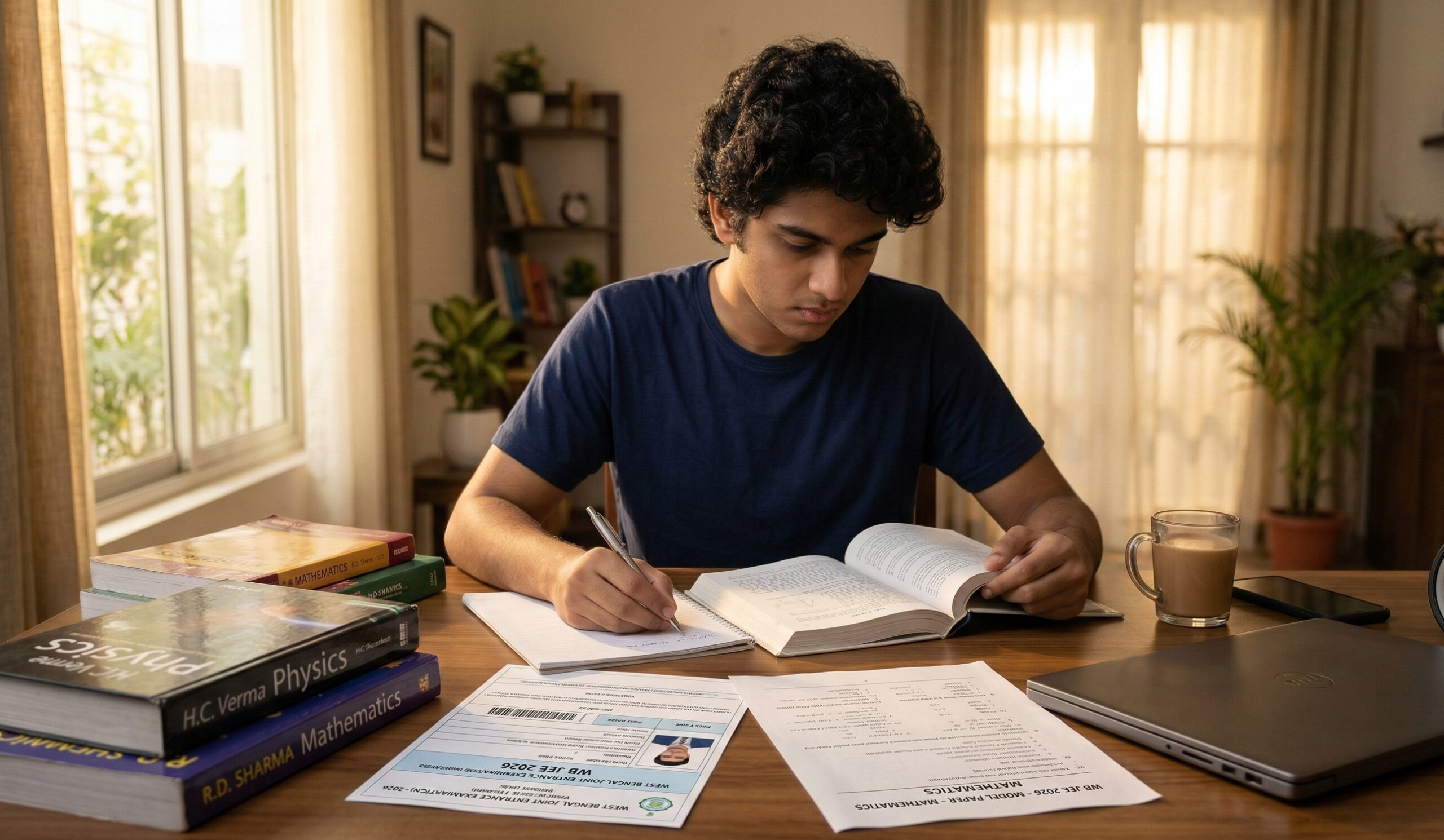
If you’re dreaming of a seat at Jadavpur University, IIEST Shibpur, or any top West Bengal engineering college, WB JEE 2026 is your gateway. Every year, over one lakh students compete for limited seats in B.Tech, B.Pharma, and Architecture programs across the state — and a well-planned strategy makes all the difference.
This guide covers everything: official exam dates, who can apply, what to study, how the marking works, and proven tips to crack the test. Whether you’re just starting your prep or doing a last-minute review, you’ll find actionable, up-to-date information right here.
Table of Contents
- What Is WB JEE 2026?
- Key Dates & Important Schedule
- Eligibility Criteria
- How to Apply: Step-by-Step
- Exam Pattern & Marking Scheme
- WB JEE 2026 Syllabus Breakdown
- Top Preparation Tips & Strategy
- Common Mistakes to Avoid
- Counselling & Seat Allotment
- Key Takeaways
- FAQs
What Is WB JEE 2026?
The West Bengal Joint Entrance Examination (WBJEE) is a state-level offline entrance test conducted by the West Bengal Joint Entrance Examinations Board (WBJEEB). It opens doors to undergraduate courses in:
- Engineering & Technology (B.Tech/B.E.)
- Pharmacy (B.Pharma)
- Architecture (B.Arch)
These programs are offered at government universities, government colleges, and self-financed private institutions across West Bengal.
One important point many students miss: JEE Main qualifiers are also eligible to participate in WBJEE counselling for certain seat categories — so even if you didn’t register for WBJEE separately, your JEE Main score may still get you a seat.
Key Dates & Important Schedule
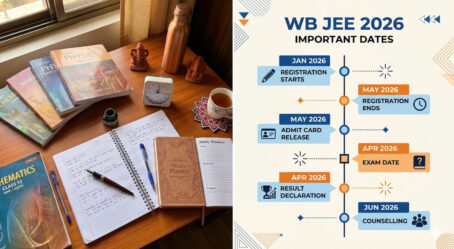
All dates below are tentative, based on previous-year patterns. The official notification is expected on the WBJEEB website (wbjeeb.nic.in) around December–January.
The official notification was released on March 6, 2026. Mark these dates on your calendar:
| Event | Date |
| Online Registration Starts | March 10, 2026 |
| Last Date to Apply | April 2026 (TBA) |
| Admit Card Release | May 2026 (1st Week) |
| WBJEE 2026 Exam Date | May 24, 2026 (Sunday) |
| Result Declaration | June 2026 (Expected) |
Pro Tip: Set calendar reminders for the registration window. The WBJEEB does not extend deadlines, and late applications are simply not accepted.
Eligibility Criteria
Before you fill out the application form, make sure you tick every eligibility box. Getting rejected at the counselling stage due to overlooked criteria is a real and painful outcome.
Academic Qualification
Candidates must have passed Class 12 (or equivalent) with the following subjects:
- Physics and Mathematics — compulsory
- Chemistry, Biology, Computer Science, or Biotechnology — any one as the third subject
A minimum aggregate of 45% marks (40% for SC/ST/OBC-A/OBC-B candidates) is required in Physics, Chemistry, and Mathematics combined.
Age Limit
You must be at least 17 years old as of December 31, 2026. There is no upper age limit for most general engineering courses.
Nationality & Domicile
- Must be an Indian citizen
- For state-quota seats, candidates need to satisfy West Bengal domicile requirements
- Students from other states can still apply for seats under the All India Quota
How to Apply: Step-by-Step
The entire application process is online through wbjeeb.nic.in. Here’s what the process looks like:
Step 1 — Register Create an account using your active email ID and mobile number. You’ll receive login credentials for the candidate portal.
Step 2 — Fill the Application Form Enter personal details, academic history, category information, and preferred exam city. Be precise — errors here can cause rejection during document verification.
Step 3 — Upload Documents Upload a recent passport-size photograph, signature, and Class 10/12 certificates. Follow the specified file formats and size limits exactly.
Step 4 — Pay the Application Fee Fees are payable online via debit/credit card or net banking:
- General / OBC / EWS candidates: ₹500
- SC / ST candidates: ₹400
Step 5 — Submit & Take Printout After final submission, download and keep the confirmation page. You’ll need it for future reference.
Exam Pattern & Marking Scheme
Understanding the exam structure before you start studying is non-negotiable. WBJEE 2026 has two papers, both conducted on the same day in offline OMR-based mode.
| Paper | Subjects | Questions | Marks | Duration |
|---|---|---|---|---|
| Paper 1 | Mathematics | 80 MCQs | 100 | 2 hours |
| Paper 2 | Physics & Chemistry | 75 MCQs | 100 | 2 hours |
| Total | 155 MCQs | 200 | 4 hours |
Question Categories
Questions in both papers are divided into three categories:
- Category 1 — Single correct answer. Each correct answer earns +1 mark; wrong answers get −0.25 marks.
- Category 2 — Single correct answer. Each correct answer earns +2 marks; wrong answers get −0.5 marks.
- Category 3 — One or more correct answers. Marks are awarded only if all correct options are selected. No negative marking.
The mixed category system rewards both accuracy and intelligent guessing strategy. Category 3 is your safety net — attempt all of them since there’s no penalty.
WB JEE 2026 Syllabus Breakdown
The syllabus is based on Class 11 and Class 12 curriculum as prescribed by the West Bengal Council of Higher Secondary Education (WBCHSE) and equivalent boards.
Mathematics (Paper 1)
High-weightage topics include:
- Algebra — complex numbers, quadratic equations, permutations & combinations, binomial theorem, matrices
- Trigonometry — inverse trig functions, properties of triangles
- Coordinate Geometry — straight lines, circles, conics (parabola, ellipse, hyperbola)
- Calculus — limits, continuity, differentiation, integration, differential equations
- Vectors and 3D Geometry
- Statistics and Probability
Physics (Paper 2)
Focus areas:
- Mechanics (laws of motion, work-energy, rotational motion)
- Heat and Thermodynamics
- Waves and Oscillations
- Electricity and Magnetism (current electricity, electromagnetic induction)
- Optics (ray and wave optics)
- Modern Physics (photoelectric effect, nuclear physics, semiconductors)
Chemistry (Paper 2)
Key topics:
- Physical Chemistry — mole concept, solutions, electrochemistry, chemical kinetics
- Organic Chemistry — basic principles, reactions and mechanisms, named reactions, biomolecules
- Inorganic Chemistry — periodic table, chemical bonding, coordination compounds, qualitative analysis
There are typically no major syllabus changes from year to year, but always cross-check with the official information bulletin once it’s released.
Top Preparation Tips & Strategy
Cracking WBJEE is not about studying more — it’s about studying smarter. Here’s what actually works:
Start with the Official Syllabus
Download the official WBJEE 2026 information bulletin (once released) and create a topic-by-topic checklist. Don’t rely on memory or third-party summaries — go to the source.
Prioritise NCERT, Then Go Deeper
For Chemistry especially, NCERT is your foundation. Physics concepts from HC Verma, and Mathematics problems from RD Sharma and SL Loney give you the edge in Category 2 and 3 questions.
Solve Previous Year Papers
This is the single most effective prep activity. Solving WBJEE papers from the past 5–7 years familiarises you with question style, difficulty distribution, and category patterns. Timed practice is key — do not solve casually.
Take Full-Length Mock Tests
At least 10 full mocks under exam conditions (no phone, no breaks) before the actual test date. Review every mistake afterward. Patterns in errors — whether calculation mistakes or conceptual gaps — become clear quickly.
Master Time Management
With 155 questions across 4 hours, you have roughly 90 seconds per question on average. In practice, Category 3 questions require more time. Build a paper-attempt strategy: tackle Categories 1 and 3 first, then return to Category 2.
Manage Negative Marking Intelligently
Attempt all Category 3 questions (no penalty). For Category 1 and 2, only mark answers when you have eliminated at least two options. Blind guessing on Categories 1 and 2 erodes your score.
Common Mistakes to Avoid
Even well-prepared students lose marks due to avoidable errors:
- Missing the application deadline. WBJEEB is strict — there are no grace periods.
- Ignoring domicile document requirements until counselling, only to be disqualified.
- Over-focusing on Mathematics and neglecting Physical Chemistry, which is highly scoring.
- Not practicing OMR filling. Incorrectly shaded bubbles cannot be corrected. Practice with physical OMR sheets before exam day.
- Skipping revision. Students who cover the full syllabus but don’t revise often struggle with recall under exam pressure.
- Attempting Category 1 & 2 questions without confidence. If you’re unsure, leave it. Negative marking can pull a 150-mark score down to 120 fast.
Counselling & Seat Allotment
Clearing the exam is only half the battle. WBJEE 2026 counselling is expected to begin in August 2026 after result declaration.
The counselling process includes:
- Online registration for counselling at wbjeeb.nic.in
- Document verification (eligibility, category, domicile)
- Choice filling — shortlist your preferred colleges and courses in order
- Seat allotment — based on rank, category, and preferences
- Multiple rounds — including upgradation and mop-up rounds for better options
- Fee payment and reporting to the allotted institute
Both WBJEE rank holders and JEE Main qualifiers can participate in counselling. JEE Main candidates are eligible for specific seat pools, so check the official counselling notification carefully.
Key Takeaways
- WB JEE 2026 is tentatively scheduled for 27 April 2026, conducted in offline OMR mode
- Registration opens in January–February 2026 at wbjeeb.nic.in
- Application fee is ₹500 (General) and ₹400 (SC/ST)
- Minimum age: 17 years as of December 31, 2026; minimum marks: 45% in PCM
- The exam has 155 questions across 200 marks (Paper 1: Math; Paper 2: Physics + Chemistry)
- Negative marking applies in Categories 1 and 2; Category 3 has no penalty
- JEE Main qualified candidates can also participate in WBJEE counselling
- Counselling begins in August 2026, with multiple allotment rounds
Conclusion
WB JEE 2026 is a genuine, well-structured pathway to quality engineering education in West Bengal. The competition is real — over a lakh students appear every year — but the exam rewards students who study the right material consistently and approach the paper strategically.
Start your preparation now, build your foundation with NCERT and standard reference books, practice with previous year papers, and stay plugged into official notifications at wbjeeb.nic.in. The seat you want is achievable with the right plan.
FAQs
1. What is the WB JEE 2026 exam date? The exam is tentatively scheduled for 27 April 2026. The official date will be confirmed in the WBJEEB notification, expected around December 2025–January 2026.
2. Who can appear for WB JEE 2026? Indian citizens who have passed or are appearing in Class 12 with Physics, Mathematics, and at least one more science subject, with a minimum of 45% aggregate marks (40% for reserved categories), and are at least 17 years old by December 31, 2026.
3. Is there negative marking in WBJEE 2026? Yes, for Category 1 (−0.25 per wrong answer) and Category 2 (−0.5 per wrong answer). Category 3 questions carry no negative marking.
4. Can students from outside West Bengal apply for WB JEE? Yes. Students from other states can apply and may be eligible for All India Quota seats. State-quota seats require West Bengal domicile. JEE Main qualifiers can also participate in counselling.
5. What is the WB JEE 2026 application fee? ₹500 for General, OBC, and EWS candidates. ₹400 for SC and ST candidates. Payment is online only.
6. Which books are best for WBJEE 2026 preparation? NCERT textbooks for all three subjects form the core. For deeper practice: HC Verma (Physics), RD Sharma / SL Loney (Mathematics), and VK Jaiswal / O.P. Tandon (Chemistry). Previous year WBJEE papers are essential.
7. How is WBJEE different from JEE Main? WBJEE is a state-level exam specific to West Bengal colleges, conducted in offline OMR mode. JEE Main is a national-level exam held online. WBJEE is generally considered somewhat less difficult than JEE Main, but it has its own unique question patterns and three-category marking structure that require dedicated preparation.
Click here : https://www.collegechalo.com/news-panel/bse-telangana-2026-full-details/