

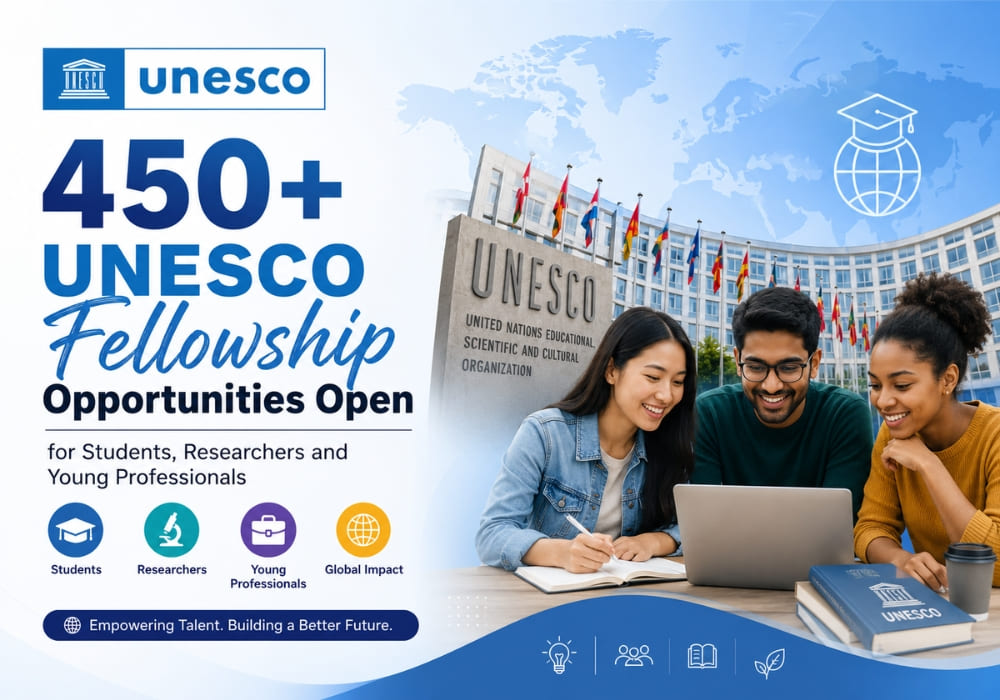
Author – Ritesh Ranjan: UNESCO fellowships are among the most respected international opportunities for students, PhD candidates, researchers, young professionals and project innovators. With more than 450 fellowship opportunities available across different fields, these programmes offer a valuable pathway for applicants who want to study abroad, conduct advanced research, gain international exposure or develop projects with social impact.
The United Nations Educational, Scientific and Cultural Organization, widely known as UNESCO, supports global development through education, science, culture, communication and knowledge-sharing. Its fellowship programmes are designed to promote international cooperation and help talented individuals build skills that can contribute to society. For students and young professionals, these fellowships can become an important stepping stone toward academic growth, professional success and global networking.
Unlike many scholarship programmes that focus only on undergraduate or postgraduate study, UNESCO fellowships cover a broad range of applicants. Some programmes are meant for students, while others support doctoral research, postdoctoral work, early-career professionals, heritage experts, scientists, innovators and youth leaders. This makes UNESCO’s fellowship portfolio one of the most diverse international funding options available today.
Who Can Apply for UNESCO Fellowships?
UNESCO fellowship opportunities are open to different categories of applicants depending on the specific programme. In general, students, PhD candidates, researchers, young professionals, project initiators and early-career experts can apply for suitable fellowships.
Applicants may belong to fields such as science, engineering, education, archaeology, conservation, sustainable development, social innovation, gender studies, culture, public policy, technology or research. However, eligibility criteria vary from one fellowship to another. Some programmes may be open only to applicants from selected countries, while others may require a specific academic background, age limit, work experience or research proposal.
Therefore, candidates should always check the official eligibility details before applying. The best starting point is UNESCO’s official fellowship page, where applicants can explore the available programmes and select the one that matches their profile.
UNESCO Fellowships for Students and PhD Candidates
Several UNESCO fellowships are especially useful for students and doctoral researchers. These opportunities can help applicants pursue academic training, gain international exposure and access advanced research facilities.
Some important fellowship options for students and PhD candidates include:
UNESCO/People’s Republic of China: The Great Wall Fellowships
This programme supports candidates who wish to study or conduct research in China. It is a valuable opportunity for students looking for international academic experience.
TWAS PhD Fellowships
TWAS fellowships support young scientists, especially from developing countries, who want to pursue doctoral research in science and technology-related fields.
OWSD PhD Fellowships
The Organization for Women in Science for the Developing World offers PhD fellowship support for women scientists from eligible countries. This programme helps promote gender equality in science and research.
UNESCO/ISEDC Co-Sponsored Fellowships
These fellowships support training in energy-related fields and sustainable development. They are suitable for candidates interested in energy systems, environment and development-focused study.
For PhD candidates, UNESCO fellowships can be extremely valuable. Doctoral research often requires financial support, access to laboratories, academic guidance, fieldwork opportunities and global networks. A UNESCO fellowship can help researchers strengthen their dissertation work and build a strong academic profile.
UNESCO Fellowships for Early-Career Researchers
UNESCO also offers several opportunities for early-career researchers and professionals. These fellowships are ideal for candidates who have completed advanced study and now want to expand their research experience, collaborate internationally or work on specialised projects.
Some notable fellowship options include:
UNESCO/Poland Co-Sponsored Fellowships in Engineering
This programme supports researchers and professionals in engineering-related fields. It can help candidates gain exposure to technical training and research environments.
UNESCO/Poland Fellowships in Archaeology and Conservation
These fellowships are useful for applicants working in heritage, archaeology and conservation. They help professionals build expertise in preserving cultural and historical resources.
UNESCO/Republic of Korea Co-Sponsored Fellowships
This programme provides training and research opportunities in selected fields, helping applicants gain international experience in Korea.
UNESCO/Keizo Obuchi Japan Young Researchers Fellowships
This fellowship supports young researchers working in areas linked to UNESCO’s priority themes. It is especially useful for candidates who want to build an international research career.
UNESCO/AlUla Fellowships Programme
This programme supports research and professional development related to culture, heritage and sustainable development.
TWAS Postdoctoral Fellowships
These fellowships support researchers who have completed their PhD and want to continue advanced scientific work.
OWSD Early Career Fellowship
This programme supports women scientists who are building their research careers and contributing to scientific development in their home countries.
Silk Roads Youth Research Grant
This grant encourages young researchers to explore themes connected to the Silk Roads, intercultural dialogue and shared heritage.
Early-career fellowships are important because they help researchers move from academic study to professional recognition. They allow candidates to publish, collaborate, attend training programmes and develop strong international networks.
Fellowships for Projects, Innovation and Social Impact
UNESCO fellowships are not limited to traditional academic study. Some programmes support innovation, advocacy, policy research and project development. These opportunities are useful for candidates who have strong ideas and want to create real-world impact.
Examples include:
Green Chemistry for Life: PhosAgro/UNESCO/IUPAC
This programme supports research in green chemistry and sustainable science. It is ideal for young scientists working on solutions that can benefit the environment.
UNESCO/Nestlé: Because Youth Matter
This initiative focuses on youth-led ideas and projects. It supports young people who want to create positive change in their communities.
GEM Report Fellowship
This fellowship is connected to education research and policy. It is suitable for candidates interested in global education, data analysis and development reporting.
These fellowships reflect UNESCO’s broader mission of supporting education, science, culture and sustainable development. They are especially useful for applicants who want to combine research with practical action.
How to Apply for UNESCO Fellowships
Applicants should begin by visiting the official UNESCO fellowship page at unesco.org/en/fellowships. This page provides details about available fellowships, eligibility, deadlines, required documents and application procedures.
Before applying, candidates should carefully identify the fellowship that matches their academic level, field of interest and country eligibility. Applying randomly to multiple programmes without checking the criteria can reduce the chances of success.
Most fellowship applications may require documents such as:
- Updated CV or resume
- Academic transcripts
- Degree certificates
- Research proposal or project idea
- Statement of purpose
- Recommendation letters
- Proof of nationality or eligibility
- Language proficiency documents, if required
Applicants should prepare these documents early. A strong application usually takes time, especially if it includes a research proposal or project plan. Candidates should avoid waiting until the last date because incomplete or rushed applications are often rejected.
Tips to Build a Strong UNESCO Fellowship Application
A successful fellowship application should clearly show why the candidate is suitable for the programme. Applicants should explain their academic background, research interest, professional goals and the impact of their proposed work.
The research proposal or project idea should be specific, practical and aligned with UNESCO’s priority areas. Candidates should avoid vague statements and instead focus on clear objectives, methodology, expected outcomes and social relevance.
A well-written statement of purpose can also make a major difference. It should explain why the applicant is applying, how the fellowship will help their career and how their work can contribute to their community, country or field of study.
Recommendation letters should come from professors, supervisors or professionals who know the applicant’s work well. Generic recommendation letters are less effective than letters that highlight specific achievements and potential.
Why UNESCO Fellowships Matter
UNESCO fellowships can open doors to global education, advanced research, professional training and international collaboration. For many applicants, these fellowships provide more than financial support. They offer access to mentors, institutions, research facilities, cultural exchange and global academic networks.
For students, a UNESCO fellowship can improve academic confidence and international exposure. For PhD candidates, it can support dissertation research and specialised study. For early-career researchers, it can strengthen professional growth and research visibility. For young innovators, it can help turn ideas into meaningful projects.
In a competitive world, international fellowships can also improve career opportunities. Candidates who receive UNESCO fellowships often gain valuable experience that can help them in universities, research organisations, development agencies, non-profits, public institutions and global organisations.
Conclusion
The availability of 450+ UNESCO fellowship opportunities is a major opportunity for students, researchers and young professionals across the world. Whether an applicant is planning doctoral research, seeking postdoctoral support, working on an innovation project or building a career in education, science, culture or development, UNESCO offers a wide range of fellowships to explore.
Interested candidates should visit the official UNESCO fellowship page, review eligibility criteria carefully and begin preparing their documents as early as possible. With the right planning, a strong proposal and a clear academic or professional goal, UNESCO fellowships can become a powerful platform for global learning and long-term career growth.
FAQs on UNESCO Fellowship Opportunities
1. What are UNESCO fellowships?
UNESCO fellowships are international funding and training opportunities offered or supported by UNESCO. They help students, PhD candidates, researchers, young professionals and project innovators pursue study, research, training or development-focused projects.
2. Who can apply for UNESCO fellowships?
Eligibility depends on the specific fellowship. In general, students, doctoral candidates, postdoctoral researchers, early-career professionals, women scientists, project leaders and young innovators may apply if they meet the academic, country and programme-specific requirements.
3. Are UNESCO fellowships fully funded?
Some UNESCO fellowships may provide full support, while others may offer partial funding, training support, travel assistance or research grants. Applicants should check the official details of each fellowship to understand the exact benefits.
4. How can I apply for UNESCO fellowships?
Candidates should visit the official UNESCO fellowship page at unesco.org/en/fellowships, select a suitable programme, check eligibility and follow the application instructions. Required documents may include a CV, academic records, research proposal, statement of purpose and recommendation letters.
5. Why should students and researchers apply for UNESCO fellowships?
UNESCO fellowships offer global exposure, research support, professional development and international networking opportunities. They can help applicants strengthen their academic profile, gain specialised training and contribute to important global development goals.