

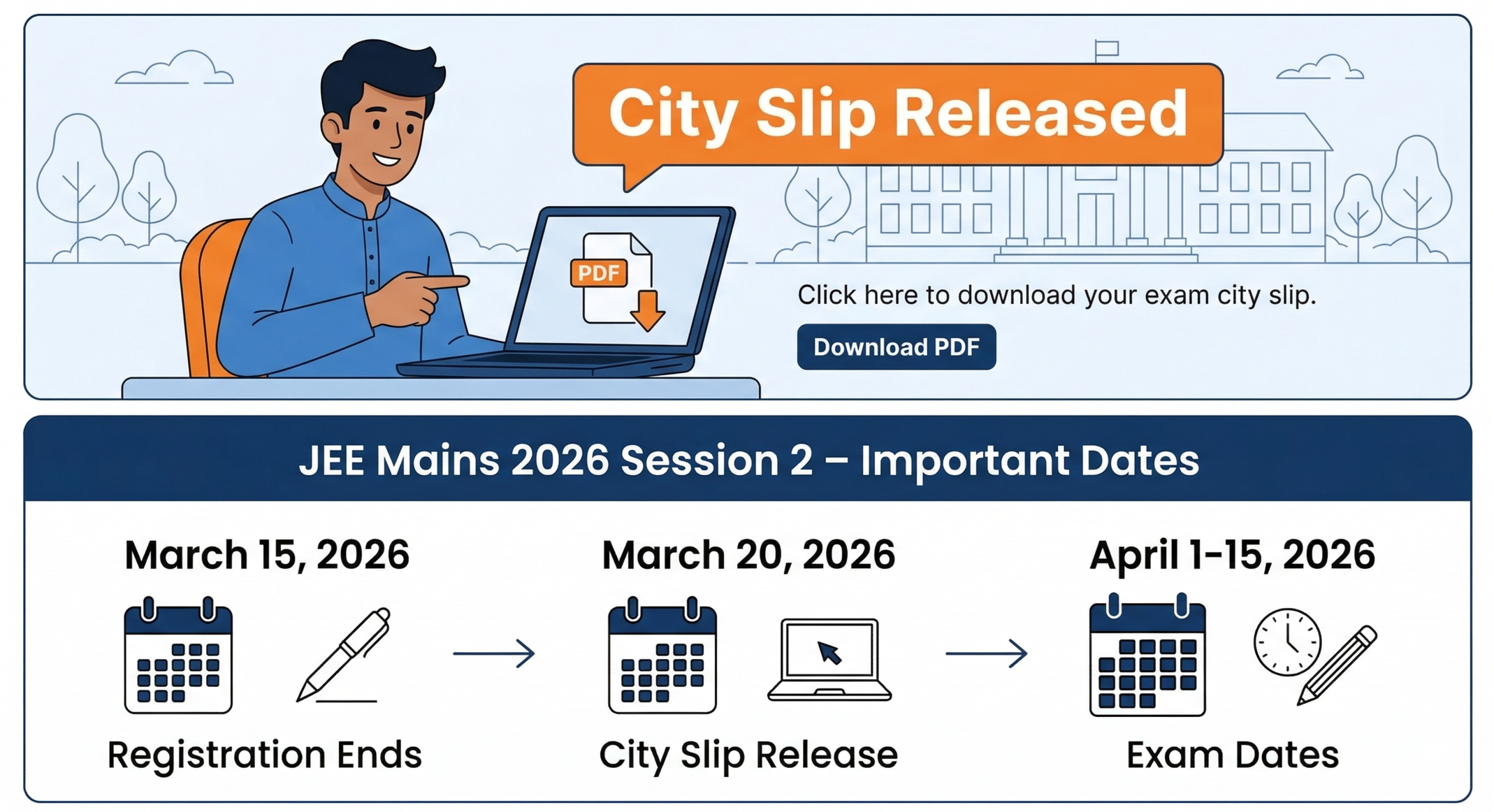
If you’re one of the lakhs of students gearing up for JEE Mains 2026 Session 2, today is a big day. The JEE Mains 2026 Session 2 city intimation slip is expected to be released on March 20, 2026, on the official NTA portal at jeemain.nta.nic.in. This document tells you which city your exam centre has been allotted — giving you crucial time to plan your travel before the April examination window.
In this guide, you’ll find everything you need in one place: what the city slip contains, how to download it, when the admit card will be released, the complete exam schedule, and a subject-wise syllabus breakdown for your final-phase preparation. Whether you’re appearing for the first time or improving your Session 1 score, this article has you covered.
Table of Contents
- What Is the JEE Mains 2026 Session 2 City Slip?
- Key Dates at a Glance
- How to Download the City Intimation Slip
- JEE Mains 2026 Session 2 Admit Card
- Session 2 Exam Date and Pattern
- JEE Mains 2026 Syllabus
- Application / Registration Details
- Preparation Tips for Session 2
- Common Mistakes to Avoid
- Key Takeaways
What Is the JEE Mains 2026 Session 2 City Slip?
The advance city intimation slip is a document released by the National Testing Agency (NTA) before the official admit card. It is not a hall ticket — you cannot enter the exam centre with just this slip. However, it is equally important because it reveals:
- Your allotted exam city
- Your tentative exam date (within the April 2–9 window)
- The exam medium (language of the question paper)
- Basic candidate details for verification
The city slip is released days or even weeks before the admit card specifically so candidates travelling from different states or cities have enough time to make logistical arrangements — booking trains, buses, hotels, and so on.
Important: Do not confuse the city intimation slip with the admit card. The admit card, released later, contains the exact exam centre address, reporting time, and other entry-related instructions.
Key Dates at a Glance
| Event | Date |
|---|---|
| Session 2 Registration (Original) | February 1 – February 25, 2026 |
| Registration Re-opened | March 12–13, 2026 (9:00 PM) |
| City Intimation Slip Release | March 20, 2026 (Expected) |
| Session 2 Exam Dates | April 2 – April 9, 2026 |
| Session 2 Admit Card | Last week of March 2026 (3–4 days before exam) |
| Session 2 Answer Key | Last week of April 2026 |
| JoSAA Counselling | April/May 2026 |
How to Download the City Intimation Slip
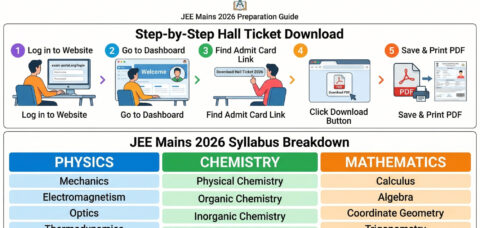
Downloading the city slip is a simple, five-step process. Here’s exactly how to do it:
Step 1: Open your browser and go to the official JEE Main portal: jeemain.nta.nic.in
Step 2: On the homepage, locate the link titled “Advance City Intimation Slip – JEE Main 2026 Session 2” under the Candidate Activity section. (This link becomes active once NTA releases the slip.)
Step 3: Click the link. You will be redirected to the login page. Enter your Application Number and Password (or Date of Birth).
Step 4: Enter the security captcha/PIN shown on screen and click Submit.
Step 5: Your exam city and tentative date will appear on the dashboard. Download the PDF and keep a printed copy for reference.
What to Check After Downloading
Once you have the slip, verify the following immediately:
- Your name and application number are correct
- The exam city is among your preferred choices (if not, contact NTA promptly)
- The exam date aligns with your preparation schedule
Any discrepancy should be reported to NTA without delay, as changes after the admit card release are generally not entertained.
JEE Mains 2026 Session 2 Admit Card
The JEE Main 2026 Session 2 admit card is expected to be released in the last week of March 2026, typically 3 to 4 days before each candidate’s specific exam date.
What the Admit Card Contains
Unlike the city slip, the admit card has complete information required to appear in the examination:
- Candidate’s name, roll number, and photograph
- Date of birth and category
- Exact exam centre address
- Exam date and shift timing
- Medium (language) of the paper
- Important instructions for exam day
Documents to Carry on Exam Day
On the day of your examination, bring the following:
- Printed copy of the admit card
- Self-declaration form (duly filled)
- One valid government-issued photo ID (Aadhaar, PAN, Passport, etc.)
- One passport-size photograph (identical to the one uploaded during registration)
- Simple ball-point pen
Session 2 Exam Date and Pattern
Exam Window
The JEE Mains Session 2 exam will be conducted from April 2 to April 9, 2026 in Computer-Based Test (CBT) mode. The exam runs in two shifts daily:
- Morning Shift: 9:00 AM – 12:00 Noon
- Afternoon Shift: 3:00 PM – 6:00 PM
The exam is conducted across cities in India and a few centres outside India. It is offered in 13 languages: English, Hindi, Assamese, Bengali, Gujarati, Kannada, Malayalam, Marathi, Odia, Punjabi, Tamil, Telugu, and Urdu.
Marking Scheme (Paper 1 – B.E./B.Tech)
| Answer Type | Marks |
|---|---|
| Correct answer | +4 |
| Incorrect answer | –1 |
| Unattempted | 0 |
| Multiple correct options (if applicable) | +4 for any correct option marked |
JEE Mains 2026 Syllabus
The JEE Main 2026 syllabus remains unchanged from last year. It is based on the NCERT Class 11 and 12 curriculum for Physics, Chemistry, and Mathematics. NTA has not introduced any new deletions for 2026 — the reduced syllabus from 2024 and 2025 continues to apply.
Physics
Physics tests your conceptual understanding alongside numerical application. Key topics include:
- Mechanics: Laws of Motion, Work, Energy and Power, Rotational Motion
- Thermodynamics: Heat and Thermodynamics, Kinetic Theory of Gases
- Electrodynamics: Electric Charges and Fields, Current Electricity, Electromagnetic Induction
- Optics: Ray Optics and Optical Instruments, Wave Optics
- Modern Physics: Dual Nature of Radiation, Atoms and Nuclei
- Waves and Oscillations: Simple Harmonic Motion, Wave Motion
Note: Topics like the Doppler Effect (sound) and certain subtopics in radioactivity have been removed from the syllabus. Do not spend time on these.
Chemistry
Chemistry is divided into three branches:
Physical Chemistry: Some of the Areas of Study
- Basic Concepts of Chemistry, Atomic Structure
- Chemical Thermodynamics, Equilibrium
- Chemical Kinetics, Electrochemistry, Solutions
Inorganic Chemistry: Some of the Areas of Study
- s-Block, d and f-Block Elements
- Coordination Compounds, Chemical Bonding
Organic Chemistry: Some of the Areas of Study
- Hydrocarbons, Haloalkanes and Haloarenes
- Alcohols, Aldehydes, Ketones, Carboxylic Acids
- Amines, Biomolecules
Removed topics include: Solid State, Polymers, Environmental Chemistry, Hydrogen (as a standalone chapter), and most P-Block Element groups. NCERT remains the single most important resource for inorganic and organic sections.
Mathematics
Mathematics emphasises analytical and problem-solving skills. High-weightage topics include:
- Calculus: Limits, Continuity, Differentiability, Integration, Differential Equations
- Algebra: Matrices and Determinants, Complex Numbers, Sequences and Series, Binomial Theorem
- Coordinate Geometry: Straight Lines, Circles, Parabola, Ellipse, Hyperbola, 3D Geometry
- Trigonometry and Vectors: Inverse Trigonometric Functions, Vector Algebra
Removed topics include: Mathematical Induction, Mathematical Reasoning, certain Vector Algebra subtopics, and some advanced 3D Geometry sections.
Tip: Based on historical trends, Calculus, 3D Geometry, Matrices, and Differential Equations collectively account for over 50% of the Mathematics paper. Prioritise these.
Application / Registration Details
The Session 2 registration window originally ran from February 1 to February 25, 2026. NTA briefly reopened registrations until March 13, 2026 at 9:00 PM (with fee payment allowed until 11:50 PM on the same date), but without a form correction facility.
If you have already registered, you can download your Confirmation Page by logging into your account at jeemain.nta.nic.in.
Eligibility Reminder
- Candidates who have passed Class 12 (or equivalent) from a recognised board
- Students appearing in Class 12 in 2026 are also eligible
- No age limit for B.E./B.Tech admissions (as per the revised norms)
- Both Session 1 and Session 2 scores are considered; the best of the two NTA scores is used for ranking
Preparation Tips for Session 2
Session 2 is a golden opportunity — whether you sat for Session 1 or not. Here is how to make the most of the remaining weeks:
Analyse Session 1 Papers If you appeared in January, go through your Recorded Response Sheet. Identify which topics led to wrong answers and plug those gaps before April.
Prioritise High-Weightage Chapters Use the chapter-wise weightage analysis from Session 1 to focus your revision on topics that yield the most marks. In Maths, Calculus and 3D Geometry are non-negotiable. In Chemistry, NCERT-based inorganic questions are often straightforward marks if you’ve read the textbook carefully.
Solve Previous Year Papers (PYQs) PYQs from the last 5–7 years are the best predictor of the kind of questions NTA asks. Solve them under timed conditions to build speed and accuracy.
Take Full-Length Mock Tests Simulate the actual CBT environment. Most coaching platforms and NTA’s own portal offer free mock tests. Aim for at least two to three full mocks per week in the final month.
Maintain Physical and Mental Health Exam pressure is real. Short breaks, adequate sleep (7–8 hours), and light physical activity like walking or yoga have been shown to improve concentration and retention — don’t skip these.
Common Mistakes to Avoid
Many students stumble due to avoidable errors. Watch out for these:
- Studying deleted topics: Time spent on removed chapters (Solid State, Mathematical Induction, etc.) is time wasted. Stick to the current syllabus.
- Confusing the city slip with the admit card: The city slip alone will not get you into the exam hall. Always carry a printed admit card.
- Ignoring NCERT for Chemistry: A surprising number of inorganic questions are lifted almost directly from NCERT. Read it thoroughly.
- Not verifying city slip details: Check your name, application number, and allotted city immediately after downloading. Report discrepancies to NTA at the earliest.
- Calculator dependency: NTA has explicitly clarified that calculators are not allowed in JEE Mains 2026. Ensure your mental arithmetic and manual calculation speed is sharp.
- Skipping numerical value questions: These carry 4 marks each with no negative marking — they are scoring opportunities that many students underestimate.
Key Takeaways
- The JEE Mains 2026 Session 2 city intimation slip is expected to release on March 20, 2026 at jeemain.nta.nic.in
- Session 2 exams are scheduled for April 2 to April 9, 2026 in two daily shifts
- The admit card will be released 3–4 days before the exam, in the last week of March
- The syllabus is based on NCERT Class 11 and 12 — no new deletions for 2026
- High-priority topics: Calculus, 3D Geometry, and Matrices (Maths); Current Electricity and Thermodynamics (Physics); Chemical Kinetics and Organic Chemistry (Chemistry)
- Carry the printed admit card + photo ID + passport photograph on exam day
- Your best NTA score across both sessions will be used for ranking
Conclusion
With the JEE Mains 2026 Session 2 exam less than two weeks away, every day of focused preparation counts. The release of the city intimation slip today marks the beginning of the final stretch. Download your slip, verify your details, plan your travel, and redirect all your energy toward smart, targeted revision.
Remember: Session 2 is not just a second attempt — it’s another opportunity to achieve the rank that gets you into your dream college. Stay consistent, trust your preparation, and approach the exam with confidence.
Official Website: jeemain.nta.nic.in
FAQs
Q1. When will the JEE Mains 2026 Session 2 city intimation slip be released? The city intimation slip for Session 2 is expected to be released on March 20, 2026. Candidates can download it from jeemain.nta.nic.in using their application number and date of birth or password.
Q2. What is the difference between the JEE Mains city slip and the admit card? The city slip only reveals the candidate’s allotted exam city and tentative date. The admit card, released later, contains the exact exam centre address, shift timing, and is the mandatory document required for entry into the examination hall.
Q3. What are the JEE Mains 2026 Session 2 exam dates? Session 2 is scheduled from April 2 to April 9, 2026, in two shifts — morning (9 AM–12 noon) and afternoon (3 PM–6 PM).
Q4. When will the JEE Mains 2026 Session 2 admit card be released? The admit card is expected in the last week of March 2026, approximately 3 to 4 days before a candidate’s specific exam date.
Q5. Has the JEE Mains syllabus changed for 2026? No. NTA has not introduced any new syllabus changes for 2026. The syllabus follows the same reductions made in 2024 and 2025, covering Class 11 and 12 NCERT topics in Physics, Chemistry, and Mathematics.
Q6. Can a candidate appear in both Session 1 and Session 2? Yes. Candidates can appear in one or both sessions. For ranking and JEE Advanced eligibility, NTA considers the best NTA score from both sessions.
Q7. What documents must be carried to the JEE Mains exam centre? Candidates must bring a printed admit card, a filled self-declaration form, a valid government-issued photo ID (Aadhaar, PAN, Passport, Voter ID, etc.), and one passport-size photograph identical to the one uploaded during registration.
Click here : https://www.collegechalo.com/news-panel/ts-icet-2026-exam-date-syllabus/