

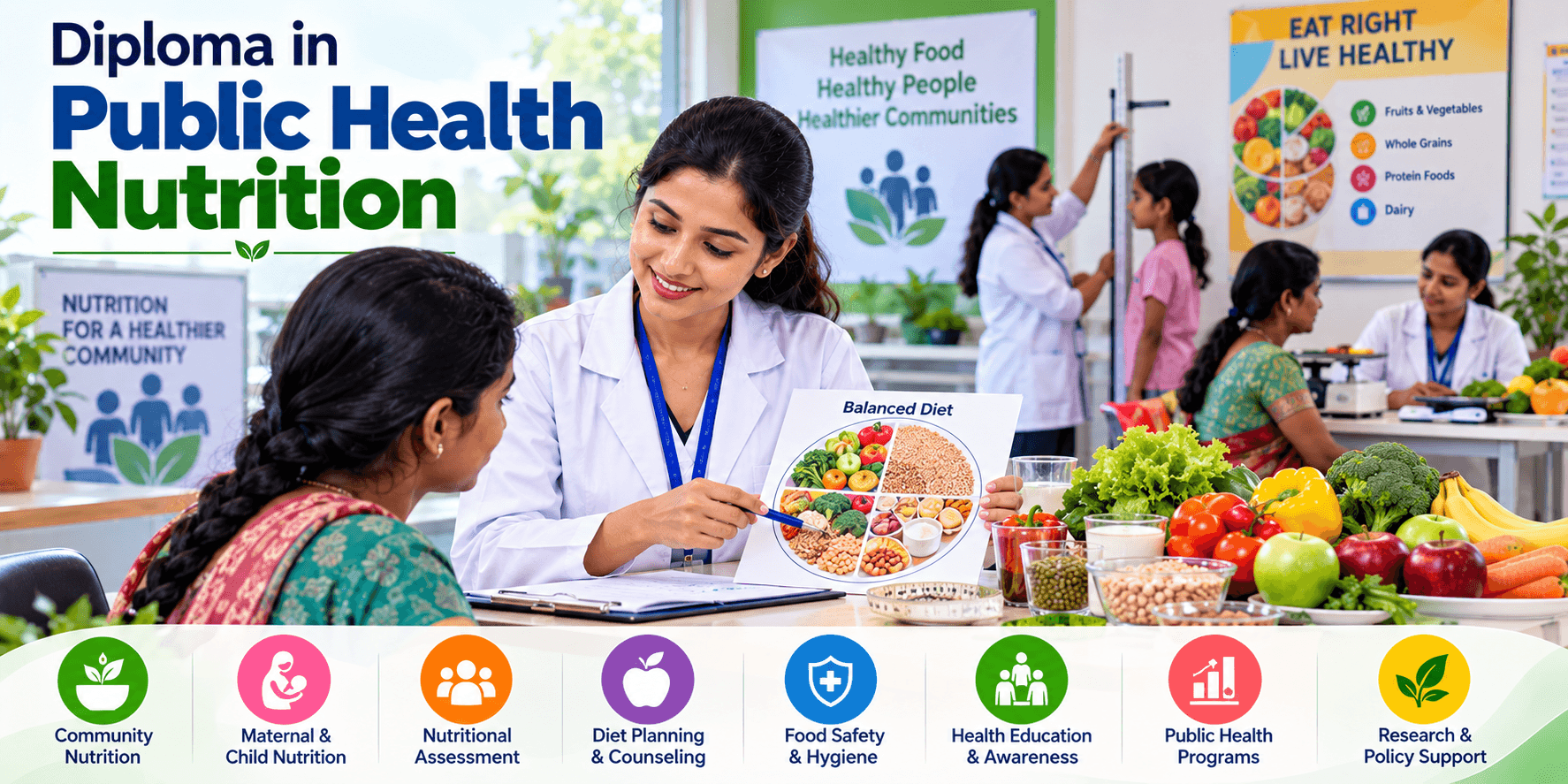
Diploma in Public Health Nutrition
Diploma in Public Health Nutrition (DPHN) is a one-year programme that trains students in community nutrition, dietary planning and nutrition education for public health settings. It covers topics such as maternal and child nutrition, nutritional deficiency disorders, food safety, nutrition surveillance and the planning of community nutrition programmes, combined with fieldwork in community or hospital settings. The programme is offered by universities and health institutes, with eligibility open to both Class 12 passes in some institutes and graduates in a related field in others. DPHN suits students and working professionals who want to enter community health, nutrition counselling or public health programme roles, or who want a focused add-on qualification alongside a background in science, nursing or home science.
About Diploma in Public Health Nutrition
Diploma in Public Health Nutrition (DPHN) is a one-year programme that trains students in community nutrition, dietary planning and nutrition education for public health settings. It covers topics such as maternal and child nutrition, nutritional deficiency disorders, food safety, nutrition surveillance and the planning of community nutrition programmes, combined with fieldwork in community or hospital settings. The programme is offered by universities and health institutes, with eligibility open to both Class 12 passes in some institutes and graduates in a related field in others. DPHN suits students and working professionals who want to enter community health, nutrition counselling or public health programme roles, or who want a focused add-on qualification alongside a background in science, nursing or home science.
Why Choose DPHN
Short, focused qualification
The one-year duration allows students to add a nutrition specialisation quickly alongside an existing science, nursing or home science background.
Community health relevance
The programme addresses malnutrition and diet-related illness, which remain significant public health concerns in India.
Entry into public health programmes
Graduates can join government and NGO nutrition programmes that work with mothers, children and vulnerable communities.
Detailed Syllabus (2 semesters over 1 year)
Core Subjects
Elective Subjects
Eligibility Criteria
Basic Requirements
| Minimum Percentage | Pass in Class 12 (Science or Home Science preferred), or a bachelor's degree in a related field where the diploma is offered at postgraduate level. No single regulator sets this diploma's norms; institutes typically ask for 45-50%. |
| Mandatory Subjects | Science or Home Science background preferred (not always mandatory) |
| Entrance Exams | Merit-based on qualifying marks (most institutes) |
Admission Process
Check eligibility
Confirm whether the offering institute admits after Class 12 or requires a bachelor's degree in a related field, since this varies by institute.
Apply to the institute
Submit the application form along with mark sheets and other documents to the university or institute offering the diploma.
Merit list or interview
Most institutes select candidates on merit in the qualifying examination; a few may conduct a short interview.
Admission confirmation
Complete document verification, pay the course fee and complete enrolment formalities.
Required Documents
Important Notes
Estimated Fee Structure
| Government Institutions | ₹5,000 – ₹20,000 per year (indicative) |
| Private Institutions | ₹15,000 – ₹50,000 per year (indicative) |
Return on Investment
| Total Investment | ₹5,000 – ₹50,000 for the 1-year programme, depending on a government or private institution |
| Average Starting Salary | ₹1.5–2.5 LPA |
| Payback Period | 1–2 years |
Figures are indicative and vary by institution, location and individual career path; they are not a guarantee of placement or salary.
Scholarship Opportunities
| Post-Matric Scholarship for SC/ST/OBC students | SC, ST and OBC students within the income limit, applied for through the National Scholarship Portal or the relevant state portal. | Fees and a maintenance allowance; amounts set by the Centre and states |
Career Opportunities
Typical Employers
Typical Salary Packages
| Nutrition Counsellor | Avg: ₹2 LPA | Range: ₹1.5–2.8 LPA |
| Community Health Worker (Nutrition) | Avg: ₹1.8 LPA | Range: ₹1.4–2.5 LPA |
| Field Officer, Nutrition Programmes | Avg: ₹2.2 LPA | Range: ₹1.8–3 LPA |
| NGO Programme Associate | Avg: ₹2.5 LPA | Range: ₹2–3.5 LPA |
* These are indicative figures based on industry patterns; actual packages vary by employer, location and individual performance.
Career Pathway
Entry Level
0–2 yearsGraduates typically start in field or community-level nutrition roles, supporting awareness and basic counselling work.
Mid Level
2–5 yearsWith experience, professionals coordinate nutrition programmes at block or district level, working with government or NGO teams.
Senior Level
5–10 yearsExperienced professionals can manage larger nutrition programmes, usually alongside a further qualification in public health or nutrition.